 Word document preview
Bank supervision (OCC, FFIEC, FDIC)
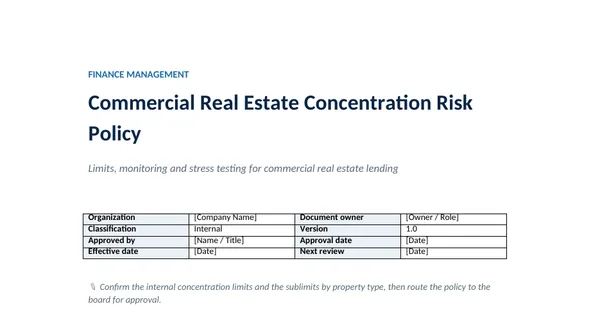
Commercial Real Estate Concentration Risk Policy
3 free downloads per account. Just your email and a 6-digit code.
About this template
A CRE concentration risk policy sets how much commercial real estate lending a bank is willing to hold, how the portfolio is split and watched, and what happens when a limit is near. Examiners ask for it when a bank approaches or exceeds the supervisory criteria in the 2006 interagency guidance, and the FDIC repeated the point in its 2023 advisory on managing CRE concentrations.
This policy follows the 2006 interagency guidance on concentrations in commercial real estate lending: board and management oversight, portfolio management, management information systems, market analysis, underwriting standards, stress testing and credit risk review. Worked tables show the supervisory criteria next to internal limits, sublimits by property type and four stress scenarios for a fictional community bank.
Who it is for
The chief credit officer of a community bank near the CRE supervisory criteria, whose examiners asked for a concentration policy with limits, stress testing and board reporting.
What is inside
- Policy built on the seven risk management elements of the 2006 interagency CRE concentration guidance
- The two supervisory criteria (100 percent for construction and land, 300 percent with 50 percent growth over 36 months) beside internal limits and worked current levels
- Property-type sublimit table with limits and current levels as a share of total capital
- Underwriting standards list, MIS stratification list and quarterly board report contents
- Stress testing table with four scenarios, their assumptions and worked results
- Contingency plan for reducing concentrations, credit risk review, and capital and allowance links
- Roles table, an adoption checklist and the 2023 FDIC CRE advisory and workout policy statement as context
How to use it
Confirm the internal concentration limits and the sublimits by property type, then route the policy to the board for approval.
Files
- DOCXcommercial-real-estate-concentration-risk-policy.docx41 KB
Opens in Microsoft Word or Excel, Google Docs or Sheets, and LibreOffice. Built on free, official texts that anyone can read: laws, regulations, standards and guidance published by public bodies. A template to adapt, not legal, tax or accounting advice.
Questions about this template
What are the CRE concentration thresholds?
The 2006 interagency guidance names two supervisory criteria: construction, land development and other land loans at 100 percent or more of total capital, or total CRE loans at 300 percent or more of total capital with the CRE portfolio up 50 percent or more over the prior 36 months. They are screens that prompt more supervisory analysis, not lending limits.
Is it a problem to be above 300 percent?
Not by itself. The guidance says the criteria do not limit lending and are not a safe harbor either. A bank above them can be in good standing if its risk management and capital match the concentration. Examiners look at board oversight, limits, stress testing, MIS and underwriting, and give closer review to banks with recent rapid CRE growth.
Which loans count as CRE under the guidance?
Construction, land development and other land loans, loans secured by multifamily property, and nonfarm nonresidential loans where the main source of repayment is rental income from unaffiliated parties or the sale or refinancing of the property. Owner-occupied properties repaid from the owner's business operations are excluded.