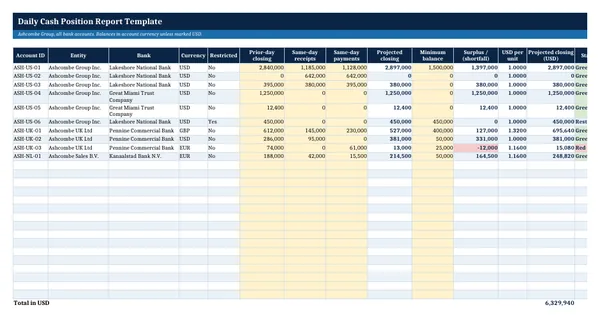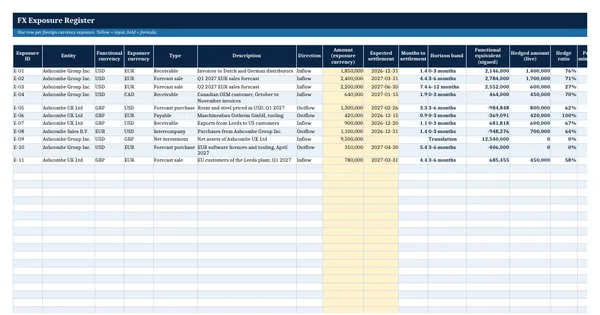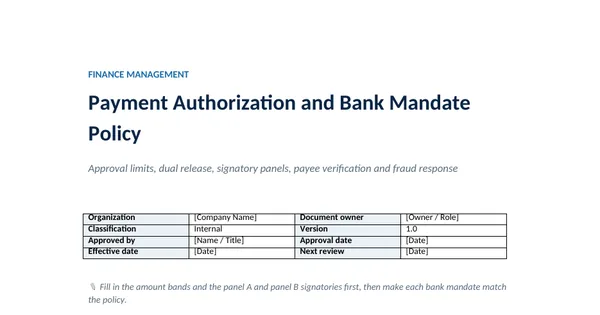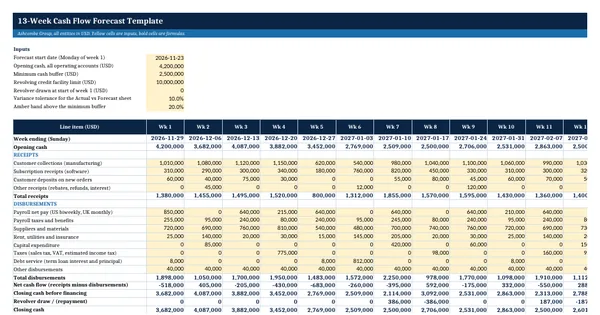

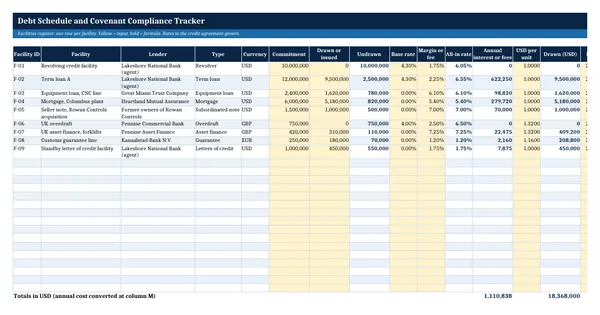
 Excel workbook preview
Debt Schedule and Covenant Compliance Tracker
3 free downloads per account. Just your email and a 6-digit code.
About this template
A debt schedule lists every borrowing facility with its limit, drawn balance, rate and maturity. A covenant compliance tracker tests the financial ratios the lenders set, such as leverage and coverage, and shows how much room is left before a breach. Lenders expect a signed compliance certificate each quarter, and boards want warning well before a test fails, not after the certificate is due.
This workbook combines a facilities register, a twenty-quarter term loan schedule, a covenant calculation sheet, a covenant tracker with headroom and status, and a reporting calendar. The worked example is an invented manufacturer whose fixed charge cover is moving toward its floor while capital spending rises. Ratios use plain definitions. Your credit agreement's definitions always govern, so the input cells say so and every ratio is a formula you can trace.
Who it is for
The controller or CFO who must show the lender, auditor or board where every loan stands and how close each covenant is to a breach.
What is inside
- Facilities register with 9 worked facilities: undrawn amount, all-in rate, annual cost, USD equivalent and months to maturity
- Term loan schedule for 20 quarters with actual day count, interest, principal, balloon and paid or scheduled status
- Covenant Calc sheet for 4 quarters: net debt, net leverage, interest cover, fixed charge cover, liquidity and EBITDA cushion
- Covenants sheet with 12 worked tests, headroom, headroom % and a Red, Amber or Green status
- Compliance certificate due dates and Delivered, Open or Overdue status
- Reporting Calendar with 10 lender deliverables and due-date flags
- How to use sheet, dropdowns, colour bands, freeze panes, filters and print fit
How to use it
Replace the sample facilities and enter the definitions from your credit agreement in the Covenant Calc inputs before you read any headroom.
Files
- XLSXdebt-schedule-and-covenant-compliance-tracker.xlsx24 KB
Opens in Microsoft Word or Excel, Google Docs or Sheets, and LibreOffice. Based on general finance practice, not on one published standard. A template to adapt, not legal, tax or accounting advice.
Questions about this template
What is covenant headroom?
Headroom is the distance between the actual ratio and the covenant limit. For a maximum leverage test it is the limit minus the actual. For a minimum coverage test it is the actual minus the limit. The template also shows headroom as a percentage of the limit and turns Amber inside a band you set.
Why does the template show an EBITDA cushion?
The cushion is how far EBITDA could fall before net leverage reaches its maximum, with debt and cash unchanged. It translates a ratio into a number managers understand and is a quick way to show the board how much a weak quarter would hurt.
Which definitions should I use for EBITDA and debt?
Use the definitions in your credit agreement. They often add back specific items, exclude certain debt or cap cash netting. The Covenant Calc sheet takes the figures as inputs so that you can calculate them under the agreement and keep the working papers with the certificate.