

 Word document preview
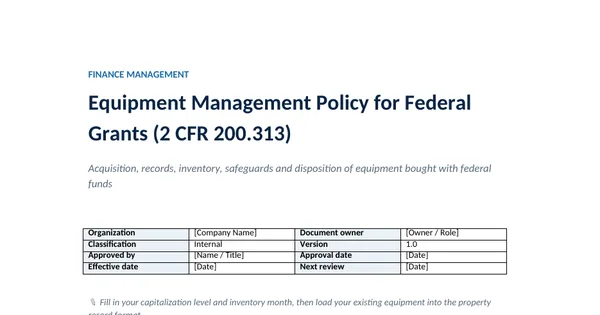
Equipment Management Policy for Federal Grants (2 CFR 200.313)
3 free downloads per account. Just your email and a 6-digit code.
About this template
An equipment management policy for federal grants sets how an organisation buys, records, uses, protects and disposes of equipment paid for in whole or in part with federal funds. Section 200.313 of the Uniform Guidance sets the minimum: property records with defined fields, a physical inventory reconciled at least once every two years, a control system against loss, maintenance, and disposition rules. Single auditors test these records, and gaps are a frequent finding.
The policy applies the 2024 revision of 2 CFR 200: equipment means property with a useful life of more than one year and a per-unit cost at or above the lower of the capitalization level or USD 10,000. It covers prior approval under 2 CFR 200.439, title and use, the property record fields, inventory, loss and theft, maintenance, disposition by fair market value, residual supplies under 200.314 and record retention under 200.334.
Who it is for
The finance manager or grants manager whose auditor or funder found federally funded equipment without proper property records or a recent physical inventory.
What is inside
- Definitions table with the 2024 equipment threshold of USD 10,000 per unit or the lower capitalization level
- Prior approval rules for general purpose, special purpose and capital improvement costs from 2 CFR 200.439
- Property record table with every field 2 CFR 200.313(d)(1) requires and a worked entry
- Physical inventory at least every two years, reconciliation, tagging and safeguards
- Disposition table by fair market value, with a worked sale calculation of the federal share
- Residual unused supplies rule above USD 10,000 and the three-year retention of property records after disposition
- Roles table for 5 roles and a checklist of 6 decisions before adoption
How to use it
Fill in your capitalization level and inventory month, then load your existing equipment into the property record format.
Files
- DOCXequipment-management-policy-for-federal-grants.docx41 KB
Opens in Microsoft Word or Excel, Google Docs or Sheets, and LibreOffice. Built on free, official texts that anyone can read: laws, regulations, standards and guidance published by public bodies. A template to adapt, not legal, tax or accounting advice.
Questions about this template
What is the equipment threshold under the 2024 Uniform Guidance?
Section 200.1 as revised in 2024 defines equipment as tangible personal property, including information technology systems, with a useful life of more than one year and a per-unit acquisition cost at or above the lower of the organisation's capitalization level for financial statements or USD 10,000. Items below that are supplies.
How often must federally funded equipment be inventoried?
Section 200.313(d)(2) requires a physical inventory of the property, with the results reconciled to the property records, at least once every two years. Many organisations count more often, for example every year, which the policy allows. Differences found in the count are investigated and the records corrected.
What happens when we sell equipment bought with a federal grant?
Equipment with a current fair market value of USD 10,000 or less per unit may be kept, sold or disposed of with no further responsibility. Above that, the federal agency is entitled to its percentage share of the current market value or sale proceeds, and the agency or pass-through entity may let you keep USD 1,000 of its share to cover selling costs.
More Uniform Guidance (2 CFR 200) templates
Uniform Guidance (2 CFR 200)
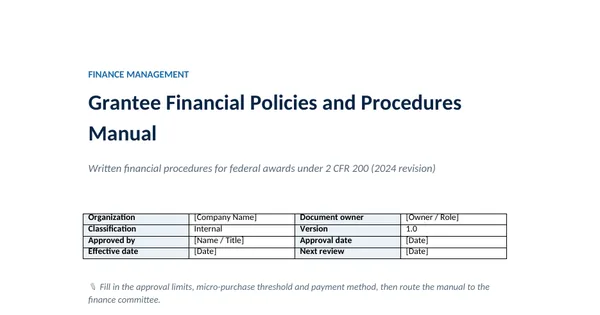
Grantee Financial Policies and Procedures Manual
Uniform Guidance (2 CFR 200)
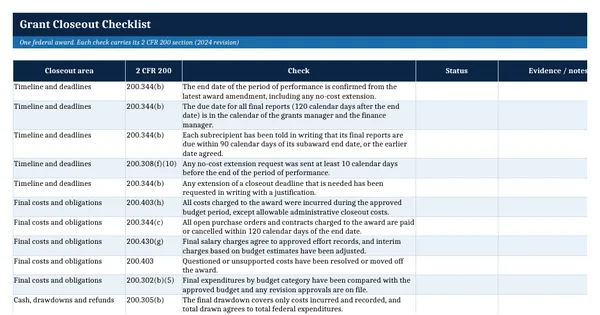
Grant Closeout Checklist
GAO Yellow Book and Single Audit
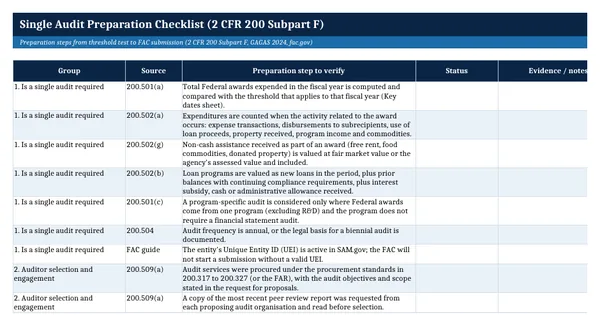
Single Audit Preparation Checklist (2 CFR 200 Subpart F)
GAO Yellow Book and Single Audit