

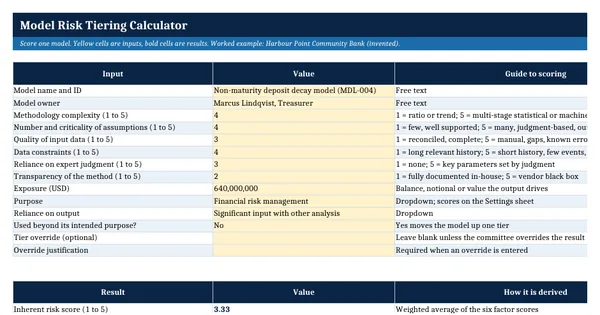
 Excel workbook preview
Model risk management (SR 26-2)
Model Risk Tiering Calculator
3 free downloads per account. Just your email and a 6-digit code.
About this template
Model risk tiering sorts a bank's models into a few risk levels so that validation depth, monitoring and approval effort follow the risk. Examiners and auditors ask how each tier was reached, and a tier typed into the inventory without a method is hard to defend. A tiering calculator records the inputs, the scoring and any override with its reason.
The workbook scores six inherent risk factors, then exposure as a share of total assets, purpose and reliance on the output, and combines them into a model risk score and a tier. Use beyond the intended purpose raises the tier by one step, and overrides need a written reason. The factors follow the April 2026 interagency guidance (SR 26-2): inherent risk, exposure, purpose and use.
Who it is for
The model risk manager who must show the examiner or the risk committee how each model's tier was decided, instead of a tier typed in by hand.
What is inside
- Calculator sheet with 14 inputs, 17 live outputs and a worked example for a deposit decay model
- Six inherent risk factors scored 1 to 5 with weights you can change
- Exposure scored from its share of total assets, plus purpose and reliance scores, combined into a materiality score
- Model risk score from 1 to 25 mapped to Tier 1, 2 or 3, with a one-tier step up for use beyond the intended purpose
- Tier override with a check that flags a missing justification
- Portfolio Tiering sheet with 10 sample models and 16 blank rows using the same formulas
- Settings sheet with weights, thresholds, cut-offs and the oversight standard for each tier
- Summary sheet with models, share and average score per final tier
How to use it
Open the Settings sheet first, check the weights and cut-offs against your policy, then score one model on the Calculator sheet.
Files
- XLSXmodel-risk-tiering-calculator.xlsx20 KB
Opens in Microsoft Word or Excel, Google Docs or Sheets, and LibreOffice. Built on free, official texts that anyone can read: laws, regulations, standards and guidance published by public bodies. A template to adapt, not legal, tax or accounting advice.
Questions about this template
How do banks tier their models?
Most combine a view of how likely a model is to be wrong with how much its errors would matter. The April 2026 interagency guidance describes inherent risk, exposure and purpose, notes that purpose and exposure together determine materiality, and adds that a sound model can still carry high risk if it is misused.
Are the weights and cut-offs in this calculator regulatory?
No. The guidance names the risk factors but sets no scores, weights or tier boundaries. The values on the Settings sheet are a worked starting point. Calibrate them on your own models, record the reasons in your policy and keep them stable so tiers stay comparable.
What does model materiality mean?
In the April 2026 interagency guidance, materiality is the combination of model exposure, the significance of the output to business decisions, and model purpose, the nature and importance of the use. Models used for regulatory requirements or to manage financial risk exposures are generally treated as higher risk.
More Model risk management (SR 26-2) templates
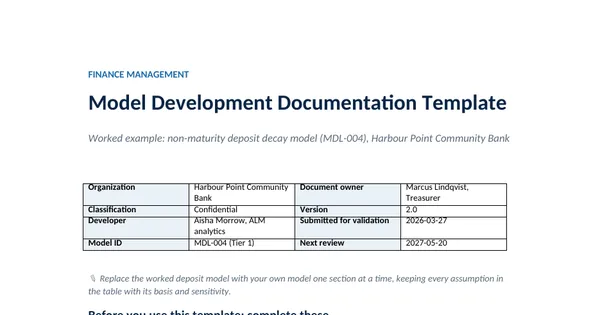
Model risk management (SR 26-2)
Model Development Documentation Template
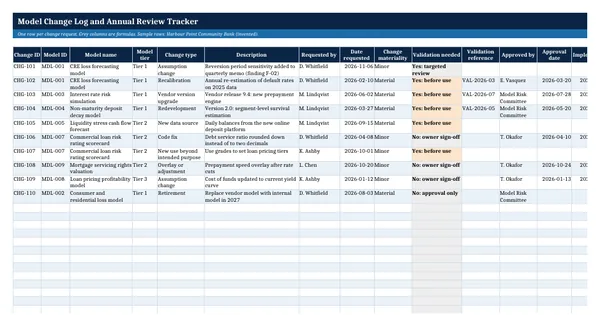
Model risk management (SR 26-2)
Model Change Log and Annual Review Tracker
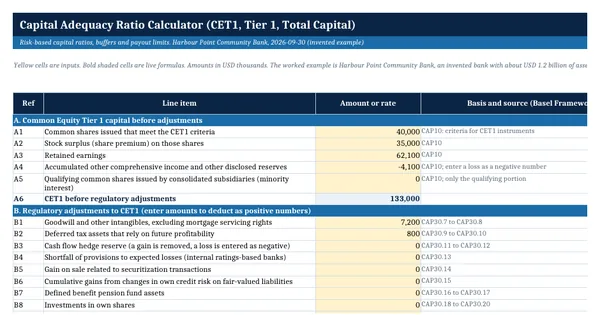
Basel Framework and BCBS 239
Capital Adequacy Ratio Calculator (CET1, Tier 1, Total Capital)
Basel Framework and BCBS 239