 Word document preview
Nonprofit Document Retention and Destruction Policy
3 free downloads per account. Just your email and a 6-digit code.
About this template
A document retention and destruction policy tells staff, volunteers and directors how long each kind of record is kept and how it is destroyed when the time is up. Form 990, Part VI, line 14 asks whether the organization has one, and the instructions describe it as a policy that identifies the record retention responsibilities of staff, volunteers, board members and outsiders. It also protects the organization when a lawsuit, audit or investigation starts.
This template is a complete policy with a retention schedule for 22 record types. Each period is marked as a legal minimum with its source, such as the Form 990 instructions, 29 CFR 516, the USCIS Form I-9 rule or 2 CFR 200.334, as IRS guidance from Publication 4221-PC, or as a policy choice the board can change. It adds a legal hold procedure, electronic records rules, destruction methods with a log, and public inspection duties.
Who it is for
The operations or finance lead of a charity who has to answer Yes to Form 990, Part VI, line 14 and needs a written retention and destruction policy the board can adopt.
What is inside
- 13 numbered sections, from purpose and scope to the review clause
- Retention schedule for 22 record types, each marked as a legal minimum (IRS, Labor, USCIS or Uniform Guidance), IRS guidance or a policy choice
- Legal hold procedure that suspends destruction, including federal award audits under 2 CFR 200.334
- Electronic records, email and backup rules
- Destruction methods and a destruction log with 4 worked entries
- Public inspection rules for Form 990 and the exemption application
- Roles table and a 6-item adoption checklist
How to use it
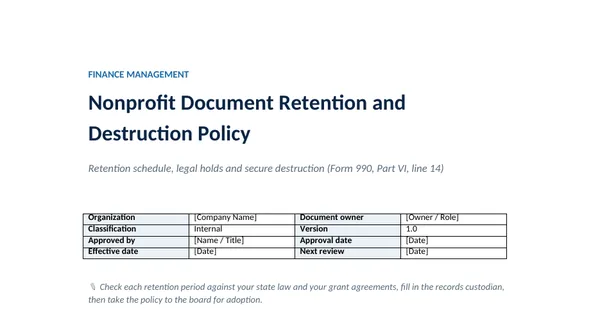
Check each retention period against your state law and your grant agreements, fill in the records custodian, then take the policy to the board for adoption.
Files
- DOCXnonprofit-document-retention-and-destruction-policy.docx41 KB
Opens in Microsoft Word or Excel, Google Docs or Sheets, and LibreOffice. Built on free, official texts that anyone can read: laws, regulations, standards and guidance published by public bodies. A template to adapt, not legal, tax or accounting advice.
Questions about this template
How long must a nonprofit keep its records?
Publication 4221-PC says records supporting a return are generally kept until the statute of limitations runs, usually three years after the return is due or filed, whichever is later. It lists permanent records such as the exemption application, determination letter, governing documents and board minutes, and employment tax records for at least four years. Grants and state law can require longer.
Is a document retention policy required for a 501(c)(3)?
The Internal Revenue Code does not require one. Form 990, Part VI, Section B says its policy questions ask about policies not required by the Code, but line 14 asks whether the organization has a written document retention and destruction policy, and the answer is public. Most boards adopt one so they can answer Yes.
What is a legal hold?
A legal hold stops the normal destruction of records when litigation, an audit or a government investigation is pending or expected. 18 U.S.C. 1519 makes it a federal crime to destroy or conceal records with intent to obstruct a federal matter, and 2 CFR 200.334 keeps federal award records until any litigation, claim or audit started within the retention period is resolved.