
 Word document preview
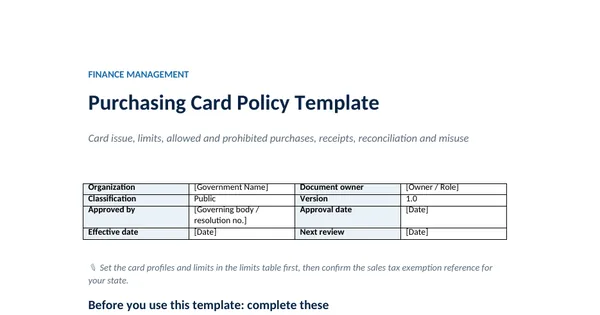
Purchasing Card Policy Template
3 free downloads per account. Just your email and a 6-digit code.
About this template
A purchasing card policy sets who may hold a P-card, what it may buy, the limits on each card, and how every transaction is receipted, reconciled and approved. Auditors test card programs often because cards move money quickly with little paperwork. This template gives a local government, school district or nonprofit a complete policy that matches a card log and a monthly review routine.
The policy draws on published public practice, such as the State of Georgia statewide purchasing card policy, and on 2 CFR 200.320, which allows purchase cards as a payment method for micro-purchases under federal awards. It covers program roles and separation of duties, limit profiles and merchant blocks, prohibited purchases, split purchases, receipts and sales tax, the reconciliation calendar, lost cards and the response to misuse.
Who it is for
The finance director or P-card administrator who was told by the auditor that the card program has no current written policy.
What is inside
- 15 numbered sections, including Roles, Compliance, Exceptions and Review
- Card profile table with 4 limit profiles and merchant category groups
- Allowed, restricted and prohibited purchase lists
- Split purchase rule and the 2 CFR 200.320 rule for federal micro-purchases
- Itemized receipt, lost receipt and sales tax rules
- Monthly reconciliation timeline with 6 steps and owners
- Misuse response table with 4 findings, from missing receipts to personal purchases
- Checklist of 7 decisions to make before adoption
How to use it
Set the card profiles and limits in the limits table first, then confirm the sales tax exemption reference for your state.
Files
- DOCXpurchasing-card-policy-template.docx41 KB
Opens in Microsoft Word or Excel, Google Docs or Sheets, and LibreOffice. Built on free, official texts that anyone can read: laws, regulations, standards and guidance published by public bodies. A template to adapt, not legal, tax or accounting advice.
Questions about this template
What should a purchasing card policy include?
It should cover eligibility and training, the cardholder agreement, spending limits and merchant blocks, allowed and prohibited purchases, the ban on split purchases, receipt and sales tax rules, monthly reconciliation and approval deadlines, lost or stolen cards, cards of leavers and the consequences of misuse. It should also set out who administers the program and who approves.
Who should approve P-card transactions?
An approver who is not the cardholder and does not report to the cardholder, usually the cardholder's supervisor or department head. The program administrator who sets up cards and limits should not hold a card. This separation means no one person can issue a card, use it and approve the charges.
What is a split purchase on a purchasing card?
A split purchase breaks one requirement into two or more charges, on one card, on several cards, or on a card plus a purchase order, to stay under the single transaction limit or a bidding threshold. The policy prohibits it, and the card log flags repeated charges at the same merchant for review.