

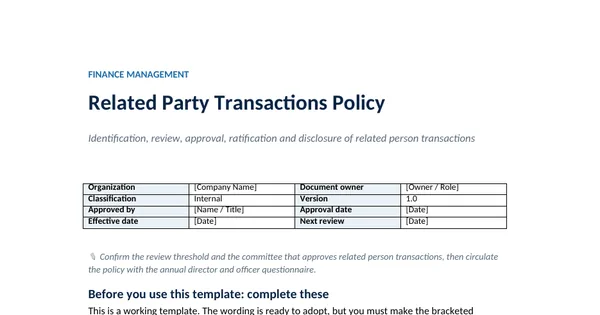
 Word document preview
Finance governance and board reporting
Related Party Transactions Policy
3 free downloads per account. Just your email and a 6-digit code.
About this template
A related party transactions policy sets out how an organization finds, reviews and approves deals in which a director, an executive officer, a large shareholder or one of their family members has an interest. Auditors and audit committees ask for it because these transactions carry a higher risk of terms that favor the insider, and US public companies must describe their review policy in their annual disclosures.
The policy takes its definitions from Item 404 of Regulation S-K on ecfr.gov: who counts as a related person, which family members are included, and how the amount involved is measured. It adds an approval route by amount, review standards, pre-approved categories, a ratification process for transactions found late, the federal ban on personal loans to executives, and a worked register of four example transactions.
Who it is for
The general counsel or CFO asked by the audit committee or auditor for a written policy on reviewing and approving transactions with directors, officers and their families.
What is inside
- Definitions of related person and immediate family member taken from Item 404(a) of Regulation S-K
- How the amount involved is measured, including leases, and the smaller reporting company threshold
- Approval route table by amount, from logging to advance audit committee approval
- Review standards and pre-approved categories, with the Instruction 6 and 7 carve-outs
- Ratification steps for transactions found after the fact
- Ban on personal loans to directors and executive officers under 15 U.S.C. 78m(k)
- Worked register with four example transactions and their outcomes
- Roles table plus compliance, exceptions and review sections
How to use it
Confirm the review threshold and the committee that approves related person transactions, then circulate the policy with the annual director and officer questionnaire.
Files
- DOCXrelated-party-transactions-policy.docx41 KB
Opens in Microsoft Word or Excel, Google Docs or Sheets, and LibreOffice. Based on general finance practice, not on one published standard. A template to adapt, not legal, tax or accounting advice.
Questions about this template
Who is a related person under Item 404?
Item 404 of Regulation S-K covers directors, executive officers, nominees for director, holders of more than five percent of a class of voting securities, and the immediate family members of each, which include spouses, children, stepchildren, parents, stepparents, siblings, in-laws and anyone other than a tenant or employee who shares their household.
What is the disclosure threshold for related person transactions?
Item 404(a) requires disclosure of transactions where the amount involved exceeds 120,000 dollars and the related person has a direct or indirect material interest. For smaller reporting companies the threshold is the lesser of 120,000 dollars or one percent of average total assets at year end for the last two completed fiscal years.
Can a private company use this policy?
Yes. The SEC rules apply only to registrants, but the same risks arise in any organization where insiders can deal with the company. A private company can keep the definitions, pick a lower review threshold that suits its size, and give the approval role to its board or audit committee.
More Finance governance and board reporting templates
Finance governance and board reporting
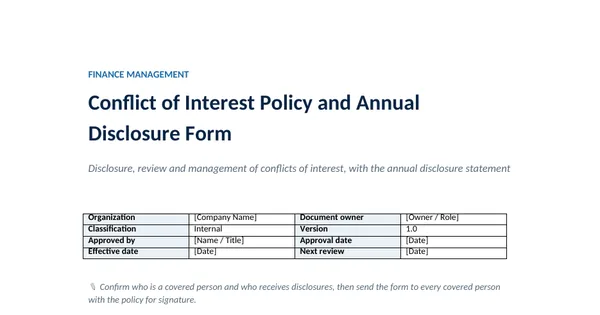
Conflict of Interest Policy and Annual Disclosure Form
Finance governance and board reporting
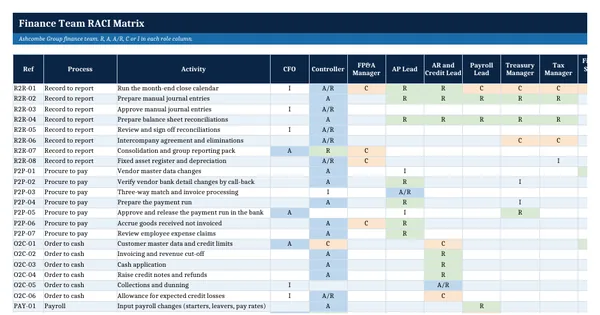
Finance Team RACI Matrix
UK Corporate Governance Code and FRS 102
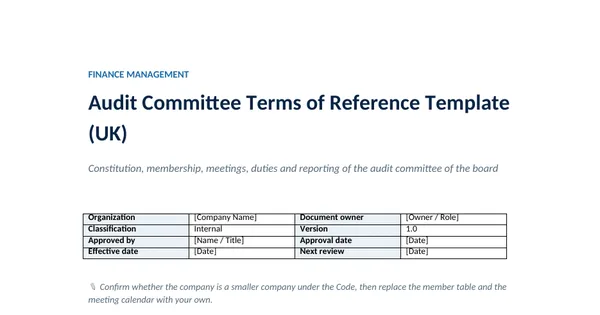
Audit Committee Terms of Reference Template (UK)
UK Corporate Governance Code and FRS 102