
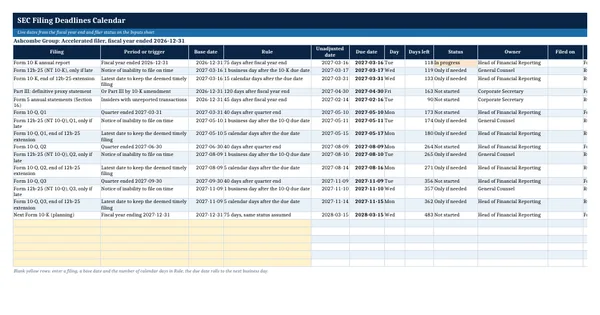
 Excel workbook preview
SEC Filing Deadlines Calendar (10-K, 10-Q, 8-K)
3 free downloads per account. Just your email and a 6-digit code.
About this template
An SEC filing deadlines calendar puts every periodic and current report due date for a reporting year in one place. Controllers and reporting managers use it to plan the close, book the filing agent and audit committee dates, and brief the CFO, especially after a change in filer status moves the 10-K and 10-Q deadlines, or when a new team takes over the reporting calendar.
The workbook takes the fiscal year end and filer status and calculates the Form 10-K, three Forms 10-Q, Part III proxy, Form 5 and Form 12b-25 dates with live formulas, rolling weekend and holiday dates forward. An event log dates each Form 8-K and Form 4 in business days. Periods come from the SEC forms' General Instructions and Rules 0-3, 12b-2, 12b-25 and 16a-3 on sec.gov and ecfr.gov.
Who it is for
The controller or reporting manager asked by the CFO or the audit committee for one dated view of every SEC deadline in the coming year.
What is inside
- Calendar of 15 filing deadlines that recalculate from one fiscal year end and filer status
- Due dates roll past weekends and federal holidays with WORKDAY, following Rule 0-3
- Form 12b-25 notice dates and the 15-day and 5-day extension dates for each report
- 8-K and Form 4 log with 11 worked events and 20 blank rows, due dates in business days
- Dropdown of all 33 Form 8-K items plus Form 4, and the 71-day Item 9.01 amendment date
- Public float test that flags a filer status to check against Rule 12b-2
- Deadline Rules sheet citing the form or rule behind each period, and a Holidays sheet with 2026 and 2027
- Amber and red flags 14 days and 2 days out, and once a date passes unfiled
How to use it
Enter the fiscal year end and filer status on the Inputs sheet, then check every due date on the Calendar.
Files
- XLSXsec-filing-deadlines-calendar.xlsx23 KB
Opens in Microsoft Word or Excel, Google Docs or Sheets, and LibreOffice. Built on free, official texts that anyone can read: laws, regulations, standards and guidance published by public bodies. A template to adapt, not legal, tax or accounting advice.
Questions about this template
How many days does a company have to file a 10-K?
Form 10-K General Instruction A sets 60 days after fiscal year end for large accelerated filers, 75 days for accelerated filers and 90 days for all other registrants. Filer status comes from the Rule 12b-2 definitions. If the last day falls on a weekend or holiday, Rule 0-3 lets the report be filed on the next business day.
When is a Form 8-K due?
Unless an item says otherwise, a Form 8-K is filed or furnished within four business days after the event. If the event happens on a weekend or holiday, the count starts on the next business day and includes it. Item 1.05 and Item 5.08 count from the company's determination, and Regulation FD disclosure has its own timing.
What happens if a 10-Q or 10-K will be late?
Rule 12b-25 requires a Form 12b-25 no later than one business day after the due date. If the company states that the delay could not be avoided without unreasonable effort or expense and files within 15 calendar days for a 10-K, or 5 calendar days for a 10-Q, the report is treated as filed on time.