
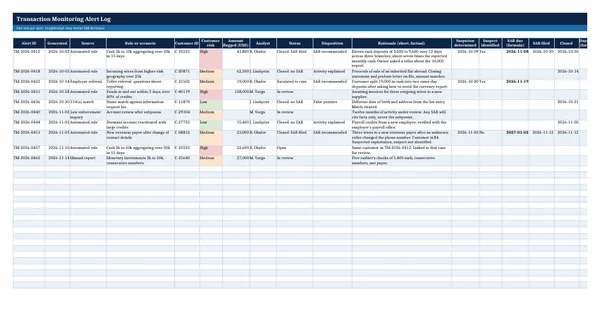
 Excel workbook preview
Transaction Monitoring Alert Log
3 free downloads per account. Just your email and a 6-digit code.
About this template
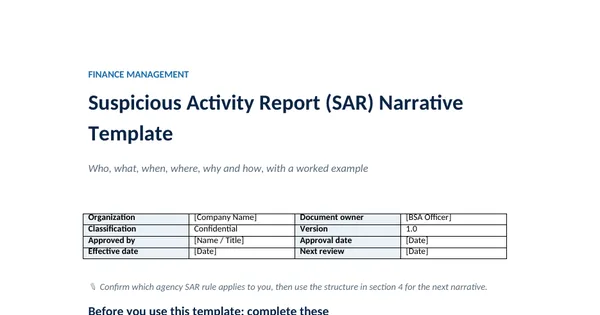
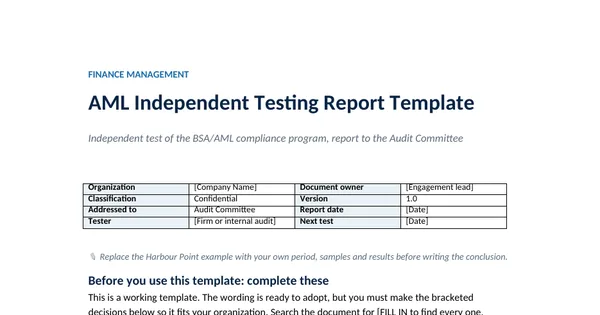
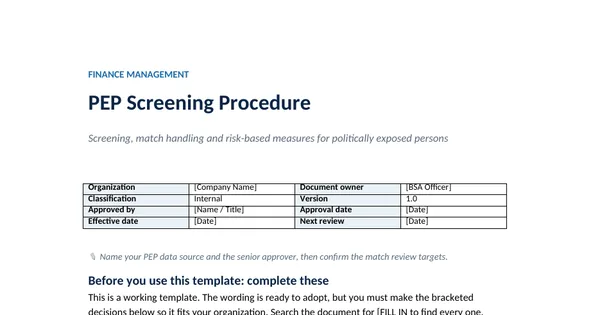
A transaction monitoring alert log is the record of every piece of unusual activity a bank looks at: alerts from automated rules, employee referrals, law enforcement inquiries and information request matches. Examiners and independent testers use it to check that each alert was reviewed in a reasonable time, that the decision was recorded, and that a SAR, when needed, was filed within the deadline.
This workbook logs each alert from generation to disposition and calculates the SAR due date from the date suspicion was determined, following 31 CFR 1020.320 and the FFIEC BSA/AML Examination Manual. It tracks review age against your own targets, summarises status and sources, and measures how often each rule leads to a SAR. The reference sheet reflects the interagency SAR FAQs of October 2025.
Who it is for
The BSA Officer whose examiner or independent tester asked to see how each monitoring alert was reviewed, decided and filed on time.
What is inside
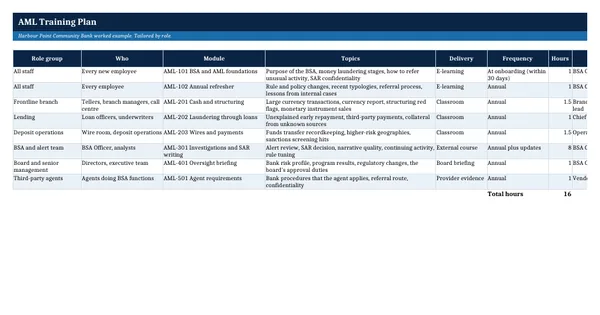
- Alert Log with 19 columns: source, rule, customer risk, analyst, status, disposition, rationale and dates
- 10 invented worked alerts for Harbour Point Community Bank plus 20 blank formatted rows
- SAR due date formula: 30 days from the suspicion determination, 60 when no suspect is identified
- Live filing check (Filed on time, Filed late, Overdue, Due soon) and review age against targets
- Settings sheet with internal review targets per customer risk rating in yellow input cells
- Summary sheet: alerts by status and source, late and overdue SARs, alert to SAR rate, days to close
- Rule Performance sheet that counts alerts and SARs per scenario for the tuning review
- Rules Reference sheet with 11 filing rules and their official sources
How to use it
Enter your review targets on the Settings sheet, then delete the sample alerts and log your own.
Files
- XLSXtransaction-monitoring-alert-log.xlsx20 KB
Opens in Microsoft Word or Excel, Google Docs or Sheets, and LibreOffice. Built on free, official texts that anyone can read: laws, regulations, standards and guidance published by public bodies. A template to adapt, not legal, tax or accounting advice.
Questions about this template
When does the 30-day SAR clock start?
Under 31 CFR 1020.320(b)(3) the bank files no later than 30 calendar days after initial detection of facts that may be a basis for a SAR. The FFIEC manual explains that this is not the moment a system flags a transaction but the point at which a review determines the activity is suspicious. With no suspect identified, up to 30 more days are allowed, never more than 60 in total.
Do we have to document a decision not to file a SAR?
No. FinCEN and the federal banking agencies said in their FAQs of 9 October 2025 that there is no requirement or expectation to document a decision not to file. Where an institution does document it, a short and concise statement will usually suffice, with more detail for complex investigations. The log has a rationale column for that statement.
Why track SARs per monitoring rule?
The FFIEC manual expects management to document and periodically test the filtering criteria and thresholds of its monitoring system and to explain why they fit the bank's risks. Counting alerts, SARs and alerts closed with no suspicion per rule gives the tuning review real numbers, and shows rules that only generate noise.