

 Word document preview
Anti-bribery (FCPA, UK Bribery Act)
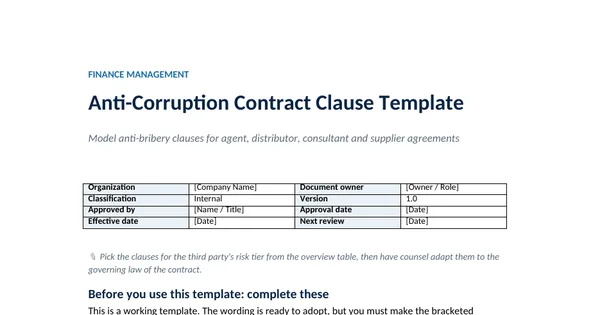
Anti-Corruption Contract Clause Template
3 free downloads per account. Just your email and a 6-digit code.
About this template
An anti-corruption clause commits an agent, distributor, consultant or supplier to the same anti-bribery standards a company applies to its own staff, and gives the company rights to check and to act if they are broken. The DOJ Evaluation of Corporate Compliance Programs asks whether contract terms describe the services, set appropriate payment terms and keep compensation commensurate with the work. This template is model wording, not legal advice.
It contains ten numbered clauses: definitions, compliance with anti-corruption laws, facilitation payments and hospitality, representations about public officials and ownership, payment terms, books and audit rights, subcontracting, training and annual certification, notification and cooperation, and suspension, termination and indemnity. An overview table maps clauses to risk tiers, and an annual compliance certificate closes the document. It draws on the DOJ and SEC Resource Guide to the FCPA and the UK Bribery Act 2010.
Who it is for
The finance, procurement or legal manager who needs anti-corruption wording to add to an agent, distributor or supplier contract before signing.
What is inside
- Ten model clauses, A.1 to A.10, from definitions to suspension, termination and indemnity
- Clause set overview table showing which clauses apply to low, medium and high risk third parties
- Definitions of Anti-Corruption Laws, Public Official and Improper Payment
- Payment clause requiring transfers to the contractor's own account in its own country and detailed invoices
- Books, records and audit rights clause with a cost shift when a breach is found
- Annual compliance certificate with seven statements and a worked example
- Not legal advice line and a checklist of 7 decisions for counsel and the contract owner
How to use it
Pick the clauses for the third party's risk tier from the overview table, then have counsel adapt them to the governing law of the contract.
Files
- DOCXanti-corruption-contract-clause-template.docx41 KB
Opens in Microsoft Word or Excel, Google Docs or Sheets, and LibreOffice. Built on free, official texts that anyone can read: laws, regulations, standards and guidance published by public bodies. A template to adapt, not legal, tax or accounting advice.
Questions about this template
What should an anti-corruption clause in a contract include?
At a minimum it should include a promise to comply with anti-corruption laws, a ban on improper payments and facilitation payments, accurate records and audit rights, a duty to report a breach, and the right to suspend payment and terminate. For higher-risk third parties add representations about links to public officials, limits on subcontracting, training and an annual compliance certificate.
Can we terminate a contract for a breach of the anti-corruption clause?
The clause in this template makes a breach a material breach that allows immediate termination by written notice, without a claim for commissions or damages, and makes affected fees repayable. Whether that works as written depends on the governing law and the rest of the contract, so counsel should review it before use. It is not legal advice.
Do suppliers need the same clause as sales agents?
Not always. Sales agents and distributors who deal with customers or public officials usually carry the highest risk and get the full set. A supplier with no contact with officials may need only the core clauses. The overview table in this template maps each clause to a low, medium or high risk tier from your due diligence.
More Anti-bribery (FCPA, UK Bribery Act) templates
Anti-bribery (FCPA, UK Bribery Act)
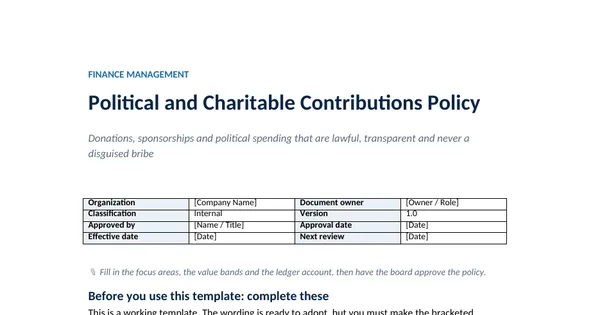
Political and Charitable Contributions Policy
Anti-bribery (FCPA, UK Bribery Act)
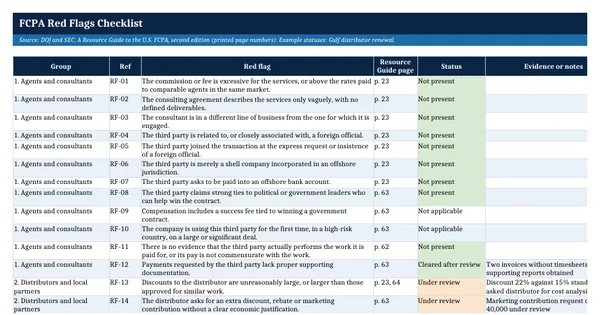
FCPA Red Flags Checklist
Basel Framework and BCBS 239
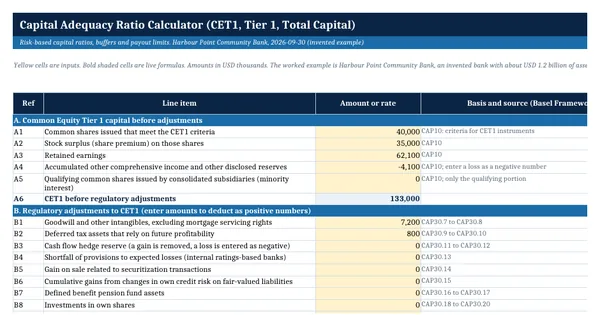
Capital Adequacy Ratio Calculator (CET1, Tier 1, Total Capital)
Basel Framework and BCBS 239