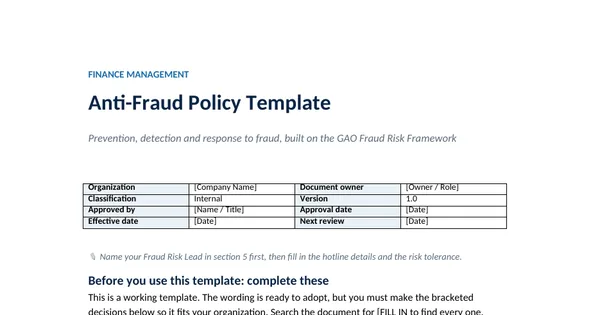
 Word document preview
Anti-Fraud Policy Template
3 free downloads per account. Just your email and a 6-digit code.
About this template
An anti-fraud policy states that an organization does not tolerate fraud and explains how it prevents, detects and responds to it: who leads the work, how fraud risk is assessed, which controls are expected, how to report a suspicion and what happens next. Auditors, lenders and grantors ask for one because it turns good intentions into duties with names and dates.
This template is built on the four components of the GAO publication A Framework for Managing Fraud Risks in Federal Programs (GAO-15-593SP): commit, assess, design and implement, and evaluate and adapt. It has 10 body sections, three worked tables (fraud categories, minimum controls and quarterly metrics) and a roles table, and it covers the disclosure duties in 2 CFR 200.113 and FAR 52.203-13 for organizations with federal awards or contracts.
Who it is for
The CFO or controller who was asked by the auditor, the bank or the board for a written anti-fraud policy and found that the code of conduct was all there was.
What is inside
- 10 body sections plus roles and the standard policy closing sections, about 1,500 words
- Fraud categories table with 5 categories and examples
- Fraud Risk Lead mandate with 6 duties drawn from GAO leading practice 1.2
- Fraud risk assessment rules with triggers, a tolerance and accept, reduce, share or avoid responses
- Minimum controls table with 6 controls, including data analytics, a hotline and employee integrity
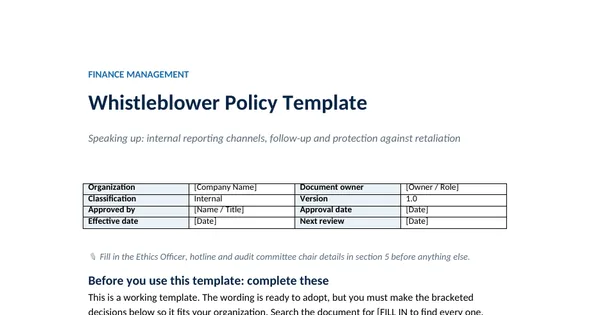
- Reporting section confirming that nobody is stopped from reporting directly to a regulator such as the SEC
- Disclosure paragraph for federal awards and contracts citing 2 CFR 200.113 and FAR 52.203-13
- Quarterly metrics table with 5 outcome measures for the audit committee
How to use it
Name your Fraud Risk Lead in section 5 first, then fill in the hotline details and the risk tolerance.
Files
- DOCXanti-fraud-policy-template.docx42 KB
Opens in Microsoft Word or Excel, Google Docs or Sheets, and LibreOffice. Built on free, official texts that anyone can read: laws, regulations, standards and guidance published by public bodies. A template to adapt, not legal, tax or accounting advice.
Questions about this template
What is the difference between an anti-fraud policy and a fraud response plan?
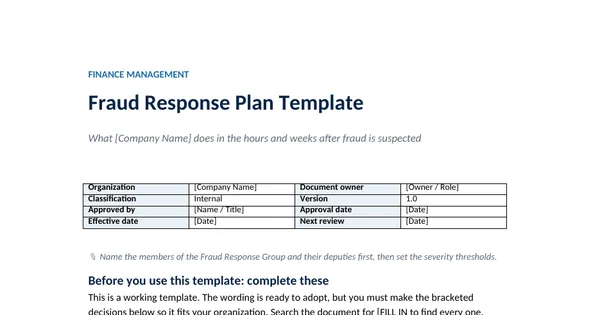
The policy sets the standing rules: what counts as fraud, who is responsible, how risk is assessed, which controls are required and how to report. The response plan is the procedure used once fraud is suspected: the first 72 hours, severity levels, evidence preservation, investigation, recovery and notifications. Most organizations keep both and link them.
Who should own the anti-fraud policy?
The board or audit committee approves it, and a named manager owns the day-to-day work. GAO-15-593SP recommends a dedicated lead entity with defined responsibilities, the necessary authority and a direct reporting line to senior management. Keeping that role outside internal audit lets internal audit review the antifraud program independently.
Can a policy or agreement stop employees from reporting fraud to the SEC?
No. SEC Rule 21F-17(a), 17 CFR 240.21F-17, says no person may take any action to impede an individual from communicating directly with SEC staff about a possible securities law violation, including by enforcing or threatening to enforce a confidentiality agreement. The template states this right in the reporting section.