 Word document preview
GAO Yellow Book and Single Audit
Audit Finding Template (Criteria, Condition, Cause, Effect)
3 free downloads per account. Just your email and a 6-digit code.
About this template
A finding has to show what should be, what is, why, and what it means. The GAO Government Auditing Standards describe those elements as criteria, condition, cause and effect, and 2 CFR 200.516(b) adds the information a single audit finding needs so that the auditee can write a corrective action plan and the funding agency can issue a management decision. This template is for the auditor, internal auditor or reviewer who has to write a finding that holds up.
Each section covers one element and cites its source paragraph: GAGAS 2024 revision paragraphs 6.17 to 6.28 and 6.52 to 6.61, and 2 CFR 200.516(b)(1) to (11). The worked example is a repeat payroll finding at an invented town, with a seven item exceptions table, known and likely questioned costs, a recommendation and the views of responsible officials. The criteria come from 2 CFR 200.430(g) and 200.303.
Who it is for
The auditor or audit senior who has to write up an exception as a finding that management, the funding agency and the reader can act on.
What is inside
- 12 numbered sections, with one each for criteria, condition, cause, effect, questioned costs, recommendation and views
- Elements table mapping each element to its GAGAS paragraph and its 2 CFR 200.516(b) item
- Worked single audit finding for an invented town on payroll charged from budget estimates
- Finding identification block with program, award, compliance requirement type and classification
- Exceptions table of seven sampled payroll charges with known and likely questioned costs
- Recommendation, views of responsible officials and the auditor's evaluation
- Pre-use checklist for adapting the finding
How to use it
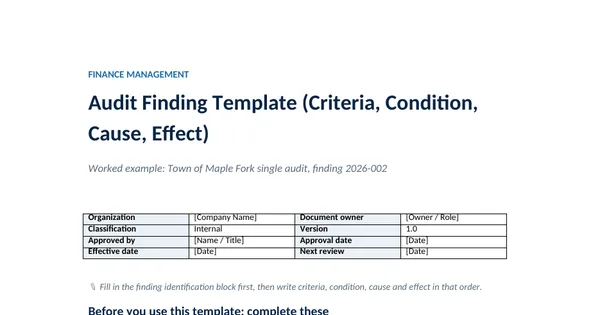
Fill in the finding identification block first, then write criteria, condition, cause and effect in that order.
Files
- DOCXaudit-finding-template.docx41 KB
Opens in Microsoft Word or Excel, Google Docs or Sheets, and LibreOffice. Built on free, official texts that anyone can read: laws, regulations, standards and guidance published by public bodies. A template to adapt, not legal, tax or accounting advice.
Questions about this template
What are the elements of an audit finding?
Government Auditing Standards (2024 revision) paragraph 6.17 asks auditors to develop the criteria, condition, cause and effect of findings to the extent relevant to the audit objectives. Paragraphs 6.25 to 6.28 define each: criteria is the required or desired state, condition is the situation that exists, cause explains the difference, and effect is the outcome or consequence.
What extra information does a single audit finding need?
2 CFR 200.516(b) lists it: Federal program and award identification, criteria, condition, cause, effect, known questioned costs and how they were computed, perspective on prevalence, whether the finding repeats a prior one with its reference number, recommendations, and the views of responsible officials of the auditee.
When are questioned costs reported as a finding?
Under 2 CFR 200.516(a)(3), the auditor reports known questioned costs when either known or likely questioned costs are greater than USD 25,000 for a type of compliance requirement for a major program. For programs not audited as major programs, known questioned costs over USD 25,000 that the auditor becomes aware of are reported.