

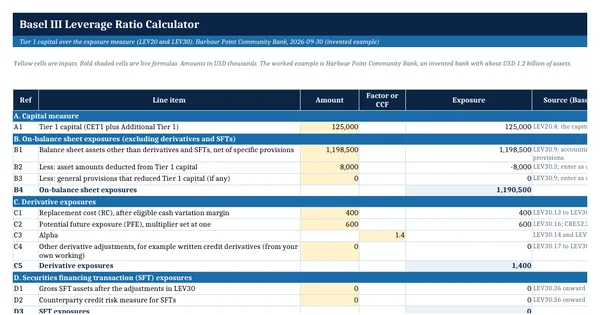
 Excel workbook preview
Basel III Leverage Ratio Calculator
3 free downloads per account. Just your email and a 6-digit code.
About this template
The Basel III leverage ratio is a simple backstop to the risk-based capital ratios: Tier 1 capital divided by a total exposure measure that does not depend on risk weights. Boards and examiners use it to check that a bank with low-risk assets is not running a very large balance sheet on thin capital. This workbook sets out the leverage ratio calculation so that each part of the exposure measure can be traced.
It follows chapters LEV20 and LEV30 of the Basel Framework on bis.org. The capital measure is Tier 1, the minimum is 3 percent under LEV20.7, and the exposure measure adds on-balance sheet assets, derivatives with the 1.4 alpha, securities financing transactions and off-balance sheet items after credit conversion factors. A quarterly log and an exposure mix sheet complete the picture.
Who it is for
The finance manager or regulatory reporting lead at a bank who was asked to show the Basel III leverage ratio and the exposure measure behind it.
What is inside
- Leverage Calculator sheet with 20 input lines across Tier 1 capital and the four exposure categories
- Derivative exposure with the alpha of 1.4 applied to replacement cost and potential future exposure (LEV30.14)
- Off-balance sheet items converted with the 100, 50, 40, 20 and 10 percent CCFs of LEV30.49 to LEV30.54
- Leverage ratio against the 3 percent minimum of LEV20.7 plus any buffer, surplus Tier 1 and exposure headroom
- Quarterly Log sheet with 8 worked quarters, 16 blank rows, a status against your internal floor and an ALCO review dropdown
- Exposure Mix sheet with each category's share of the exposure measure and the Tier 1 it needs
- Worked example for an invented USD 1.2 billion community bank, with a How to use sheet
How to use it
Enter Tier 1 capital and each exposure in the yellow cells of the Leverage Calculator sheet, then set the minimum and buffer to your national rule.
Files
- XLSXbasel-iii-leverage-ratio-calculator.xlsx14 KB
Opens in Microsoft Word or Excel, Google Docs or Sheets, and LibreOffice. Built on free, official texts that anyone can read: laws, regulations, standards and guidance published by public bodies. A template to adapt, not legal, tax or accounting advice.
Questions about this template
How is the Basel III leverage ratio calculated?
LEV20.3 of the Basel Framework defines it as the capital measure divided by the exposure measure, shown as a percentage. LEV20.4 sets the capital measure as Tier 1 capital. The exposure measure is the sum of on-balance sheet exposures, derivative exposures, securities financing transaction exposures and off-balance sheet items after credit conversion factors.
What is the minimum leverage ratio?
LEV20.7 says banks must meet a 3 percent leverage ratio minimum at all times. Global systemically important banks face an additional leverage buffer under LEV40, and national rules can set a different minimum. The workbook keeps the minimum and any buffer in input cells so you can apply your own rule.
Which credit conversion factors apply to off-balance sheet items?
LEV30.49 to LEV30.54 set 100 percent for direct credit substitutes, 50 percent for note issuance and revolving underwriting facilities and certain transaction-related contingents, 40 percent for commitments, 20 percent for short-term self-liquidating trade letters of credit and 10 percent for commitments the bank can cancel unconditionally at any time.
More Basel Framework and BCBS 239 templates
Basel Framework and BCBS 239
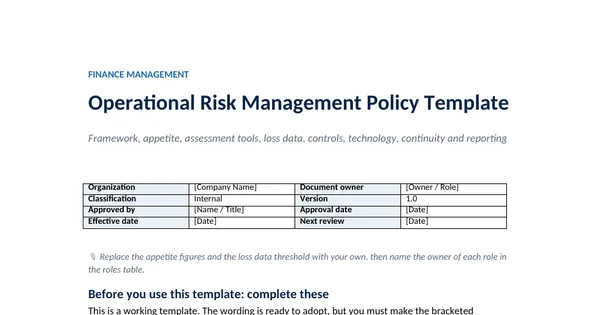
Operational Risk Management Policy Template
Basel Framework and BCBS 239
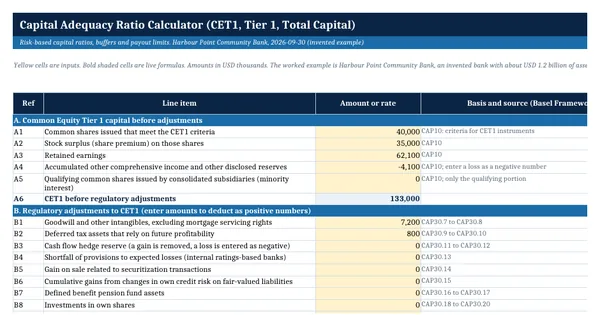
Capital Adequacy Ratio Calculator (CET1, Tier 1, Total Capital)
Basel Framework and BCBS 239
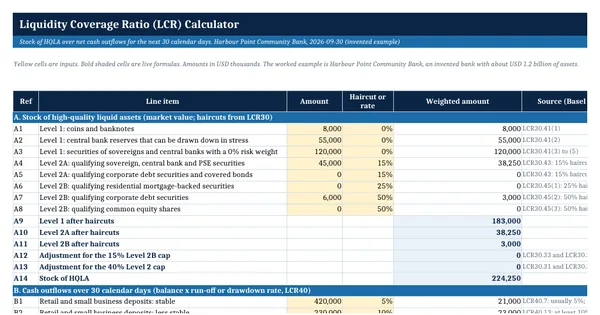
Liquidity Coverage Ratio (LCR) Calculator
Basel Framework and BCBS 239