
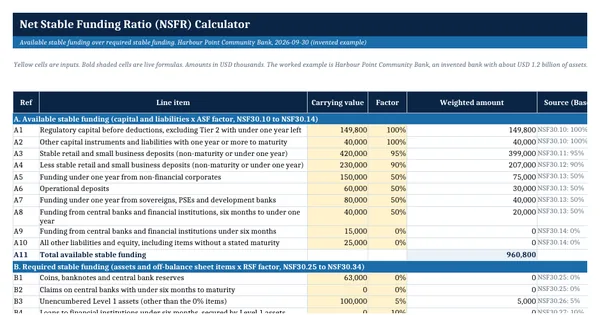
 Excel workbook preview
Net Stable Funding Ratio (NSFR) Calculator
3 free downloads per account. Just your email and a 6-digit code.
About this template
The net stable funding ratio tests whether a bank funds its long-term assets with funding that will still be there in a year. Treasurers and asset and liability managers use the NSFR calculation to show the board and examiners that loan growth is backed by stable deposits and capital rather than short-term wholesale money. This workbook gives that calculation a clear structure that a reviewer can follow line by line.
Each liability and capital item is weighted by its available stable funding factor and each asset and off-balance sheet item by its required stable funding factor, using chapter NSF30 of the Basel Framework. NSF20.2 defines the ratio and the 100 percent minimum. The workbook shows the ratio, the surplus stable funding and a quarterly trend, with every factor kept as an editable input.
Who it is for
The treasurer or ALM analyst who was asked to show how the bank's net stable funding ratio is calculated and how much stable funding headroom it has.
What is inside
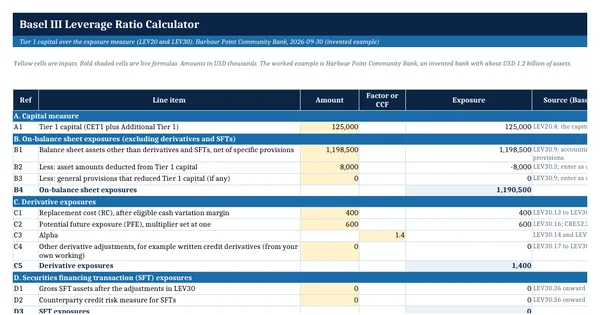
- NSFR Calculator sheet with 10 available stable funding lines and 22 required stable funding lines
- ASF factors from NSF30.10 to NSF30.14 and RSF factors from NSF30.25 to NSF30.34 pre-filled with paragraph references
- Maturity buckets (under 6 months, 6 months to 1 year, 1 year or more) built into the line items
- NSFR, surplus stable funding against the 100 percent minimum and against an internal floor, with status colors
- Quarterly Log sheet with 8 worked quarter-ends, 16 blank rows, a live status column and an ALCO review dropdown
- Input cell for the derivative liabilities add-on, which the Basel text leaves to national discretion
- Worked example for an invented USD 1.2 billion community bank, with a How to use sheet
How to use it
Map your balance sheet to the line items on the NSFR Calculator sheet, enter carrying values in the yellow cells and check the factors against your national rule.
Files
- XLSXnet-stable-funding-ratio-calculator.xlsx13 KB
Opens in Microsoft Word or Excel, Google Docs or Sheets, and LibreOffice. Built on free, official texts that anyone can read: laws, regulations, standards and guidance published by public bodies. A template to adapt, not legal, tax or accounting advice.
Questions about this template
How is the net stable funding ratio calculated?
The NSFR is available stable funding divided by required stable funding. NSF20.2 of the Basel Framework says the ratio should be at least 100 percent on an ongoing basis. Available stable funding weights capital and liabilities by how reliable they are over one year, and required stable funding weights assets by how hard they are to fund or sell.
What ASF factor applies to retail deposits?
Under NSF30.11 stable retail and small business deposits receive a 95 percent available stable funding factor. Under NSF30.12 less stable retail and small business deposits receive 90 percent. Funding from non-financial corporates with less than one year to maturity receives 50 percent under NSF30.13.
What RSF factor applies to residential mortgages?
Unencumbered residential mortgages with a residual maturity of one year or more and a risk weight of 35 percent or lower receive a 65 percent required stable funding factor under NSF30.30. Other performing loans of one year or more with a risk weight above 35 percent receive 85 percent under NSF30.31.