 Word document preview
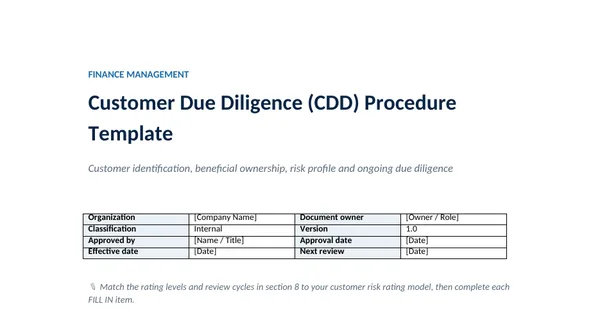
Customer Due Diligence (CDD) Procedure Template
3 free downloads per account. Just your email and a 6-digit code.
About this template
A customer due diligence procedure turns the AML policy into steps that onboarding and relationship staff follow for every customer. Examiners test it against the Customer Identification Program rule, the beneficial ownership rule and the ongoing due diligence requirement in the bank program rule. This template suits a community bank that has a policy but no written procedure, or one written before FinCEN's February 2026 order on beneficial ownership at new accounts.
The procedure covers when CDD applies, the identifying information to collect, documentary and non-documentary verification, beneficial owners, the nature and purpose of the relationship, risk rating levels, update triggers, what happens when CDD cannot be completed, and records. It rests on 31 CFR 1020.220, 1010.230 and 1020.210, FinCEN order FIN-2026-R001 and FATF Recommendation 10, all checked against the official text.
Who it is for
The onboarding manager or BSA Officer who has to show examiners a written, step by step CDD procedure behind the bank's AML policy.
What is inside
- 13 numbered sections from purpose and triggers to records and a roles table for 4 roles
- CIP table with the 4 minimum items of 31 CFR 1020.220 plus the bank's own standard, for individuals and legal entities
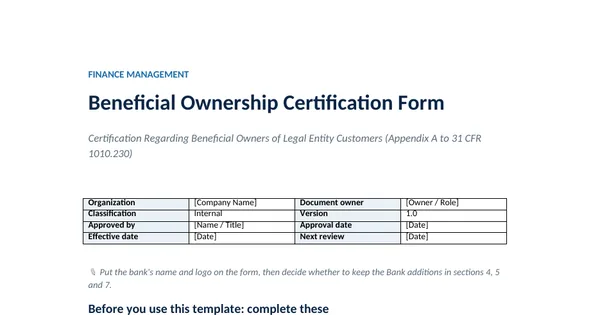
- Beneficial ownership steps with both prongs, exclusions and the FIN-2026-R001 relief
- Worked customer risk profile for a commercial customer with 7 fields
- Rating table setting due diligence, review cycle and approver for Low, Medium and High
- Trigger table with 6 update events, action, owner and timeframe
- Record retention rules from 31 CFR 1020.220 and 1010.230
- 6 item adoption checklist
How to use it
Match the rating levels and review cycles in section 8 to your customer risk rating model, then complete each FILL IN item.
Files
- DOCXcustomer-due-diligence-procedure-template.docx42 KB
Opens in Microsoft Word or Excel, Google Docs or Sheets, and LibreOffice. Built on free, official texts that anyone can read: laws, regulations, standards and guidance published by public bodies. A template to adapt, not legal, tax or accounting advice.
Questions about this template
What information must a bank collect before opening an account?
31 CFR 1020.220 requires at least the customer's name, date of birth for an individual, an address, and an identification number. For a U.S. person that is a taxpayer identification number. For a non-U.S. person it can be a taxpayer identification number, a passport number and country of issuance, an alien identification card number, or another government-issued document number.
Do banks still need beneficial ownership at every new account?
Not necessarily. FinCEN order FIN-2026-R001 of February 13, 2026 lets covered institutions identify and verify beneficial owners when a legal entity first opens an account, when facts call earlier information into question, and as their risk-based procedures require. When relying on earlier information, the customer confirms it is accurate and the bank records the confirmation.
What is the difference between CDD and EDD?
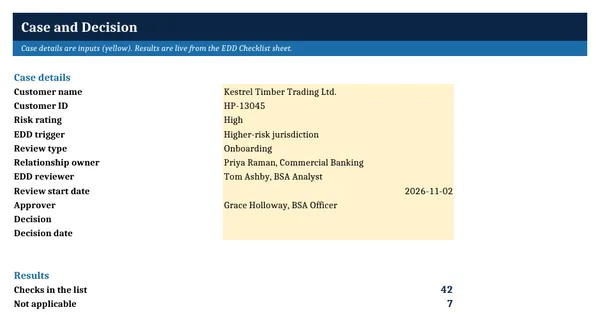
Customer due diligence is the standard set of steps for every customer: identity, beneficial owners, purpose of the relationship and ongoing monitoring. Enhanced due diligence adds deeper steps for higher-risk customers, such as source of wealth, senior management approval and closer monitoring, as FATF Recommendations 12, 13 and 19 describe for foreign PEPs, correspondent banking and higher-risk countries.