
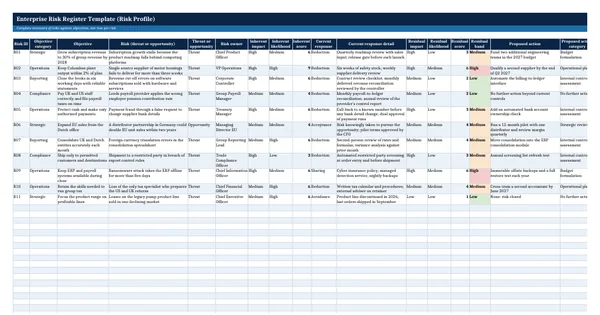
 Excel workbook preview
Enterprise Risk Register Template (Risk Profile)
3 free downloads per account. Just your email and a 6-digit code.
About this template
An enterprise risk register is the full inventory of the risks an organization has identified against its objectives. OMB Circular A-123 separates it from the risk profile, which is the prioritized list of the most significant risks that leadership reviews and approves. This workbook holds both. It is for the finance or risk lead who has to produce a credible register quickly, for a board meeting, an audit request or a strategic review.
The register follows the seven risk profile components listed in OMB Circular A-123: objectives, risk, inherent assessment, current response, residual assessment, proposed action and proposed action category. Impact and likelihood use the illustrative High, Medium and Low definitions from the Circular. Scores, bands, the formal control screen, the top 10 profile, the heat maps and the summary are all live formulas, so the workbook stays current as rows change.
Who it is for
The controller or risk lead who was asked by the board, the auditor or a new CFO for a current enterprise risk register and a prioritized risk profile.
What is inside
- Risk Register sheet with 11 worked Ashcombe Group risks and 20 blank formatted rows
- Columns for all seven risk profile components in OMB Circular A-123, from objective to proposed action category
- Live inherent and residual scores (impact x likelihood) and a High, Medium or Low band with colour
- Formal control screen formula that applies the A-123 criteria a formula can test
- Risk Profile sheet that ranks the top 10 open risks by residual score with INDEX and LARGE formulas
- Heat Map sheet with inherent and residual 3 x 3 counts, plus a Summary sheet by objective category
- Scales sheet with the A-123 illustrative impact and likelihood definitions and the four response types
- Dropdowns, overdue review highlighting, freeze panes, filters and print fit on every sheet
How to use it
Replace the Ashcombe Group sample rows with your own objectives and risks, then read the Risk Profile sheet.
Files
- XLSXenterprise-risk-register-template.xlsx22 KB
Opens in Microsoft Word or Excel, Google Docs or Sheets, and LibreOffice. Built on free, official texts that anyone can read: laws, regulations, standards and guidance published by public bodies. A template to adapt, not legal, tax or accounting advice.
Questions about this template
What is the difference between a risk register and a risk profile?
OMB Circular A-123 describes the risk profile as a prioritized inventory of the most significant risks identified and assessed, while a register is the complete inventory. In this workbook the Risk Register sheet holds every risk and the Risk Profile sheet ranks the ten most significant open risks by residual score, then inherent score.
How are the risk scores calculated?
Impact and likelihood are rated High, Medium or Low and converted to 3, 2 and 1. The score is impact multiplied by likelihood, from 1 to 9. A score of 6 or 9 is High, 3 or 4 is Medium and 1 or 2 is Low. The same scale is used for inherent and residual risk, as the Circular asks.
What does the formal control screen column do?
It flags risks that meet the A-123 criteria a formula can test: an operations, reporting or compliance objective, a reduction response, and at least medium impact and medium likelihood. Two criteria need judgment and are not tested: whether public reporting on the risk could cause harm, and whether control objectives can be clearly specified.