
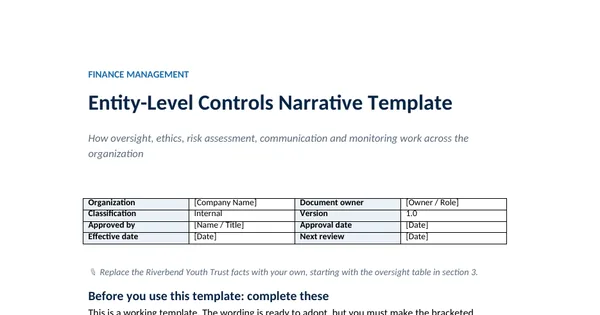
 Word document preview
Entity-Level Controls Narrative Template
3 free downloads per account. Just your email and a 6-digit code.
About this template
An entity-level controls narrative describes the controls that work across the whole organization rather than inside one transaction process: governance and oversight, the code of conduct, the risk assessment process, controls over management override, delegation of authority, communication, and monitoring. Auditors read it to understand the control environment before they test individual processes, and audit committees use it to see what they are overseeing.
This template is a completed narrative for an invented grant-funded nonprofit, organized by the five components and 17 principles of the 2025 revision of the GAO Green Book, the free federal internal control standard. It includes an oversight table, a risk assessment process that covers fraud, improper payments, information security and significant change, and a summary table of twelve entity-level controls with owner, frequency and evidence.
Who it is for
The finance director or controller of a nonprofit or local government who was asked by the auditor or the audit committee to describe the organization's entity-level controls in writing.
What is inside
- 11 numbered sections that follow the five components of the 2025 GAO Green Book
- Worked example for the invented Riverbend Youth Trust, a grant-funded nonprofit
- Oversight table: 4 governing and management bodies with membership, meetings and control duties
- Risk assessment narrative covering fraud, improper payment, information security and change risks
- Management override, delegation of authority and IT general controls described at entity level
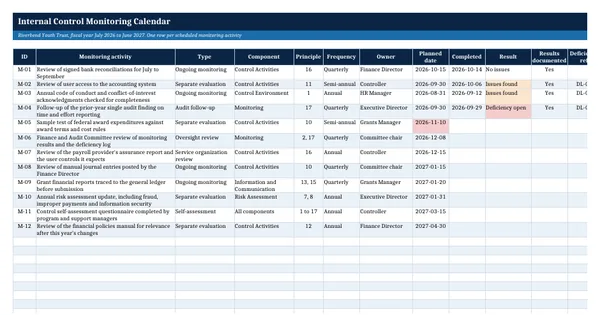
- Summary table of 12 entity-level controls with principle, owner, frequency and evidence
- Roles table and a before-you-use checklist with 7 items
How to use it
Replace the Riverbend Youth Trust facts with your own, starting with the oversight table in section 3.
Files
- DOCXentity-level-controls-narrative-template.docx42 KB
Opens in Microsoft Word or Excel, Google Docs or Sheets, and LibreOffice. Built on free, official texts that anyone can read: laws, regulations, standards and guidance published by public bodies. A template to adapt, not legal, tax or accounting advice.
Questions about this template
What are entity-level controls?
Entity-level controls are controls whose effect reaches across the whole internal control system rather than one process. The 2025 Green Book gives examples: controls over the risk assessment process, the control environment, service organizations, management override, and performance or analytical reviews (paragraph 10.16). A code of conduct, a delegation of authority and a board review of financial results are typical ones.
How are entity-level controls different from process-level controls?
Process-level controls, also called transaction controls, act directly on the transactions in one process, for example matching an invoice to a purchase order. Entity-level controls set the conditions in which every process runs and catch problems at a higher level, such as the monthly budget-to-actual review. Most organizations need both, at the level of precision their risks require.
Who should own the entity-level controls narrative?
The finance director or controller usually writes and maintains it, because most of the controls sit in or near finance. The governing body or its audit committee should review it, since several of the controls are its own oversight duties. It should be updated after significant changes in structure, systems, funding or key staff.