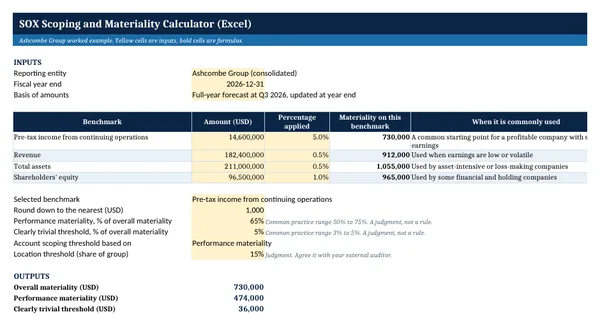
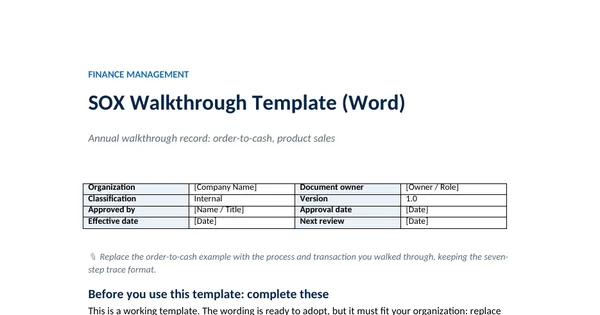
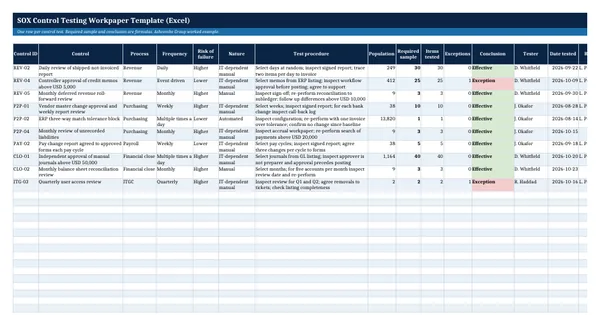
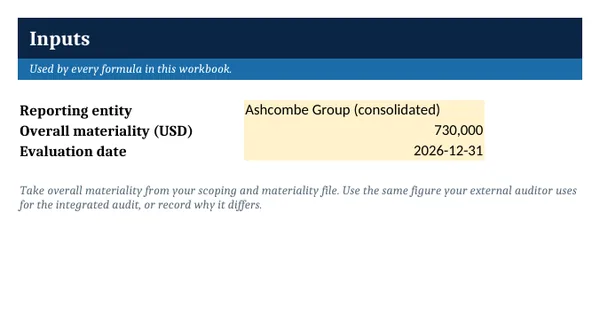
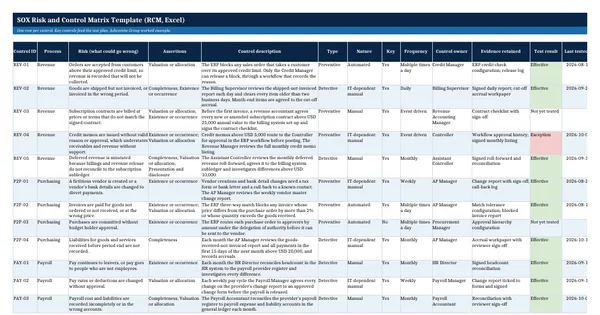
 Excel workbook preview
SOX Risk and Control Matrix Template (RCM, Excel)
3 free downloads per account. Just your email and a 6-digit code.
About this template
A risk and control matrix (RCM) is the central SOX workpaper. It lists, for each significant process, what could go wrong in the financial statements, the control that stops or finds it, and how that control is evidenced and tested. Management needs it to support the annual internal control assessment under section 404(a), and external auditors ask for it first when they plan their walkthroughs and testing.
This workbook holds 23 worked controls for an invented manufacturer and software company, spread over revenue, purchasing, payroll, the financial close and IT general controls. Each row links a risk to the financial statement assertions listed in PCAOB AS 2201 and records type, nature, key status, frequency, owner, evidence and the latest test result. Formulas flag overdue and failed tests, and two summary sheets count coverage by process and by assertion. The structure follows the top-down, risk-based approach in SEC Release 33-8810.
Who it is for
The controller or SOX lead who was asked by the external auditor or the audit committee for a current risk and control matrix and has only scattered spreadsheets.
What is inside
- 23 worked controls across five processes: revenue (5), purchasing (4), payroll (3), financial close (5) and ITGC (6)
- Each control maps a risk (what could go wrong) to one or more of the five financial statement assertions in PCAOB AS 2201.28
- Columns for control type, manual or automated nature, key control flag, frequency, owner and evidence retained
- Live days-to-next-test and status flag formulas that mark exceptions, overdue tests and untested controls in color
- 20 blank formatted rows with dropdowns for process, type, nature, key, frequency and test result
- Summary sheet with controls, key controls, effective, exceptions and percentage tested per process, all COUNTIFS
- Assertion coverage sheet that counts key controls per process and assertion, with zero-coverage cells highlighted
- How to use sheet, frozen header, filters and landscape print fit
How to use it
Replace the 23 sample controls with your own, keeping one row per control and one risk per row.
Files
- XLSXsox-risk-and-control-matrix-template.xlsx18 KB
Opens in Microsoft Word or Excel, Google Docs or Sheets, and LibreOffice. Built on free, official texts that anyone can read: laws, regulations, standards and guidance published by public bodies. A template to adapt, not legal, tax or accounting advice.
Questions about this template
What is a key control in a risk and control matrix?
A key control is a control that management relies on to address a risk of material misstatement for a relevant assertion, and so selects for testing. The SEC 2007 guidance lets management focus on the controls that adequately address financial reporting risks rather than every control in a process. Non-key controls can stay in the matrix for completeness but are not part of the test plan.
Which assertions should a SOX RCM use?
PCAOB AS 2201 lists five financial statement assertions: existence or occurrence, completeness, valuation or allocation, rights and obligations, and presentation and disclosure. This template uses those five. A company can use a different set if its controls still cover every risk that could cause a material misstatement, as the standard itself notes.
How often should the risk and control matrix be updated?
Update it whenever a process, system or owner changes, and review it in full at least once a year before the testing plan is set. SEC rules require management to evaluate changes in internal control each quarter, so many companies confirm the matrix with control owners at every quarter end and record the changes.