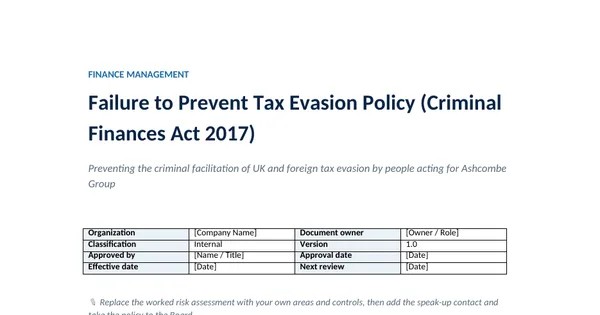
 Word document preview
Failure to Prevent Tax Evasion Policy (Criminal Finances Act 2017)
3 free downloads per account. Just your email and a 6-digit code.
About this template
Since 30 September 2017, a company or partnership commits a criminal offence if a person acting for it facilitates tax evasion, in the UK or abroad, and it had no reasonable procedures to prevent it. The Criminal Finances Act 2017 gives one defence: reasonable prevention procedures. Auditors, banks and large customers now ask suppliers for the policy that shows those procedures exist, and many finance teams find they never wrote one.
This policy sets out a zero tolerance statement, the offences in sections 44 to 46 in plain words, a documented risk assessment, due diligence by risk tier, warning signs, contract terms, reporting routes, training and monitoring. Its procedures follow the six guiding principles in the government guidance on the offences published on gov.uk, and the worked example is an invented manufacturer with a UK subsidiary and a Dutch sales office.
Who it is for
The compliance officer or finance director asked by the auditor, a bank or a large customer for the company's policy on preventing the facilitation of tax evasion.
What is inside
- 17 numbered sections, from purpose and scope to compliance, exceptions and review
- Plain summary of sections 44, 45 and 46 of the Criminal Finances Act 2017, with the defence and the penalty
- Three-stage table of the offence with an example from the group's own business
- Risk assessment table with 5 areas, inherent risk ratings and main controls
- Table mapping the six guiding principles in the government guidance to the group's procedures
- Three-tier due diligence table for associated persons, 5 warning signs and a contract clause
- Speak-up and self-reporting route, training, effectiveness monitoring and a roles table
How to use it
Replace the worked risk assessment with your own areas and controls, then add the speak-up contact and take the policy to the Board.
Files
- DOCXfailure-to-prevent-tax-evasion-policy.docx41 KB
Opens in Microsoft Word or Excel, Google Docs or Sheets, and LibreOffice. Built on free, official texts that anyone can read: laws, regulations, standards and guidance published by public bodies. A template to adapt, not legal, tax or accounting advice.
Questions about this template
What is the failure to prevent the facilitation of tax evasion offence?
Sections 45 and 46 of the Criminal Finances Act 2017 make a company or partnership guilty if an associated person, such as an employee, agent or contractor, criminally facilitates UK or foreign tax evasion while acting for it. The company itself does not need to have known. The penalty is an unlimited fine.
What are the six guiding principles?
The government guidance on the offences lists risk assessment, proportionality of risk-based prevention procedures, top level commitment, due diligence, communication including training, and monitoring and review. They are not prescriptive. Procedures should be proportionate to the risks the business actually faces.
Is there a defence to the offence?
Yes. The company has a defence if it can prove it had prevention procedures that were reasonable in all the circumstances, or that it was not reasonable to expect it to have any. The guidance says it will rarely be reasonable not to have carried out even a risk assessment.