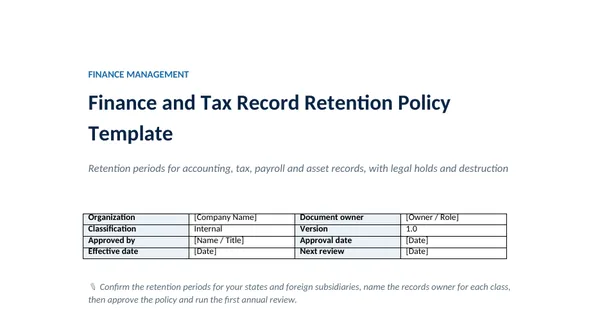
 Word document preview
Finance and Tax Record Retention Policy Template
3 free downloads per account. Just your email and a 6-digit code.
About this template
A record retention policy says how long each class of finance and tax record is kept, when the retention clock starts, and how records are destroyed once the period ends. Auditors, insurers and lenders ask for one, and it protects the company in both directions: records are there when the IRS or a court asks, and old records are not kept forever at cost and risk.
This policy builds its schedule on the IRS period of limitations table in Publication 583, the four-year rule for employment tax records, the asset rule that runs from disposal, and the Fair Labor Standards Act record rules in 29 CFR 516.5 and 516.6. It adds legal holds, electronic records, a destruction log and roles, with longer company periods clearly labelled.
Who it is for
The controller or office manager asked by the auditor, insurer or new CFO for a written rule on how long finance records are kept and when they may be destroyed.
What is inside
- 15 numbered sections, from purpose and scope to review
- Retention schedule table with 13 record classes, minimum periods and the basis for each
- IRS period of limitations table from Pub 583 (3, 6 and 7 years, and not limited)
- Trigger events table that says when each retention clock starts
- Legal hold rules that suspend destruction
- Electronic records rules drawn from the IRS description of machine-sensible records
- Destruction log table with 3 worked entries, plus a roles table and a 6-item checklist
How to use it
Confirm the retention periods for your states and foreign subsidiaries, name the records owner for each class, then approve the policy and run the first annual review.
Files
- DOCXfinance-and-tax-record-retention-policy-template.docx41 KB
Opens in Microsoft Word or Excel, Google Docs or Sheets, and LibreOffice. Built on free, official texts that anyone can read: laws, regulations, standards and guidance published by public bodies. A template to adapt, not legal, tax or accounting advice.
Questions about this template
How long should a business keep tax records?
IRS Publication 583 says to keep records that support income or deductions until the period of limitations for that return runs out. That is generally 3 years, 6 years if income over 25% of gross income was not reported, 7 years for a loss from worthless securities or a bad debt deduction, and without limit if no return or a fraudulent return was filed.
How long should payroll records be kept?
Publication 583 says employment tax records must be kept for at least 4 years after the date the tax becomes due or is paid, whichever is later. Under the Fair Labor Standards Act, 29 CFR 516.5 requires payroll records to be kept for at least 3 years, and 29 CFR 516.6 sets 2 years for time cards and wage rate tables.
What is a legal hold?
A legal hold is an instruction that stops the normal destruction of records when litigation, an audit or a government investigation is pending or reasonably expected. The policy makes the hold override every retention period until legal counsel releases it in writing, and requires the hold to be logged.