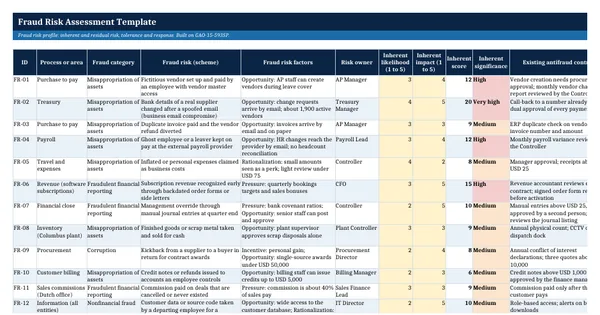
 Excel workbook preview
Fraud Risk Assessment Template
3 free downloads per account. Just your email and a 6-digit code.
About this template
A fraud risk assessment lists the ways fraud could hit an organization, rates how likely and how damaging each scheme is before and after existing controls, and records what management will do about the risks that remain too high. Auditors, audit committees, lenders and grantors ask for it because it shows that fraud risk is managed on purpose rather than discovered by accident. It is usually refreshed once a year and after a major change.
The workbook follows the Assess component of the GAO publication A Framework for Managing Fraud Risks in Federal Programs (GAO-15-593SP): identify inherent fraud risks, assess likelihood and impact on five-point scales, set a fraud risk tolerance, examine existing controls, prioritize residual risks and document the fraud risk profile. Scores, bands, the tolerance check, the heat map and the summary are all live formulas. The worked example covers 12 schemes at an invented manufacturing and software group.
Who it is for
The controller or internal control lead who was asked by the auditor or the audit committee for a documented fraud risk assessment and had none, or only an old one.
What is inside
- Fraud Risk Register with 12 worked fraud risks and 16 blank rows across four fraud categories
- Inherent and residual scores (likelihood x impact) with Very low to Very high bands, all formulas
- Tolerance check on every residual score; a risk accepted above tolerance turns red
- Response per risk (accept, reduce, share or avoid) with planned action, due date and live days to due
- Scales and Tolerance sheet with editable five-point scales, band thresholds and the tolerance cell
- Heat Map sheet counting residual and inherent risks in two 5 x 5 grids
- Summary by fraud category, by response, plus overdue actions and the average residual score
- Assessment Plan sheet with 9 planning items mapped to GAO leading practices 2.1 and 2.2
How to use it
Start on Assessment Plan, then replace the 12 Ashcombe Group risks in the Fraud Risk Register with the fraud schemes that fit your own processes.
Files
- XLSXfraud-risk-assessment-template.xlsx21 KB
Opens in Microsoft Word or Excel, Google Docs or Sheets, and LibreOffice. Built on free, official texts that anyone can read: laws, regulations, standards and guidance published by public bodies. A template to adapt, not legal, tax or accounting advice.
Questions about this template
What should a fraud risk assessment include?
At minimum, each fraud scheme that could affect the organization, the factors that make it possible, its owner, the likelihood and impact before controls, the existing antifraud controls, the likelihood and impact after them, and the response. GAO-15-593SP calls the documented result the fraud risk profile and adds a defined fraud risk tolerance, so it is clear which residual risks need more action.
What is the difference between inherent and residual fraud risk?
Inherent risk is the risk before any controls are considered. Residual risk is what remains after the existing control activities. The response is decided on the residual risk: within tolerance it may be accepted, above tolerance it is reduced, shared, for example through insurance, or avoided by stopping the activity.
How often should a fraud risk assessment be done?
GAO-15-593SP recommends regular intervals and an extra assessment when the program or operating environment changes. Most organizations refresh it once a year and again after an acquisition, a new system or payroll provider, a new incentive plan, entry into a new market or a detected fraud.