

 Excel workbook preview
GHG Protocol carbon accounting
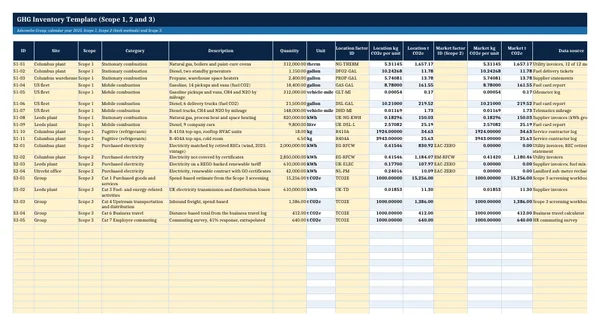
GHG Inventory Template (Scope 1, 2 and 3)
3 free downloads per account. Just your email and a 6-digit code.
About this template
A greenhouse gas inventory is the annual statement of the emissions an organisation causes, split into Scope 1 (its own fuel use, vehicles and refrigerant leaks), Scope 2 (purchased electricity and steam) and Scope 3 (its value chain). Lenders, large customers, auditors and boards now ask for one, often with little notice. This workbook gives a controller or finance manager a complete, structured inventory that can be filled in from invoices, fuel cards and the purchasing ledger.
The workbook follows the GHG Protocol Corporate Standard, Scope 2 Guidance and Scope 3 Standard, all free on ghgprotocol.org. Every factor is sourced from a public edition: the US EPA GHG Emission Factors Hub 2025, the UK DESNZ conversion factors 2025, the Green-e residual mix and the AIB European residual mix report. Scope 2 is reported both location-based and market-based, and the summary is built entirely from formulas.
Who it is for
The controller or sustainability lead asked by a lender, customer or the board for a full greenhouse gas inventory that does not exist yet.
What is inside
- Inventory sheet with 20 worked rows across Scope 1, 2 and 3 plus 20 blank formatted rows
- Scope 2 calculated twice per row: location-based and market-based factor IDs
- Factors sheet with 23 factors from EPA Hub 2025, DESNZ 2025, Green-e and AIB, each with table and edition
- Live CO2e from editable AR5 global warming potentials (CH4 28, N2O 265)
- Boundary sheet that switches between operational control, financial control and equity share
- Summary by scope, Scope 1 source type and all 15 Scope 3 categories
- Intensity per USD million and per employee, change against base year, share of estimated data
- Dropdowns, colour flags for estimates, drafts and missing market factors, print-ready
How to use it
Start on the Boundary sheet: pick your consolidation approach and list every entity and site.
Files
- XLSXghg-inventory-template.xlsx23 KB
Opens in Microsoft Word or Excel, Google Docs or Sheets, and LibreOffice. Built on free, official texts that anyone can read: laws, regulations, standards and guidance published by public bodies. A template to adapt, not legal, tax or accounting advice.
Questions about this template
What is the difference between location-based and market-based Scope 2?
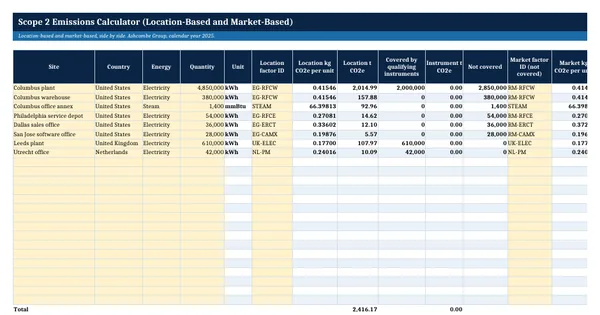
Location-based Scope 2 uses the average emission rate of the grid where the electricity is consumed. Market-based Scope 2 uses the emission rate of the electricity the company chose to purchase through certificates, contracts or supplier tariffs, and a residual mix factor for the rest. The GHG Protocol Scope 2 Guidance asks for both results when a company operates in markets that offer such instruments.
Which emission factors should I use for a US and UK business?
For US operations the free EPA GHG Emission Factors Hub covers fuels, vehicles, refrigerants and electricity by eGRID subregion. For UK operations the government's DESNZ conversion factors are published every June for the reporting year. Use the edition meant for your reporting year, record it in a factor register and keep one set of global warming potentials across the inventory.
Do I have to include Scope 3 in my first inventory?
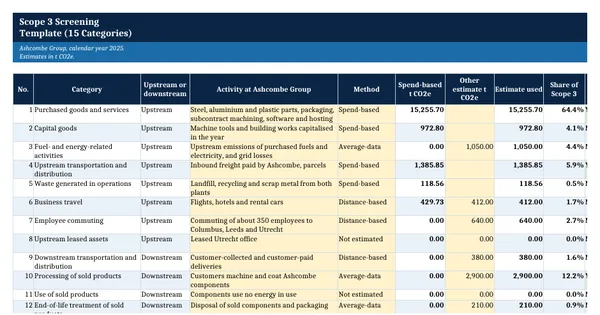
The GHG Protocol Corporate Standard requires Scope 1 and Scope 2, while Scope 3 is reported under its own standard. Many customers and lenders ask for Scope 3 anyway. A practical start is a screening of the 15 categories, then calculating the relevant ones, which is why this workbook takes Scope 3 results from a screening sheet as tonnes.
More GHG Protocol carbon accounting templates
GHG Protocol carbon accounting
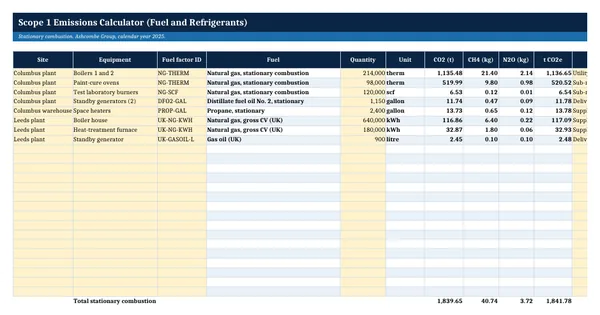
Scope 1 Emissions Calculator (Fuel and Refrigerants)
GHG Protocol carbon accounting
Scope 2 Emissions Calculator (Location-Based and Market-Based)
GHG Protocol carbon accounting
Scope 3 Screening Template (15 Categories)
GHG Protocol carbon accounting