

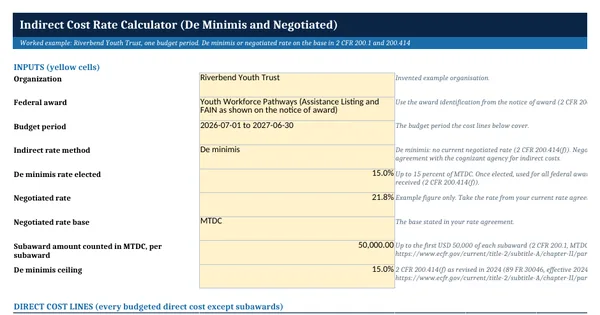
 Excel workbook preview
Indirect Cost Rate Calculator (De Minimis and Negotiated)
3 free downloads per account. Just your email and a 6-digit code.
About this template
An indirect cost rate calculation shows how much of the shared costs of running an organisation a federal award will carry. Funders, auditors and boards ask for it when a budget includes indirect costs and nobody can show how the figure was reached. Under the 2024 revision of 2 CFR 200, an organisation without a current negotiated rate may charge a de minimis rate of up to 15 percent of modified total direct costs, and an organisation with a negotiated rate applies that rate to the base its agreement states.
The workbook builds the modified total direct cost base line by line. Each direct cost line gets a cost type, and a lookup table based on the MTDC definition in 2 CFR 200.1 decides whether it counts in the base. Equipment, rental costs, participant support costs and similar items drop out, and only the first USD 50,000 of each subaward counts. The calculator then applies the elected de minimis rate, capped at the 15 percent ceiling in 2 CFR 200.414(f), or a negotiated rate, and a scenario sheet compares the options.
Who it is for
The grants manager or controller asked by a funder, a board member or the auditor to show how the indirect costs in a federal budget were worked out.
What is inside
- Calculator sheet with 9 input cells in the Inputs block, 11 worked direct cost lines and 16 blank lines
- MTDC treatment looked up live for every line from a 14-row Cost Type Rules sheet based on the 2 CFR 200.1 definition
- Subaward table that counts only the first USD 50,000 of each subaward in the base, 2 worked subawards
- 13 live result formulas: total direct costs, MTDC base, excluded costs, base used, rate applied, indirect costs and total project cost
- Choice of de minimis rate (capped at the 15 percent ceiling) or a negotiated rate on an MTDC, salaries, salaries plus fringe or total direct cost base
- Scenario Comparison sheet with 4 scenarios, the difference against the selected method and a red flag above the ceiling
- Every input cell marked yellow, with the regulation section and a verify-before-use link next to it
- How to use sheet that explains the calculation step by step
How to use it
Enter your direct cost lines and subawards on the Calculator sheet, then pick the de minimis or negotiated method.
Files
- XLSXindirect-cost-rate-calculator.xlsx15 KB
Opens in Microsoft Word or Excel, Google Docs or Sheets, and LibreOffice. Built on free, official texts that anyone can read: laws, regulations, standards and guidance published by public bodies. A template to adapt, not legal, tax or accounting advice.
Questions about this template
What is the de minimis indirect cost rate under the Uniform Guidance?
Under 2 CFR 200.414(f) as revised in 2024, a recipient or subrecipient without a current negotiated rate, including a provisional rate, may elect to charge up to 15 percent of modified total direct costs. No documentation is needed to justify it and it may be used indefinitely, but once elected it applies to all federal awards until the organisation chooses to negotiate a rate.
Which costs are excluded from modified total direct costs?
The MTDC definition in 2 CFR 200.1 excludes equipment, capital expenditures, charges for patient care, rental costs, tuition remission, scholarships and fellowships, participant support costs, and the portion of each subaward above USD 50,000. Other items can be excluded only to avoid a serious inequity and with the approval of the cognizant agency for indirect costs.
Can a funder force us to use a lower rate than our negotiated rate?
Section 200.414 says negotiated rates must be accepted by all federal agencies, and an agency may use a different rate only when a federal statute or regulation requires it or when the awarding agency approves it under the conditions in that section. Check the funding notice and the award terms, because a statutory cap on a specific program can apply.
More Uniform Guidance (2 CFR 200) templates
Uniform Guidance (2 CFR 200)
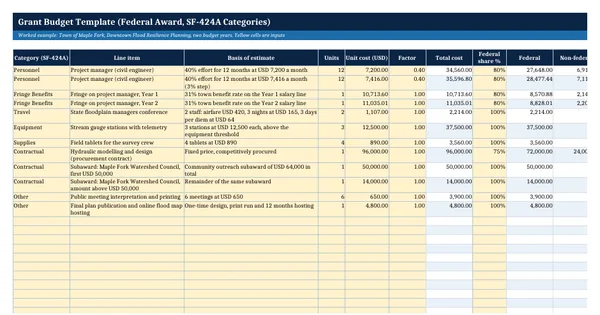
Grant Budget Template (Federal Award, SF-424A Categories)
Uniform Guidance (2 CFR 200)
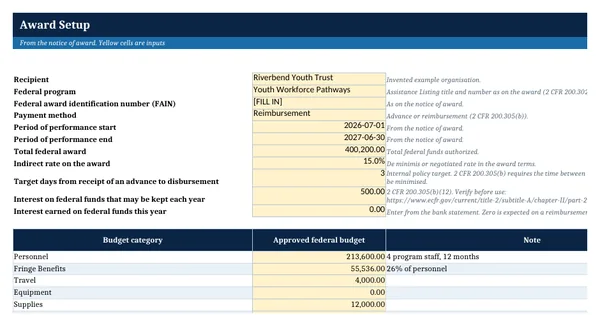
Grant Drawdown and Expenditure Tracker
Uniform Guidance (2 CFR 200)
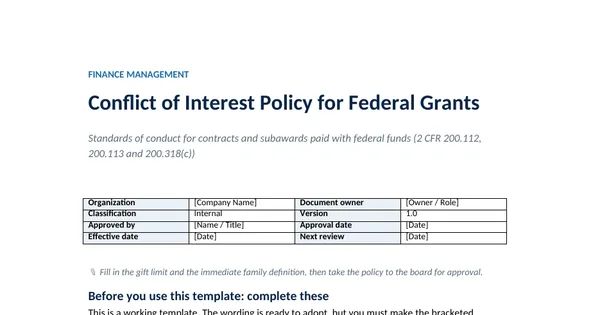
Conflict of Interest Policy for Federal Grants
Uniform Guidance (2 CFR 200)