

 Word document preview
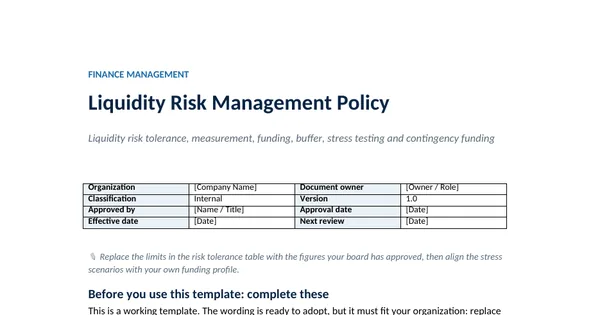
Liquidity Risk Management Policy
3 free downloads per account. Just your email and a 6-digit code.
About this template
A liquidity risk management policy sets how much liquidity risk a bank will accept and how it measures, limits and responds to it. Examiners ask for it in every safety and soundness review, and boards are expected to approve it at least once a year. This template is for the treasurer or chief risk officer who needs a current policy that matches how the bank actually manages its funding.
The policy rests on the Basel Committee's Principles for Sound Liquidity Risk Management and Supervision (2008) and the liquidity monitoring tools in chapter SRP50 of the Basel Framework, both free on bis.org. It covers risk tolerance, governance, cash flow projections, funding concentration, the liquidity buffer, collateral, intraday liquidity, stress testing, contingency funding and internal pricing, with worked tables for an invented community bank.
Who it is for
The treasurer or chief risk officer of a bank who was asked by the examiner or the board for a current, board-approved liquidity risk policy.
What is inside
- 17 numbered sections, from policy statement and risk tolerance through funding, buffer, intraday, stress testing and review
- Risk tolerance table with 8 limits and early-warning triggers
- Stress scenario table for institution-specific, market-wide and combined stress
- Contingency funding stage table with triggers, actions and decision-makers
- Built on the 17 BCBS Principles for Sound Liquidity Risk Management and Supervision (2008) and SRP50
- Roles table for the board, ALCO, treasurer, chief risk officer and internal audit
- Compliance, exceptions and annual review sections, plus a checklist of decisions to make
How to use it
Replace the limits in the risk tolerance table with the figures your board has approved, then align the stress scenarios with your own funding profile.
Files
- DOCXliquidity-risk-management-policy.docx41 KB
Opens in Microsoft Word or Excel, Google Docs or Sheets, and LibreOffice. Built on free, official texts that anyone can read: laws, regulations, standards and guidance published by public bodies. A template to adapt, not legal, tax or accounting advice.
Questions about this template
What should a liquidity risk management policy include?
It should set the board's liquidity risk tolerance and limits, assign roles, describe how cash flows and metrics are measured, set funding diversification and concentration rules, define the liquidity buffer and collateral management, cover intraday liquidity, stress testing and the contingency funding plan, and say how liquidity costs enter internal pricing and new product approval.
How often must the board approve the liquidity policy?
Principle 3 of the Basel Committee's 2008 liquidity principles says the board should review and approve the strategy, policies and practices for liquidity at least once a year. Your national rules or supervisor may add their own expectation, so record the approval date and the next review date in the document control box.
What is a contingency funding plan?
It is the part of the liquidity framework that says what the bank does when funding comes under stress. Principle 11 of the 2008 principles calls for a formal plan with clear lines of responsibility, invocation and escalation procedures, and regular testing. The policy sets the stages and triggers, and a separate plan holds the detailed actions.
More Basel Framework and BCBS 239 templates
Basel Framework and BCBS 239
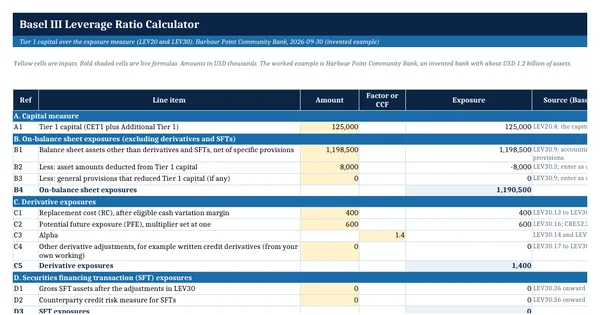
Basel III Leverage Ratio Calculator
Basel Framework and BCBS 239
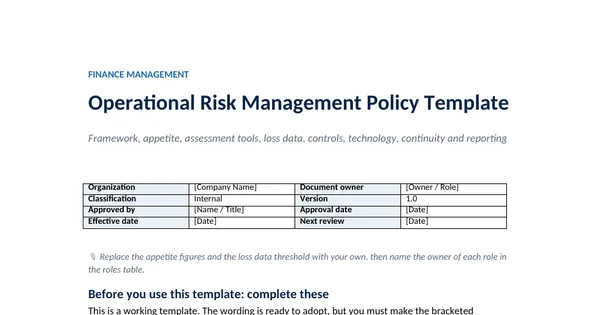
Operational Risk Management Policy Template
Basel Framework and BCBS 239
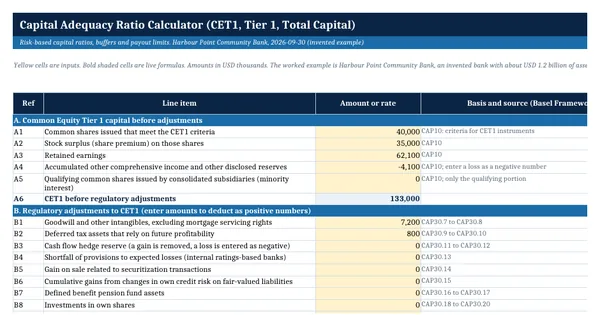
Capital Adequacy Ratio Calculator (CET1, Tier 1, Total Capital)
Basel Framework and BCBS 239