

 Word document preview
Model risk management (SR 26-2)
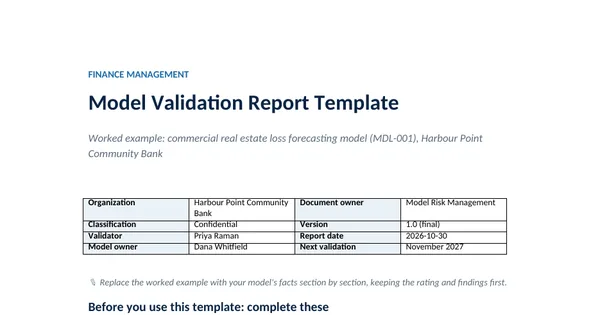
Model Validation Report Template
3 free downloads per account. Just your email and a 6-digit code.
About this template
A model validation report records whether a model is fit for its intended use, what limits apply to it and what the owner must fix. The model owner, the risk committee, internal audit and examiners all read it, usually starting with the rating and the findings. It is needed after every full validation, revalidation or validation of a material change.
This template is a complete worked report for the commercial real estate loss model of an invented community bank. It covers conceptual soundness, data and input tests, outcomes analysis with five years of back-testing, a review of ongoing monitoring, rated findings with owners and dates, conditions of use and sign-off. The structure follows the validation components in the April 2026 interagency Supervisory Guidance on Model Risk Management (SR 26-2).
Who it is for
The validator or model risk manager who must write up an independent model validation for the model owner, the risk committee and the examiner.
What is inside
- 11 numbered sections in the order a validation report is read, starting with the rating
- Worked example: the commercial real estate loss model of an invented USD 1.2 billion bank
- Key facts table with rating, tier, validator, validation type and next validation date
- Data tests table for 5 inputs and a 5-year back-testing table of forecast against actual loss rates
- Ongoing monitoring review table with 5 metrics, thresholds and status
- Findings table with 5 findings, severity, action, owner and due date, plus conditions of use
- Sign-off table for validator, model risk manager, model owner and CRO
- Covers the three validation components named in the April 2026 interagency guidance (SR 26-2)
How to use it
Replace the worked example with your model's facts section by section, keeping the rating and findings first.
Files
- DOCXmodel-validation-report-template.docx42 KB
Opens in Microsoft Word or Excel, Google Docs or Sheets, and LibreOffice. Built on free, official texts that anyone can read: laws, regulations, standards and guidance published by public bodies. A template to adapt, not legal, tax or accounting advice.
Questions about this template
What are the components of model validation?
The April 2026 interagency guidance names three: conceptual soundness, which assesses design, assumptions, judgments, data selection and developmental testing; outcomes analysis, which compares model output with real outcomes; and ongoing monitoring, which checks that the model still performs as expected as products, data and markets change.
Who can validate a model?
People with the expertise to analyze the model, enough independence to stay objective and the standing to bring about change. They can be internal staff or an outside firm. The guidance stresses that the quality of validation depends on the rigor of the review, not on where the function sits in the organization chart.
Can a model be used before validation is complete?
The guidance accepts that an urgent business need may require it. In that case sound practice is to pay closer attention to the model's limitations, tell the people who rely on it about them and add controls, such as limits on use or closer performance monitoring, until validation is done.
More Model risk management (SR 26-2) templates
Model risk management (SR 26-2)
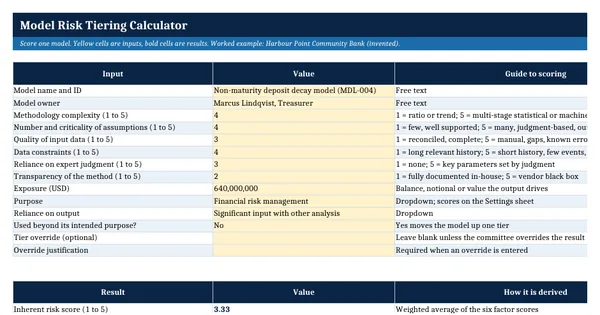
Model Risk Tiering Calculator
Model risk management (SR 26-2)
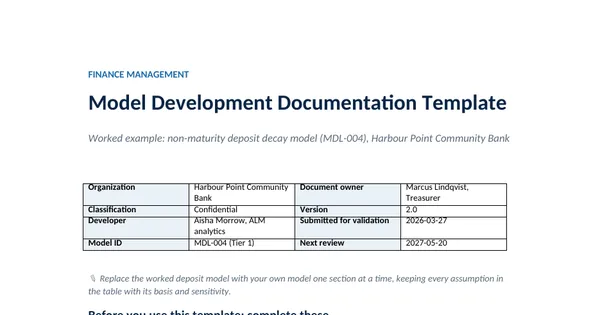
Model Development Documentation Template
Model risk management (SR 26-2)
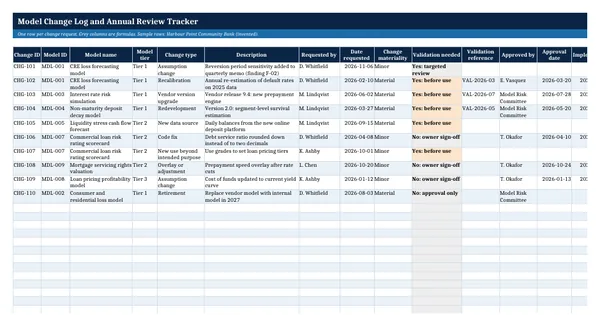
Model Change Log and Annual Review Tracker
Basel Framework and BCBS 239