 Word document preview
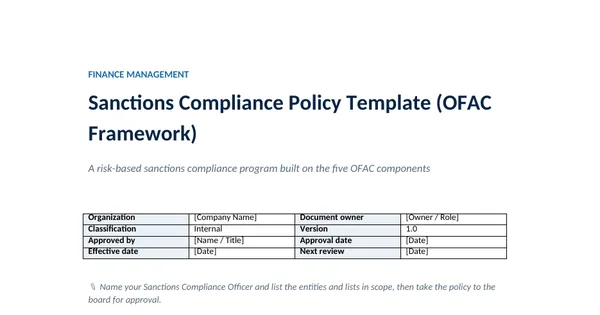
Sanctions Compliance Policy Template (OFAC Framework)
3 free downloads per account. Just your email and a 6-digit code.
About this template
A sanctions compliance policy is the board-approved document that says how an organization avoids dealing with sanctioned people, companies and places. Banks ask for it during onboarding, auditors ask for it when payments cross borders, and buyers of a business ask for it in due diligence. OFAC does not require a formal program, but it treats the absence of one as a root cause in many enforcement cases.
This template follows the five essential components in OFAC's A Framework for OFAC Compliance Commitments: management commitment, risk assessment, internal controls, testing and auditing, and training. It adds the reporting and recordkeeping rules in 31 CFR part 501 and the UK reporting duty described in OFSI guidance on gov.uk. The worked example is an invented group with US, UK and Dutch entities.
Who it is for
The CFO or compliance lead who was asked by the bank, the auditor or the board for a written sanctions policy and found none.
What is inside
- Policy built on the five components OFAC names: management commitment, risk assessment, internal controls, testing and auditing, training
- Regimes table covering US (OFAC), UK (OFSI and the UK Sanctions List) and EU lists for a group with US, UK and Dutch entities
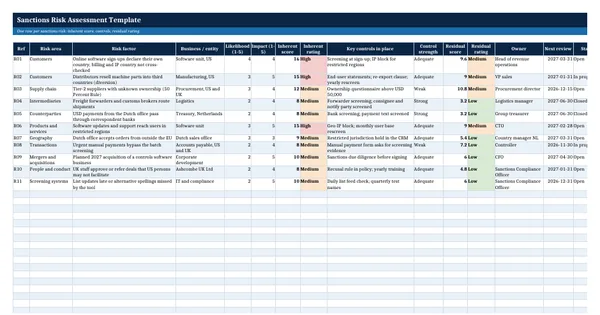
- Risk profile table with 6 worked risk areas, ratings and key controls
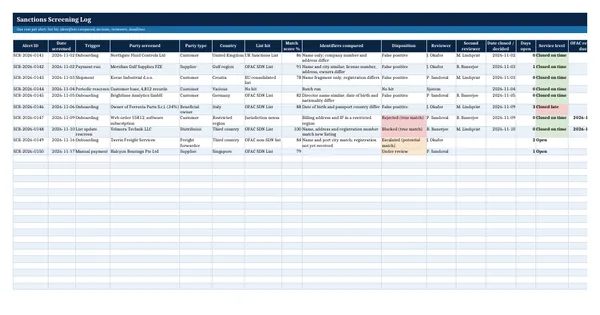
- Controls table with 7 screening and reporting controls, timing, owner and record kept
- Training table with 4 audiences, content, frequency and assessment
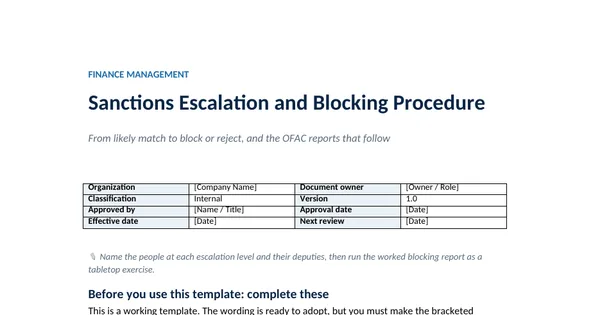
- Reporting rules from 31 CFR 501.603, 501.604 and 501.601 (10 business days, 10-year records)
- Roles table with 7 roles, plus compliance, exceptions and review sections
- Checklist of 7 adoption decisions and a document control box
How to use it
Name your Sanctions Compliance Officer and list the entities and lists in scope, then take the policy to the board for approval.
Files
- DOCXsanctions-compliance-policy-template.docx42 KB
Opens in Microsoft Word or Excel, Google Docs or Sheets, and LibreOffice. Built on free, official texts that anyone can read: laws, regulations, standards and guidance published by public bodies. A template to adapt, not legal, tax or accounting advice.
Questions about this template
What are the five components of an OFAC sanctions compliance program?
OFAC's 2019 framework names five essential components: management commitment, risk assessment, internal controls, testing and auditing, and training. Each program should be risk based and fit the organization's size, products, customers, counterparties and locations. This policy has one section for each component, so a reviewer can trace every commitment back to the framework.
Is a sanctions compliance program required by law?
OFAC regulations do not require a formal program, according to the framework itself. However, OFAC considers whether an effective program existed when it decides how to respond to an apparent violation, and it lists the lack of a formal program as a root cause in many past cases. Banks and acquirers also commonly expect one.
How fast must blocked property be reported to OFAC?
Under 31 CFR 501.603, an initial report of blocked property is due within 10 business days from the date the property becomes blocked, filed through the OFAC Reporting System. Rejected transactions are reported within 10 business days under 501.604, and an annual report of blocked property held on June 30 is due by September 30.