

 Word document preview
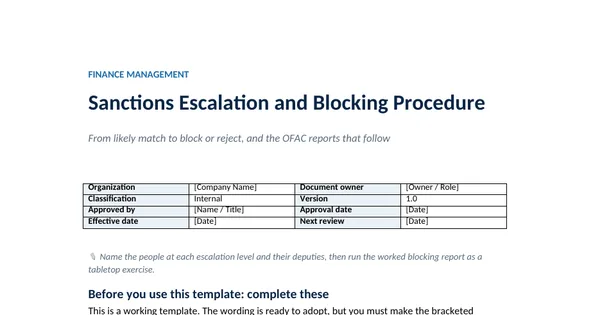
Sanctions Escalation and Blocking Procedure
3 free downloads per account. Just your email and a 6-digit code.
About this template
An escalation and blocking procedure covers the moment a screening alert stops being routine: who looks next, who decides whether to block or reject, and which reports go to OFAC by when. Examiners ask for it because the deadlines are short and the decision cannot wait for the one person who knows the rules.
This template is written for an invented community bank. It sets four escalation levels, the block or reject decision, the handling of blocked funds, and a reporting calendar taken from 31 CFR 501.603 and 501.604: initial blocking and rejected transaction reports within 10 business days, and the annual report of blocked property as of June 30, due by September 30.
Who it is for
The BSA/OFAC officer at a bank who has to show examiners what happens, hour by hour, after a screening alert turns into a likely match.
What is inside
- Escalation matrix with 4 levels, triggers, time limits and decision rights
- Block, reject or release decision rules in plain words
- Blocking steps including the blocked, interest-bearing account and customer communication
- Worked initial blocking report covering all 9 required items of 31 CFR 501.603(b)(1)(ii)
- Reporting calendar with 5 OFAC reports, rule, deadline and channel
- Records rule from 31 CFR 501.601 and reports on demand under 501.602
- Roles table with 6 roles and a checklist of 6 adoption decisions
How to use it
Name the people at each escalation level and their deputies, then run the worked blocking report as a tabletop exercise.
Files
- DOCXsanctions-escalation-and-blocking-procedure.docx40 KB
Opens in Microsoft Word or Excel, Google Docs or Sheets, and LibreOffice. Built on free, official texts that anyone can read: laws, regulations, standards and guidance published by public bodies. A template to adapt, not legal, tax or accounting advice.
Questions about this template
What is the difference between blocking and rejecting a transaction?
Blocking freezes property in which a blocked person has an interest: the funds are held, not returned. Rejecting applies when processing the transaction would violate OFAC rules but no blocked person's property is involved, so the transaction is refused. Both are reported to OFAC within 10 business days, under 31 CFR 501.603 and 501.604 respectively.
What must an initial blocking report to OFAC contain?
31 CFR 501.603(b)(1)(ii) lists nine items, including the holder's details and contact, the transaction and its parties, the sanctions target, the property and its location, the blocking date, the value in US dollars, the action taken, the legal authority and copies of the payment documents. The regulation notes that SDN alone is not a legal authority.
How long must records of blocked property be kept?
Under 31 CFR 501.601, records of blocked property must be available for examination for as long as the property is blocked and for at least 10 years after it is unblocked. Records of other transactions subject to OFAC rules are kept for at least 10 years after the transaction.
More Sanctions compliance (OFAC) templates
Sanctions compliance (OFAC)
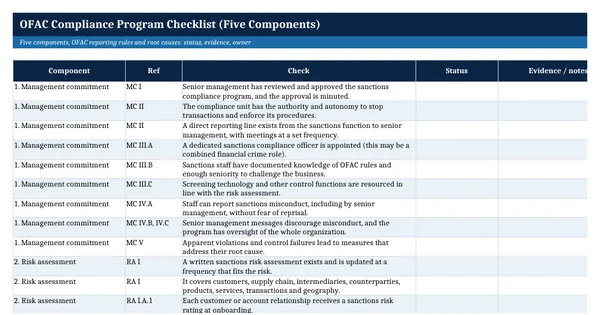
OFAC Compliance Program Checklist (Five Components)
Basel Framework and BCBS 239
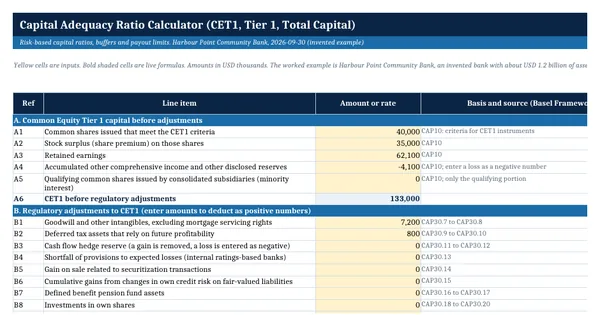
Capital Adequacy Ratio Calculator (CET1, Tier 1, Total Capital)
Basel Framework and BCBS 239
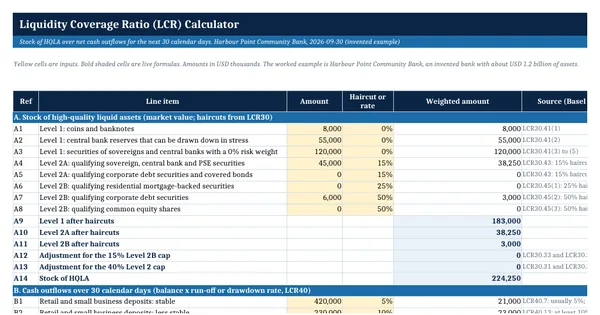
Liquidity Coverage Ratio (LCR) Calculator
Basel Framework and BCBS 239