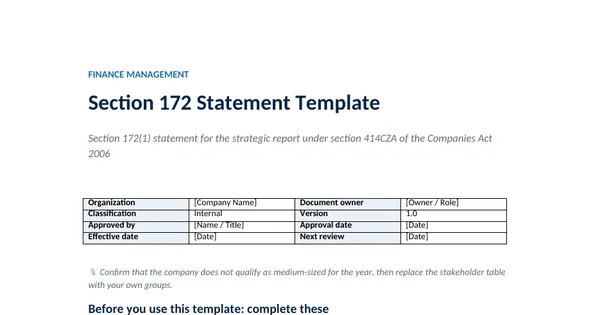
 Word document preview
UK Corporate Governance Code and FRS 102
Section 172 Statement Template
3 free downloads per account. Just your email and a 6-digit code.
About this template
Section 414CZA of the Companies Act 2006 requires the strategic report of a company that does not qualify as medium-sized to include a section 172(1) statement. The statement describes how the directors had regard to the matters in section 172(1)(a) to (f), such as the long-term consequences of decisions, employees, business relationships, the community and the environment, when performing their duty to promote the success of the company. Unquoted companies also publish it on a website under section 426B.
This template is a complete statement for an invented large private company, Ashcombe Manufacturing UK Limited. It covers the directors' duty, the stakeholder groups and how the company engaged with them, what the directors did on each matter in section 172(1), three principal decisions with their trade-offs, and the basis of preparation and publication. The legal points are summarised in our own words from the Companies Act 2006 on legislation.gov.uk.
Who it is for
The finance director or company secretary of a large UK company who must include a section 172(1) statement in the strategic report and has no current draft.
What is inside
- 9 numbered sections forming a complete statement for a large private company for the year ended 31 December 2026
- Stakeholder table with 6 stakeholder groups, what matters to them, how the company engaged and what reached the board
- Table covering each of the 6 matters in section 172(1)(a) to (f) with what the directors did
- 3 principal decisions written up with the stakeholders affected, the trade-offs and the outcome
- Basis of preparation covering sections 414CZA, 465 to 467 and 426B of the Companies Act 2006
- Medium-sized company thresholds shown with a verify-before-use note and the legislation.gov.uk source
How to use it
Confirm that the company does not qualify as medium-sized for the year, then replace the stakeholder table with your own groups.
Files
- DOCXsection-172-statement-template.docx41 KB
Opens in Microsoft Word or Excel, Google Docs or Sheets, and LibreOffice. Built on free, official texts that anyone can read: laws, regulations, standards and guidance published by public bodies. A template to adapt, not legal, tax or accounting advice.
Questions about this template
Which companies need a section 172 statement?
Section 414CZA of the Companies Act 2006 requires the statement in the strategic report of every company that prepares one, unless the company qualifies as medium-sized for that financial year under sections 465 to 467. A company entitled to the small companies exemption in section 414B prepares no strategic report at all. A public company cannot be treated as medium-sized under section 467. It has applied to financial years beginning on or after 1 January 2019.
Does the statement have to be on the website?
For an unquoted company, yes. Section 426B requires the statement to be made available on a website that the company maintains and that identifies it, free of charge, as soon as reasonably practicable, and kept there until the next year's statement is published. An officer in default commits an offence. Quoted companies already publish the whole annual report online.
What makes a good section 172 statement?
A good statement is specific to the year. It names the stakeholder groups that matter to the business, shows how the board heard from them, and explains a few principal decisions, including the trade-offs between groups and the outcome. Generic lists of stakeholders and engagement methods with no decisions attached tell the reader little about how the board actually worked.