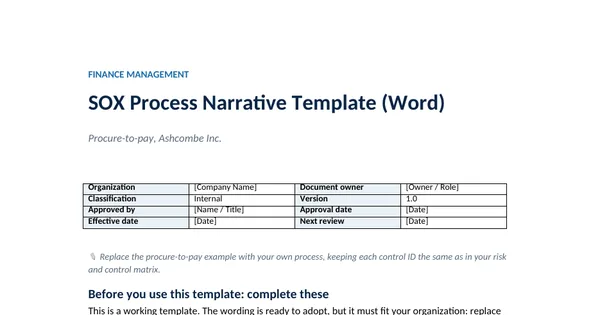
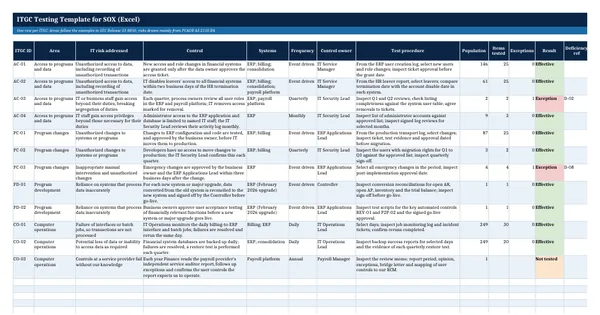
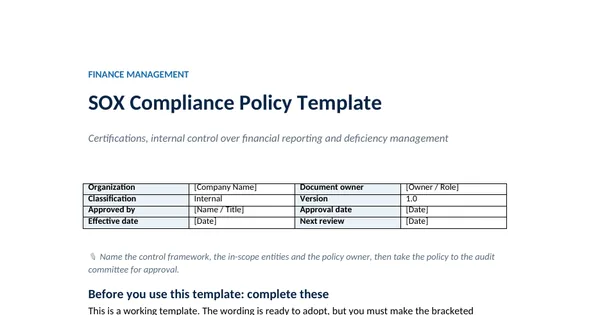
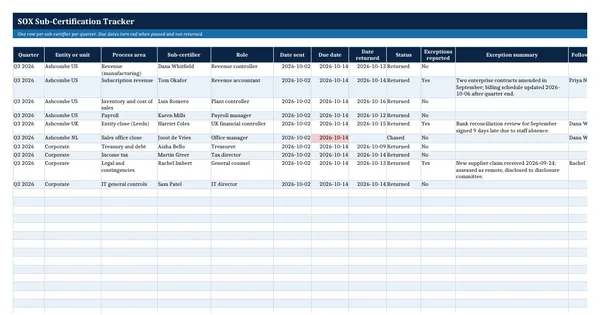
 Excel workbook preview
SOX Control Deficiency Evaluation Template
3 free downloads per account. Just your email and a 6-digit code.
About this template
Every control deficiency found during the year must be evaluated for severity. SEC rules define a material weakness and a significant deficiency, and management cannot conclude that internal control over financial reporting is effective if a material weakness exists at year end. Significant deficiencies and material weaknesses are also reported to the auditor and the audit committee under the section 302 certification rules. A structured evaluation file makes these conclusions consistent and reviewable.
This workbook logs each deficiency with its account, assertion, amount exposed, likelihood, compensating control and any indicator of a material weakness. A formula proposes a preliminary classification and management records the final one with a reason. An aggregation sheet totals open deficiencies by account and assertion so that combinations are not missed. The definitions come from 17 CFR 210.1-02 and the severity factors from SEC Release 33-8810 and PCAOB AS 2201.
Who it is for
The controller or SOX lead who must classify this year's control deficiencies, aggregate them and bring a defensible summary to the audit committee.
What is inside
- Deficiency log with 9 worked deficiencies and 20 blank formatted rows
- Exposure to materiality ratio and a preliminary classification formula, with a separate final classification chosen by management
- Dropdowns for the four indicators of a material weakness from SEC Release 33-8810 and for compensating control precision
- Aggregation sheet that sums open exposure by account and by assertion and flags combinations to evaluate
- Classification counts for preliminary and final results, with the two compared
- Definitions sheet with the SEC wording of material weakness and significant deficiency and the severity factors
- Overdue remediation dates turn red until the deficiency is closed
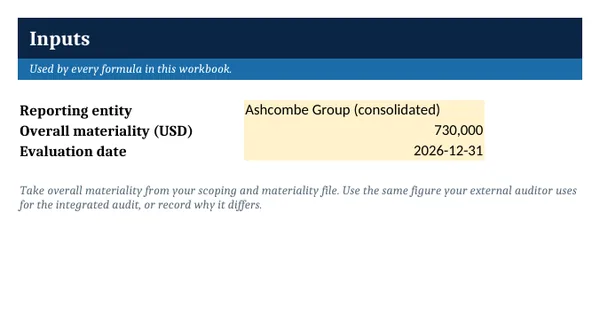
- Inputs sheet for overall materiality and the evaluation date, used by every formula
How to use it
Enter overall materiality on the Inputs sheet, then log each deficiency with its control, account, assertion and amount exposed.
Files
- XLSXsox-control-deficiency-evaluation-template.xlsx19 KB
Opens in Microsoft Word or Excel, Google Docs or Sheets, and LibreOffice. Built on free, official texts that anyone can read: laws, regulations, standards and guidance published by public bodies. A template to adapt, not legal, tax or accounting advice.
Questions about this template
What is the difference between a significant deficiency and a material weakness?
Under SEC rules a material weakness is a deficiency, or combination of deficiencies, that gives a reasonable possibility that a material misstatement of the annual or interim financial statements will not be prevented or detected on a timely basis. A significant deficiency is less severe than that, yet important enough to merit attention by those responsible for oversight of financial reporting.
Do control deficiencies have to be aggregated?
Yes. SEC Release 33-8810 and PCAOB AS 2201 both say that several deficiencies affecting the same account, disclosure, assertion or component of internal control can together be a material weakness even when each one alone is less severe. The aggregation sheet in this template groups open deficiencies by account and by assertion for that reason.
Does a material weakness require an actual misstatement?
No. The severity of a deficiency depends on whether there is a reasonable possibility that controls will fail to prevent or detect a misstatement, and on the size of the potential misstatement. It does not depend on whether an error actually occurred. A material weakness can exist even when the financial statements are not materially misstated.