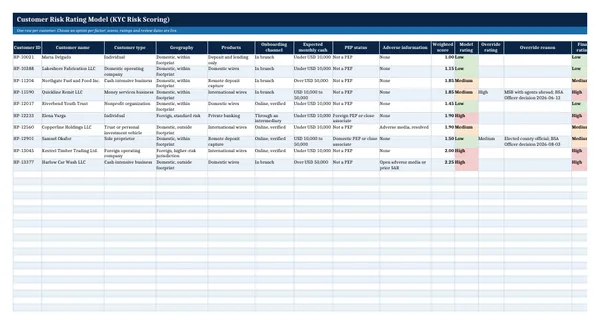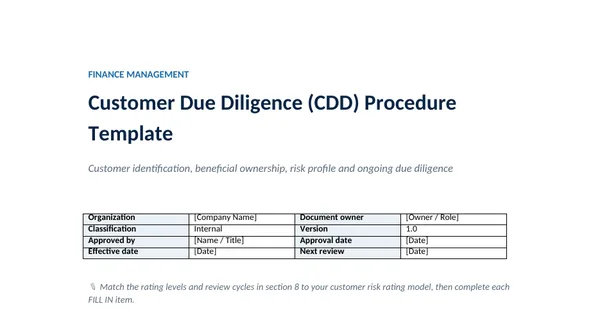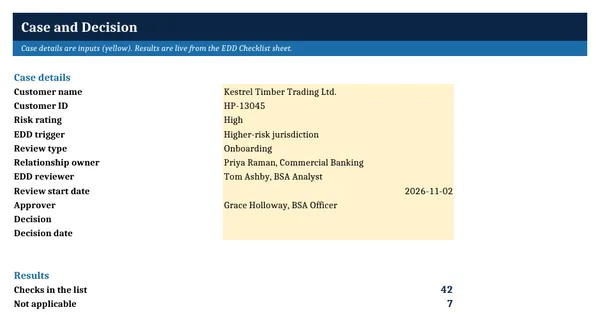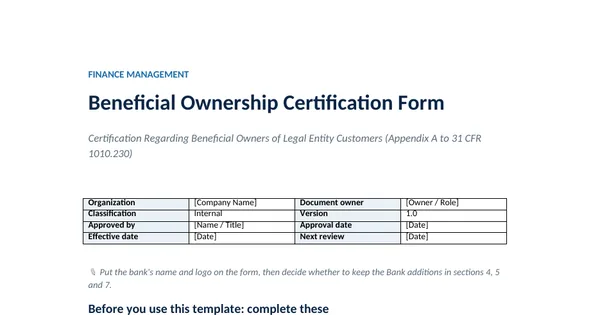

 Excel workbook preview
AML Risk Assessment Template (Enterprise-Wide)
3 free downloads per account. Just your email and a 6-digit code.
About this template
An enterprise-wide AML risk assessment shows where a bank is exposed to money laundering, terrorist financing and sanctions evasion, how well its controls work, and what risk remains. Examiners read it first, because the rest of the program should follow from it. This workbook suits a BSA Officer preparing the annual assessment for the board, or updating it after a new product, a merger or a new market.
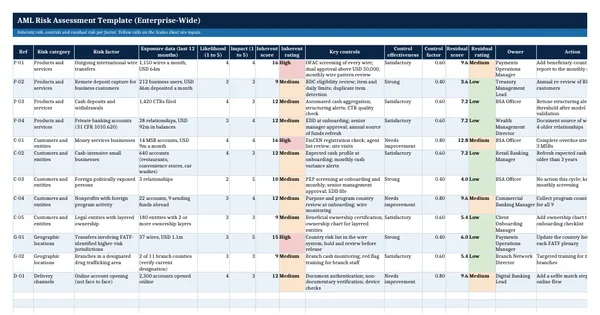
Each risk factor carries exposure data, a likelihood and impact score, key controls, a control effectiveness rating and a residual score that recalculates as you type. The categories follow the products, services, customers and geographic locations approach of the FFIEC BSA/AML Examination Manual, with delivery channels added in line with FATF Recommendations 1 and 15. A summary sheet rolls the results up per category.
Who it is for
The BSA Officer who must give the board an annual enterprise-wide money laundering risk assessment and has only last year's narrative.
What is inside
- Risk Assessment sheet with 12 worked risk factors for a community bank and 20 blank formatted rows
- 4 risk categories: products and services, customers and entities, geographic locations, delivery channels
- Live inherent score (likelihood x impact), control factor lookup, residual score and High, Medium, Low bands
- Action, owner and due date per factor, with overdue dates shown in red
- Scales sheet with likelihood, impact and control effectiveness definitions and editable thresholds
- Summary sheet per category with averages, highest residual score, counts, an overall residual rating and open and overdue actions
- Dropdowns, color bands, frozen header, filter and landscape print fit
- How to use sheet
How to use it
Replace the 12 sample factors with your own exposure data, then score likelihood, impact and control effectiveness.
Files
- XLSXaml-risk-assessment-template.xlsx17 KB
Opens in Microsoft Word or Excel, Google Docs or Sheets, and LibreOffice. Built on free, official texts that anyone can read: laws, regulations, standards and guidance published by public bodies. A template to adapt, not legal, tax or accounting advice.
Questions about this template
What is the difference between inherent and residual AML risk?
Inherent risk is the exposure before controls, based on the products, customers, places and channels involved. Residual risk is what remains after the bank's controls are taken into account. In this workbook the residual score is the inherent score multiplied by a control factor, so strong controls lower it and weak controls leave it almost unchanged.
How often should a bank update its AML risk assessment?
There is no single interval in the regulation. Many banks update it once a year and also when they launch a new product or channel, enter a new market or merge with another institution. The FFIEC manual describes updating the assessment when products, services, customers or geographic locations change.
Which risk categories should an AML risk assessment cover?
The FFIEC BSA/AML Examination Manual describes products and services, customers and entities, and geographic locations as the core categories. Many banks add delivery channels, such as online account opening and remote deposit capture, because FATF Recommendation 15 asks institutions to assess risks from new technologies and delivery mechanisms.