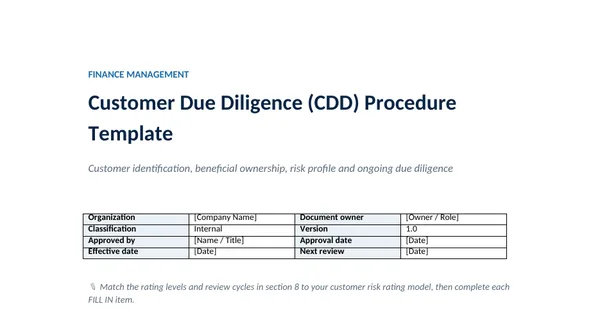
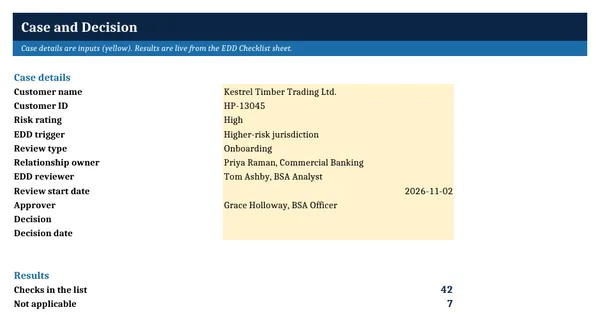
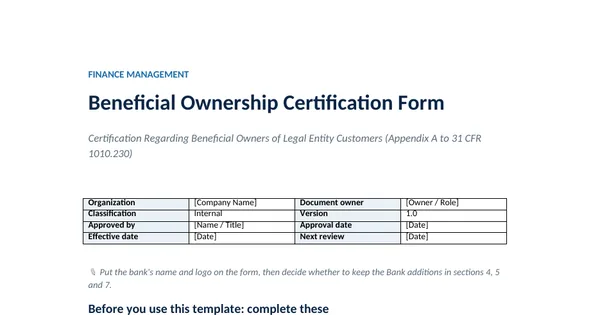
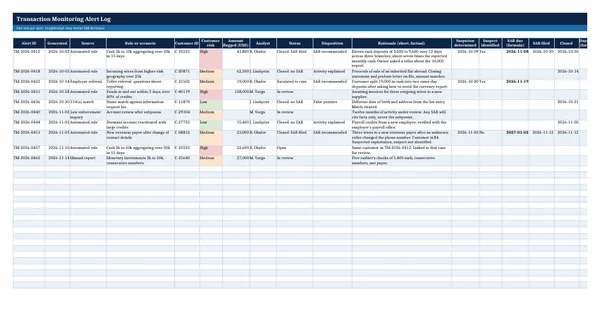
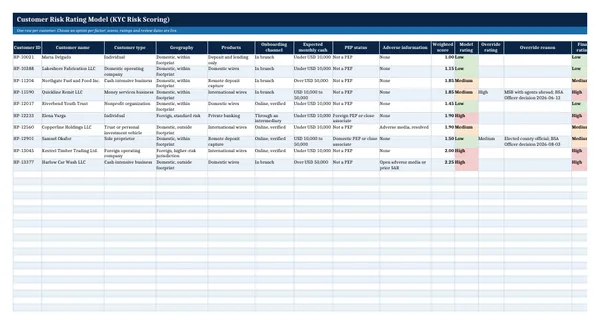
 Excel workbook preview
Customer Risk Rating Model (KYC Risk Scoring)
3 free downloads per account. Just your email and a 6-digit code.
About this template
A customer risk rating model gives every customer a Low, Medium or High money laundering risk rating in a consistent, explainable way. The rating decides how much due diligence a customer gets and how often the file is reviewed. Banks need it to meet the ongoing due diligence rule, which asks them to understand each relationship well enough to build a customer risk profile.
This workbook scores seven factors: customer type, geography, products, onboarding channel, expected cash, PEP status and adverse information. Weights, points and thresholds are editable inputs, and every score, rating and review date is a live formula. Foreign PEPs and customers tied to higher-risk jurisdictions are rated High automatically, in line with FATF Recommendations 12 and 19 and 31 CFR 1020.210(a)(2)(v).
Who it is for
The BSA analyst or compliance manager who must show examiners a documented, repeatable way to rate every customer's money laundering risk.
What is inside
- Customer Ratings sheet with 10 worked customers and 20 blank formatted rows
- 7 risk factors with 29 scored options, chosen from dropdowns linked to the Factors sheet
- Weighted score from 1 to 3, calculated live with editable weights and band thresholds
- Automatic High rating for foreign PEPs and higher-risk jurisdictions
- Override column with reason, and a final rating that drives the review cycle
- Next review date from the rating (12, 24 or 36 months, editable), overdue reviews in red and those due within 90 days in amber
- Summary sheet with counts and shares per rating, overrides, overdue and upcoming reviews
- How to use sheet with the calculation explained
How to use it
Check the weights, points and thresholds on the Factors sheet, then enter each customer on the Customer Ratings sheet.
Files
- XLSXcustomer-risk-rating-model.xlsx17 KB
Opens in Microsoft Word or Excel, Google Docs or Sheets, and LibreOffice. Built on free, official texts that anyone can read: laws, regulations, standards and guidance published by public bodies. A template to adapt, not legal, tax or accounting advice.
Questions about this template
What factors go into a customer risk rating?
Most models combine who the customer is, where it is located or operates, which products and channels it uses, its expected activity, and whether it is a politically exposed person or has adverse information. This model uses those seven factors with weights that add up to 100 percent, so each one's influence on the score is visible.
Can a compliance officer override a model rating?
Yes. A model is a starting point, and an analyst may know something the factors do not capture. This workbook keeps the model rating, the override and a required reason in separate columns, so an examiner can see each change. Overrides are counted on the Summary sheet so they can be reviewed.
How often should high-risk customers be reviewed?
No federal rule sets one interval for all banks. Many banks review High customers every 12 months, Medium every 24 and Low every 36, plus whenever monitoring shows a change. This workbook uses those intervals as editable inputs, so they can be set to the bank's own policy.