
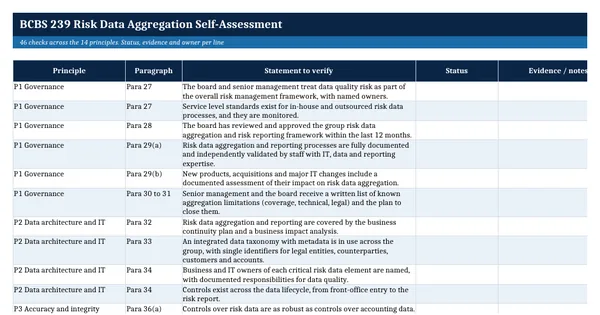
 Excel workbook preview
BCBS 239 Risk Data Aggregation Self-Assessment
3 free downloads per account. Just your email and a 6-digit code.
About this template
BCBS 239 is the Basel Committee paper Principles for effective risk data aggregation and risk reporting, published in January 2013. It was written for global systemically important banks, and paragraph 13 lets national supervisors apply it to a wider range of banks in a proportionate way. Chief data officers, risk reporting leads and internal auditors are asked for a BCBS 239 assessment when a supervisor, the board or a data program needs to know where the gaps are.
This workbook turns the 14 principles into 46 specific checks, grouped under governance and infrastructure, risk data aggregation, risk reporting and the supervisory principles. Each check cites the paragraph of the paper it rests on, which is free on bis.org. A Summary sheet scores each principle and a Remediation Plan sheet tracks every gap to closure with owners and due dates.
Who it is for
The chief data officer, risk reporting lead or internal auditor who was asked to show where the bank stands against the 14 BCBS 239 principles.
What is inside
- 46 checkable statements grouped under the 14 principles, each tied to the paragraph of the 2013 BCBS paper
- Bank-side readiness checks for the supervisory principles 12 to 14
- Status dropdown (Implemented to Not applicable) with green, amber and red colors and an overall coverage percentage
- Summary sheet with items, implemented count and percentage per principle, all live formulas
- Remediation Plan sheet with 8 worked actions, 16 blank rows, days to due date and an overdue highlight
- Evidence and owner columns for every check
- How to use sheet with the scope and proportionality notes from the paper
How to use it
Work through the Checklist sheet principle by principle with the data and reporting owners, record a status and evidence for each line, then log every gap on the Remediation Plan sheet.
Files
- XLSXbcbs-239-risk-data-aggregation-self-assessment.xlsx17 KB
Opens in Microsoft Word or Excel, Google Docs or Sheets, and LibreOffice. Built on free, official texts that anyone can read: laws, regulations, standards and guidance published by public bodies. A template to adapt, not legal, tax or accounting advice.
Questions about this template
What are the 14 principles of BCBS 239?
The paper groups them in four parts. Governance and infrastructure covers principles 1 and 2. Risk data aggregation covers accuracy and integrity, completeness, timeliness and adaptability (3 to 6). Risk reporting covers accuracy, comprehensiveness, clarity and usefulness, frequency and distribution (7 to 11). Principles 12 to 14 cover supervisory review, remedial action and home and host cooperation.
Does BCBS 239 apply to smaller banks?
The principles are addressed first to systemically important banks. Paragraph 13 says national supervisors may apply them to a wider range of banks, in a way that is proportionate to their size, nature and complexity. Paragraph 15 suggests applying them to domestic systemically important banks three years after designation. Many smaller banks use them as good practice.
How do you score a BCBS 239 self-assessment?
This workbook records a status for each check: implemented, partially implemented, planned, not implemented or not applicable. The Summary sheet counts implemented checks per principle and divides by the number of checks. Gaps go to the Remediation Plan sheet with an owner and a due date, which the board can track.