

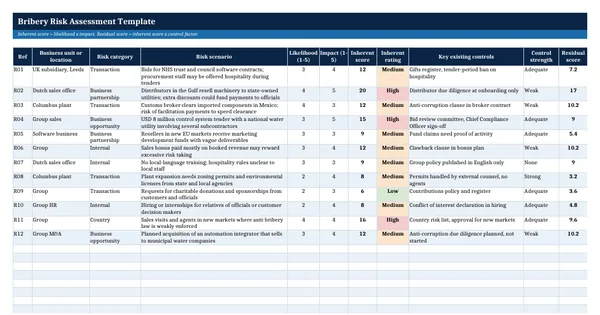
 Excel workbook preview
Anti-bribery (FCPA, UK Bribery Act)
Bribery Risk Assessment Template
3 free downloads per account. Just your email and a 6-digit code.
About this template
A bribery risk assessment identifies where in the business bribery could happen, how likely and how damaging it would be, and how well current controls reduce it. The Ministry of Justice guidance on the UK Bribery Act describes it as periodic, informed and documented, and the DOJ and SEC Resource Guide to the FCPA says resources should go to high-risk areas rather than modest gifts. Boards, auditors and lenders ask for it.
The workbook has a risk register with formulas for inherent and residual scores and ratings, an action plan with due dates, a heat map summary and a scoring method sheet whose bands and control factors are inputs. Risk categories follow the country, sectoral, transaction, business opportunity and business partnership risks named in the Ministry of Justice guidance, plus the internal factors it lists, such as a bonus culture that rewards excessive risk taking.
Who it is for
The compliance officer or finance director asked by the board or auditor for a documented, periodic bribery risk assessment.
What is inside
- Risk register with 13 columns, 12 worked scenarios for an invented manufacturing and software group and 18 blank rows
- Risk categories follow the five external risk groups and the internal factors in the Ministry of Justice guidance
- Live formulas for inherent score, inherent rating, residual score after control strength and residual rating
- Action plan sheet with 8 sample actions, days to due and overdue dates in red
- Summary sheet with a 5 by 5 heat map and counts by category and rating, all formula driven
- Scoring method sheet with likelihood and impact scales and yellow input cells for bands and control factors
- How to use sheet, dropdowns, rating colours, freeze panes, filters and print fit
How to use it
Check the scales and control factors on the Scoring method sheet, then replace the sample scenarios with the risks of your own business units.
Files
- XLSXbribery-risk-assessment-template.xlsx18 KB
Opens in Microsoft Word or Excel, Google Docs or Sheets, and LibreOffice. Built on free, official texts that anyone can read: laws, regulations, standards and guidance published by public bodies. A template to adapt, not legal, tax or accounting advice.
Questions about this template
How often should a bribery risk assessment be done?
The Ministry of Justice guidance calls for a periodic assessment and notes that risks change as the business changes, for example when it enters a new market. Most organizations review it once a year and again after a major event such as an acquisition, a new country, a new type of intermediary or an incident. The register keeps an owner per risk to support that.
What is the difference between inherent and residual bribery risk?
Inherent risk is the score before controls, here likelihood times impact on a 1 to 5 scale. Residual risk is what remains after existing controls, here the inherent score multiplied by a factor for control strength. Both factors and the rating bands are inputs on the Scoring method sheet, so you can match them to your own risk method.
Which bribery risk categories should the assessment cover?
The Ministry of Justice guidance names five external groups: country, sectoral, transaction, business opportunity and business partnership risk. It also lists internal factors such as weak training, a bonus culture that rewards excessive risk taking, unclear hospitality rules, weak financial controls and an unclear message from top management. The dropdown in the register uses these six categories.
More Anti-bribery (FCPA, UK Bribery Act) templates
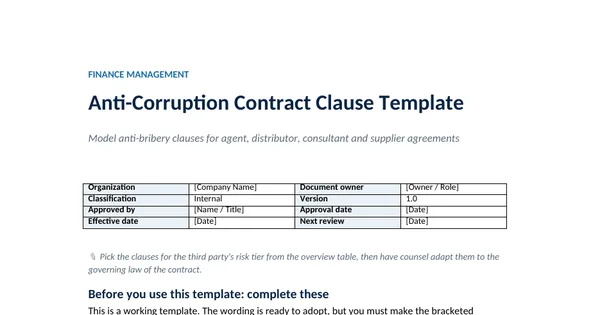
Anti-bribery (FCPA, UK Bribery Act)
Anti-Corruption Contract Clause Template
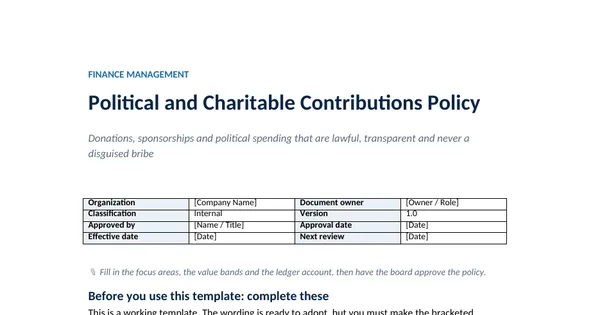
Anti-bribery (FCPA, UK Bribery Act)
Political and Charitable Contributions Policy
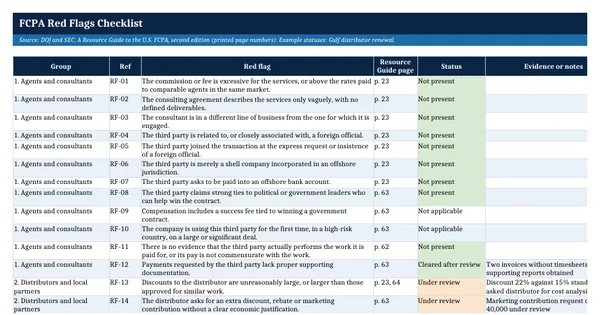
Anti-bribery (FCPA, UK Bribery Act)
FCPA Red Flags Checklist
Basel Framework and BCBS 239