
 Word document preview
Budgeting, forecasting and FP&A
Budget Policy and Process Template
3 free downloads per account. Just your email and a 6-digit code.
About this template
A budget policy sets out how an organization prepares, approves, changes and monitors its annual budget. It becomes urgent when a new CFO arrives, when the board asks why the budget changed mid-year, or when an auditor finds that spending was approved against a budget nobody formally signed. A written policy gives every budget holder the same timetable, the same assumptions and the same rules for transfers, so the approved budget stays a reliable baseline for the whole year.
This template is a complete policy for a mid-size group, written around the invented Ashcombe Group. It covers budget principles, the seven budget components and their owners, a nine-step calendar, central planning assumptions, approval authority, quarterly reforecasts, transfer and contingency rules, variance thresholds and record keeping. It rests on general financial planning practice only, with no paid standard quoted, and every threshold is an example to replace with your own.
Who it is for
The controller or FP&A lead told by the new CFO or the auditors that the budget process runs on habit and has no written policy behind it.
What is inside
- 15 numbered sections, about 1,500 words, ready to adopt as a written policy
- Budget structure table: 7 components, each with an owner, a basis and a level of detail
- Nine-step annual budget calendar from planning assumptions to the budget letters
- Approval authority table for cost center, group, board and capital project budgets
- Reforecast cycle and transfer rules, with central contingency held by the CFO
- Variance threshold table at three levels: cost center line, department and group EBITDA
- Roles table for the board, executive committee, CFO, FP&A, budget holders and business partners
- Pre-use checklist with 7 decisions, plus Compliance, Exceptions and Review sections
How to use it
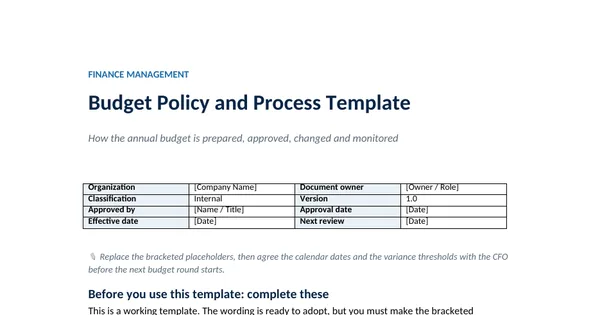
Replace the bracketed placeholders, then agree the calendar dates and the variance thresholds with the CFO before the next budget round starts.
Files
- DOCXbudget-policy-and-process-template.docx41 KB
Opens in Microsoft Word or Excel, Google Docs or Sheets, and LibreOffice. Based on general finance practice, not on one published standard. A template to adapt, not legal, tax or accounting advice.
Questions about this template
What should a budget policy include?
A useful budget policy names who owns each part of the budget, the calendar from assumptions to approval, who approves at each level, how the budget can change during the year and when variances must be explained. It also says where the central assumptions come from and how long budget records are kept. This template covers all of these in fifteen sections.
What is the difference between a budget and a forecast?
The budget is the plan approved before the year starts and stays fixed as the baseline for measuring performance. A forecast is the latest view of the full year, updated as the year goes on, often each quarter. Keeping both lets management see how far the expected outcome has moved from the commitment, and why, without rewriting the original plan.
Can a budget holder move money between budget lines?
Most organizations allow limited transfers within a cost center by the budget holder, transfers between cost centers with finance agreement, and any increase in the total only with CFO or CEO approval. The template sets out these three levels with example limits, which you replace with the limits in your own delegation of authority.