

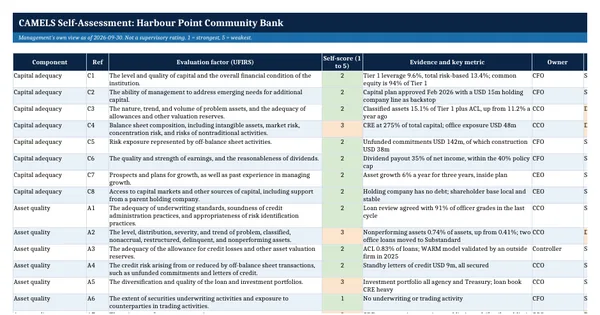
 Excel workbook preview
Bank supervision (OCC, FFIEC, FDIC)
CAMELS Self-Assessment Template
3 free downloads per account. Just your email and a 6-digit code.
About this template
CAMELS is the rating system the federal banking agencies use to summarize a bank's condition: capital adequacy, asset quality, management, earnings, liquidity and sensitivity to market risk, each rated 1 (strongest) to 5 (weakest), plus a composite. Only examiners assign the rating. Many boards still ask management for its own view before an examination, so that weak spots are known and being fixed before the examiners arrive.
This workbook lists the 50 evaluation factors that the Uniform Financial Institutions Rating System publishes for the six components. Each factor gets a 1 to 5 self-score, evidence and an owner. A summary sheet rolls the scores up per component with live formulas, a metrics sheet computes 14 common ratios against board triggers, and an action plan tracks the fixes. The rating descriptions come from the UFIRS text published in the Federal Register.
Who it is for
The CFO or chief risk officer of a community bank whose board asked for management's own view of each CAMELS component before the next examination.
What is inside
- 50 evaluation factors across the six components (capital 8, asset quality 11, management 12, earnings 7, liquidity 8, sensitivity 4), taken from the published UFIRS
- Worked example for a fictional USD 1.2 billion community bank: every factor scored with evidence, owner and trend
- Component Summary with live average, worst factor and count of weak factors per component, plus a composite consistency check
- Key Metrics sheet with 14 ratios computed from input cells and compared with board-set triggers
- Action Plan register with 8 worked actions, 16 blank rows, days-to-due formulas and overdue highlighting
- Rating Scale sheet with the composite and component descriptions for ratings 1 to 5
- Dropdowns, color bands on every score, frozen headers, filters and landscape print fit
How to use it
Score each factor on the Self-Assessment sheet with evidence, then enter management's component view on the Component Summary.
Files
- XLSXcamels-self-assessment-template.xlsx24 KB
Opens in Microsoft Word or Excel, Google Docs or Sheets, and LibreOffice. Built on free, official texts that anyone can read: laws, regulations, standards and guidance published by public bodies. A template to adapt, not legal, tax or accounting advice.
Questions about this template
What are the six CAMELS components?
Capital adequacy, asset quality, management, earnings, liquidity and sensitivity to market risk. The sixth component, sensitivity to market risk, was added when the agencies revised the Uniform Financial Institutions Rating System at the end of 1996. Each component and the composite are rated on a scale of 1 to 5, where 1 is the strongest performance and the least supervisory concern.
Is the composite CAMELS rating the average of the components?
No. The rating system text says the composite is not an arithmetic average of the component ratings. Examiners weigh the components by their situation at the bank. That is why this workbook shows the average only as a reference figure and asks management to record its composite view separately, with a check against the composite descriptions.
Can a bank give itself a CAMELS rating?
Not in any official sense. Ratings are assigned by the supervisory agencies after an examination. A self-assessment is management's own view, prepared for the board, which helps find weaknesses early and shows that the bank knows its own risks. It should be labelled as an internal assessment and never presented as a supervisory rating.
More Bank supervision (OCC, FFIEC, FDIC) templates
Bank supervision (OCC, FFIEC, FDIC)
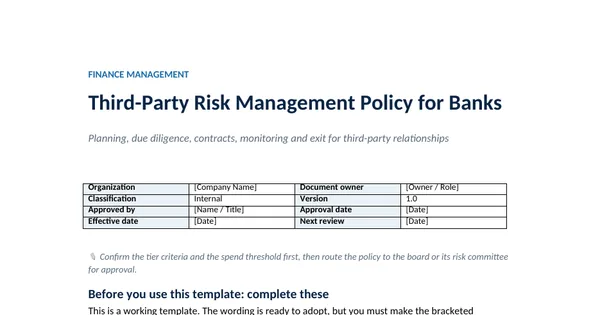
Third-Party Risk Management Policy for Banks
Bank supervision (OCC, FFIEC, FDIC)
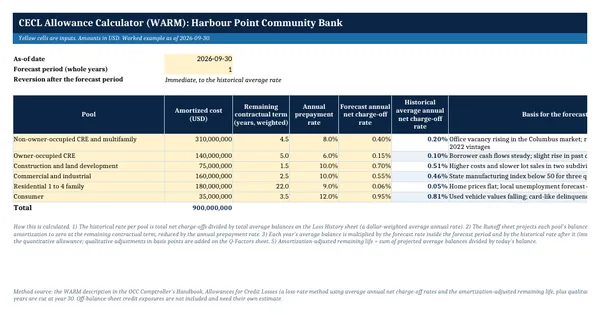
CECL Allowance Calculator (WARM Method)
Bank supervision (OCC, FFIEC, FDIC)
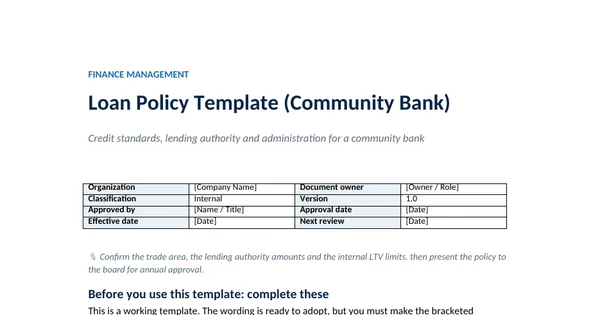
Loan Policy Template (Community Bank)
Bank supervision (OCC, FFIEC, FDIC)