

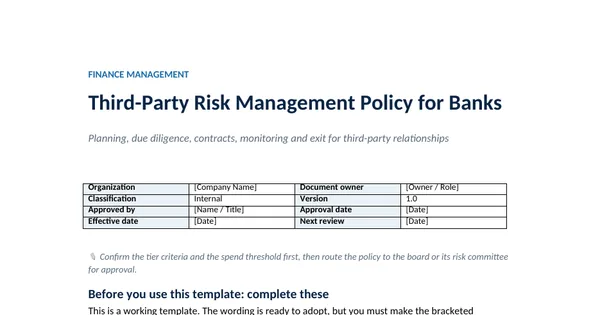
 Word document preview
Bank supervision (OCC, FFIEC, FDIC)
Third-Party Risk Management Policy for Banks
3 free downloads per account. Just your email and a 6-digit code.
About this template
A third-party risk management policy is the board-approved rulebook for how a bank chooses, contracts with, watches and exits its vendors and partners. Examiners ask for it because a bank stays responsible for an activity even when a third party performs it. It is often missing or out of date at smaller banks, especially after a core conversion or a new fintech partnership.
This template follows the June 2023 Interagency Guidance on Third-Party Relationships issued by the Federal Reserve, the FDIC and the OCC. It covers the five life-cycle stages, a four-tier risk model, due diligence by tier, the contract provisions the guidance discusses, monitoring frequency, termination and governance. It also notes the September 2026 proposal to replace that guidance and the FDIC incident notification rule.
Who it is for
The compliance officer or COO of a community bank whose examiner or auditor asked for a current third-party risk management policy aligned with the 2023 interagency guidance.
What is inside
- Policy built on the five life-cycle stages of the June 2023 interagency guidance: planning, due diligence, contract negotiation, ongoing monitoring and termination
- Four-tier risk model with criteria, examples, approval level and review cycle in a worked table
- Due diligence table covering 9 factor groups with the evidence required per tier
- 12 contract provision groups, including audit rights, incident notice, subcontracting and regulatory access
- Monitoring frequency table by tier and a termination and exit section
- Governance: board and management duties, independent review, inventory fields and reporting
- A note on the September 2026 proposal to replace the 2023 guidance, plus a roles table and an adoption checklist
How to use it
Confirm the tier criteria and the spend threshold first, then route the policy to the board or its risk committee for approval.
Files
- DOCXthird-party-risk-management-policy-for-banks.docx42 KB
Opens in Microsoft Word or Excel, Google Docs or Sheets, and LibreOffice. Built on free, official texts that anyone can read: laws, regulations, standards and guidance published by public bodies. A template to adapt, not legal, tax or accounting advice.
Questions about this template
What are the stages of the third-party risk management life cycle?
The 2023 interagency guidance describes five stages: planning, due diligence and third-party selection, contract negotiation, ongoing monitoring, and termination. Governance practices (oversight and accountability, independent reviews, and documentation and reporting) apply across all stages. The depth of each stage should match the risk and complexity of the relationship.
What makes a third-party activity critical?
The guidance says critical activities may include those that could cause a bank to face significant risk if the third party fails to meet expectations, have significant customer impacts, or have a significant impact on the bank's financial condition or operations. Each bank decides which of its activities are critical. This policy places those relationships in Tier 1.
Does the 2023 guidance still apply?
When this template was written in November 2026, the 2023 guidance had not been rescinded. On September 15, 2026 the agencies published proposed guidance that would rescind and replace it, with comments due on November 16, 2026. The proposal stresses tailoring to the risk of each relationship. Check the agencies' websites for the final outcome before you adopt this policy.
More Bank supervision (OCC, FFIEC, FDIC) templates
Bank supervision (OCC, FFIEC, FDIC)
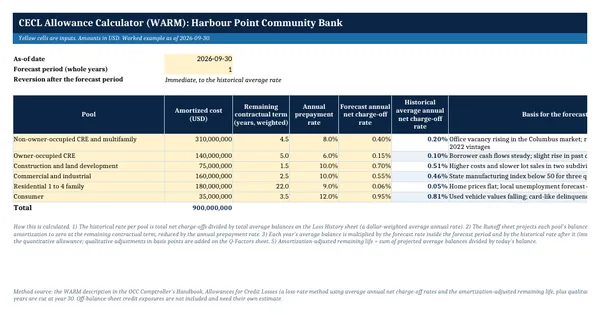
CECL Allowance Calculator (WARM Method)
Bank supervision (OCC, FFIEC, FDIC)
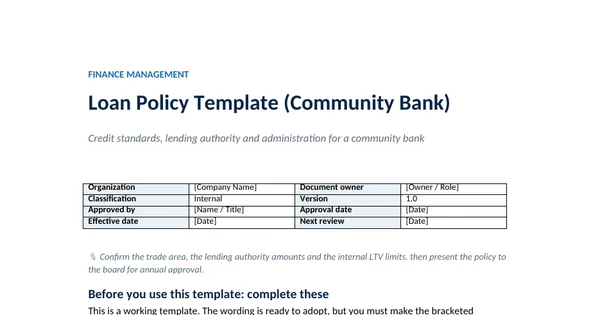
Loan Policy Template (Community Bank)
Bank supervision (OCC, FFIEC, FDIC)
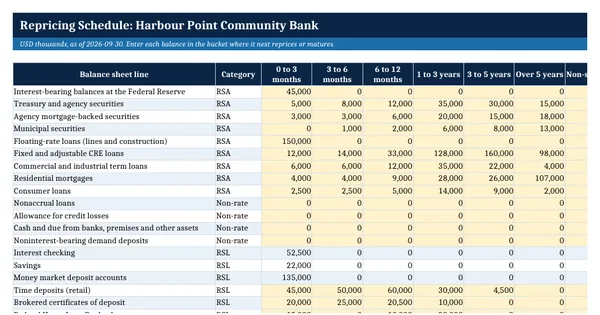
Interest Rate Risk Gap Analysis Template
Bank supervision (OCC, FFIEC, FDIC)