

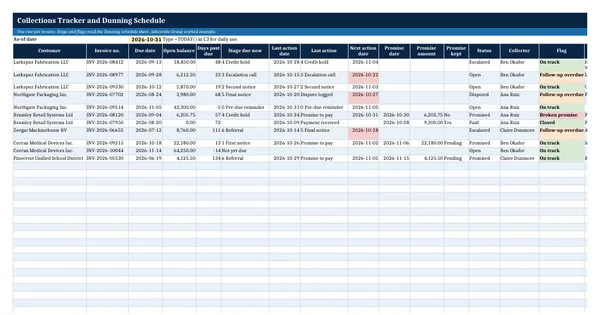
 Excel workbook preview
Order-to-cash and accounts receivable
Collections Tracker and Dunning Schedule
3 free downloads per account. Just your email and a 6-digit code.
About this template
A collections tracker is the working log of a credit team. It shows every past due invoice, the step of the dunning schedule it has reached, the last contact and the next action that is due. A dunning schedule is the fixed sequence of reminders, calls, holds and notices that follows the due date. Together they keep collection work consistent, and they give the controller evidence of collection effort when an account is later written off.
This workbook pairs a seven-stage schedule with a tracker that reads it. The stage due now is looked up from days past due, the next action date comes from the follow-up gap of the last action, and a flag marks broken promises and overdue follow-ups. The worked example is an invented manufacturer collecting its own trade receivables in its own name, using general credit practice.
Who it is for
The credit manager or collector who needs one sheet that shows every overdue invoice, what was last done about it and what is due next.
What is inside
- Tracker sheet with 11 worked invoices and 20 blank formatted rows
- Dunning schedule sheet with 7 stages from 5 days before due to day 90 referral, editable days and follow-up gaps
- Stage due now, next action date and a status flag are live formulas from one as-of date
- Promise to pay columns with date, amount and kept status, and a broken promise flag
- Summary sheet with counts and balances by stage, flag and collector, plus the promise kept rate
- Dropdowns for last action, promise kept, status and collector, with colour on flags and overdue dates
- How to use sheet explaining each formula and the daily routine
How to use it
Edit the days and follow-up gaps on the Dunning schedule sheet to match your credit policy, then enter your overdue invoices on the Tracker.
Files
- XLSXcollections-tracker-and-dunning-schedule.xlsx16 KB
Opens in Microsoft Word or Excel, Google Docs or Sheets, and LibreOffice. Based on general finance practice, not on one published standard. A template to adapt, not legal, tax or accounting advice.
Questions about this template
What is a dunning schedule?
A dunning schedule is the planned series of collection steps that follow an invoice due date: for example a reminder on day 1, a second notice on day 15, a call on day 30, a credit hold on day 45, a final notice on day 60 and referral on day 90. Each step has an owner and a channel, and the days are set in the credit policy.
How do you track promises to pay?
Record the date the customer promised, the amount and the person who made the promise. On the promise date, check the bank. If the money arrived, mark the promise kept. If not, mark it broken and move straight to the next dunning stage. This tracker flags a broken promise automatically once the promise date passes without a Yes.
Which law applies to collecting business debts?
In the US, the Fair Debt Collection Practices Act covers consumer debts and third-party collectors, and a creditor that collects under a name other than its own. A business collecting its own trade receivables in its own name is generally outside it. Contract terms, state law and, for UK and EU customers, late payment legislation still apply.
More Order-to-cash and accounts receivable templates
Order-to-cash and accounts receivable
Collection Letter Templates (First, Second and Final Notice)
Order-to-cash and accounts receivable
Business Credit Application Form
Order-to-cash and accounts receivable
Bad Debt Reserve Calculator (Aging Method)
Order-to-cash and accounts receivable