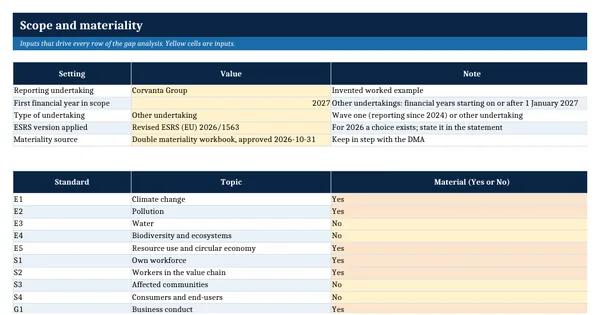
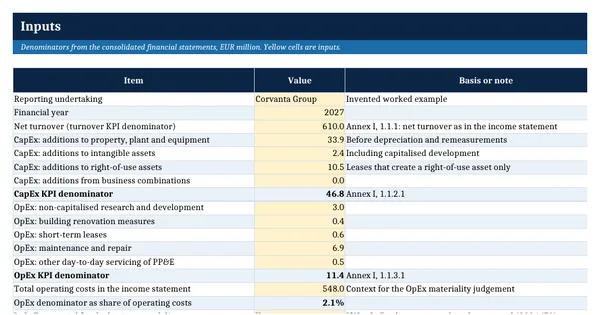
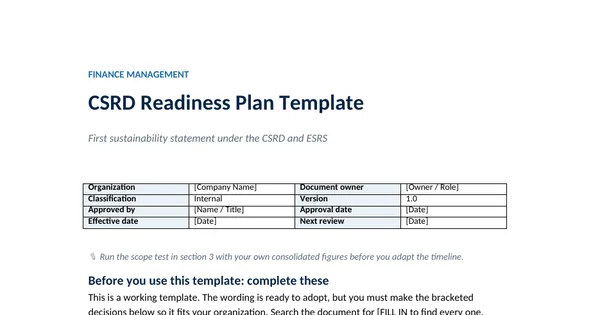
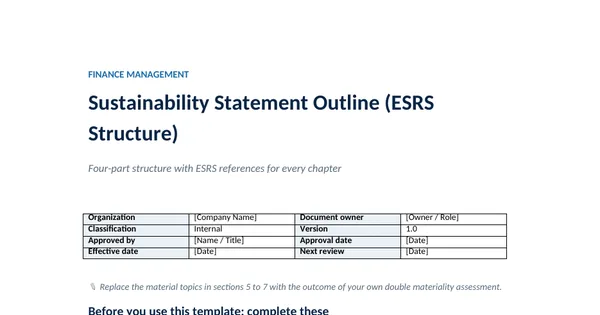
 Excel workbook preview
Double Materiality Assessment Template (CSRD, ESRS 1)
3 free downloads per account. Just your email and a 6-digit code.
About this template
A double materiality assessment decides which sustainability topics a company reports under the European Sustainability Reporting Standards. It looks at two directions: the company's impacts on people and the environment, and the sustainability risks and opportunities that affect the company financially. Auditors giving limited assurance on a sustainability statement examine this process, so it has to be written down, scored consistently and traceable to evidence. This workbook is that record for a first or refreshed assessment.
The workbook follows ESRS 1 as published in Delegated Regulation (EU) 2023/2772 and the revised ESRS adopted by the Commission on 3 July 2026. Impacts are scored on scale, scope, irremediable character and likelihood, and risks and opportunities on magnitude and likelihood, with every score a live formula. The topic summary lists the sub-topics of the revised ESRS 1 Appendix A, allows a documented top-down conclusion per sub-topic, and counts the material sub-topics per standard. A stakeholder log records the engagement behind each score.
Who it is for
The controller or sustainability lead who must show the auditor and the board how the company decided which ESRS topics are material, and has no documented assessment yet.
What is inside
- Impacts sheet with 12 worked impacts scored on scale, scope, irremediable character and likelihood
- Risks and opportunities sheet with 10 worked items scored on magnitude and likelihood
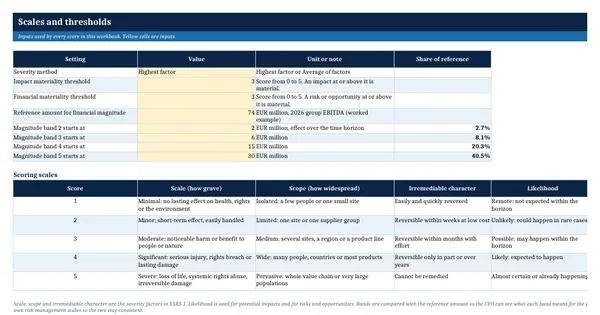
- Scales and thresholds sheet: severity method, two thresholds and EUR magnitude bands as inputs
- Human rights rule built in: for potential negative human rights impacts severity takes precedence
- Topic summary of 39 sub-topics (revised ESRS 1 Appendix A) with top-down or bottom-up conclusions
- Live count of material sub-topics per topical standard, E1 to G1 plus entity-specific
- Stakeholder input log with 10 worked entries, overdue follow-ups highlighted
- Dropdowns, conditional formatting, freeze panes, filters and print fit on every sheet
How to use it
Open Scales and thresholds first, agree the method and the two thresholds with the CFO, then score the impacts.
Files
- XLSXdouble-materiality-assessment-template.xlsx34 KB
Opens in Microsoft Word or Excel, Google Docs or Sheets, and LibreOffice. Built on free, official texts that anyone can read: laws, regulations, standards and guidance published by public bodies. A template to adapt, not legal, tax or accounting advice.
Questions about this template
What is the difference between impact materiality and financial materiality?
Impact materiality asks whether the company has an actual or potential, positive or negative effect on people or the environment. Financial materiality asks whether a sustainability matter creates risks or opportunities that could reasonably affect the company's cash flows, financial position, performance, access to finance or cost of capital. A topic is material when it meets either test or both.
Can a topic be concluded as not material without scoring every impact?
The revised ESRS 1 adopted in July 2026 allows a top-down approach: a conclusion on a topic or sub-topic from an analysis of strategy, business model, sectors, geographies and value chain, without scoring each impact, risk or opportunity. Where the conclusion is not evident, a specific assessment is needed. The workbook records the rationale for each top-down conclusion.
How often does the double materiality assessment have to be repeated?
Under the revised ESRS 1 the company considers at each reporting date whether significant changes, for example in activities, structure, business relationships or methods, could affect earlier conclusions. If they could, the assessment is reviewed and updated, and the changes are explained in the statement.