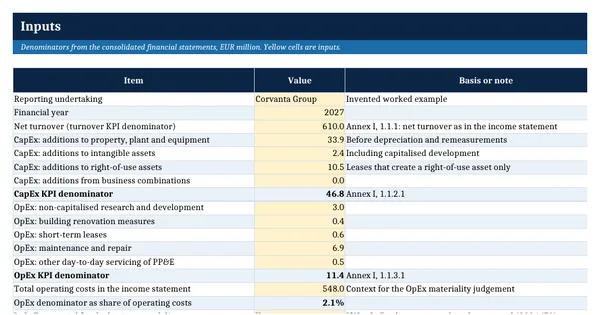
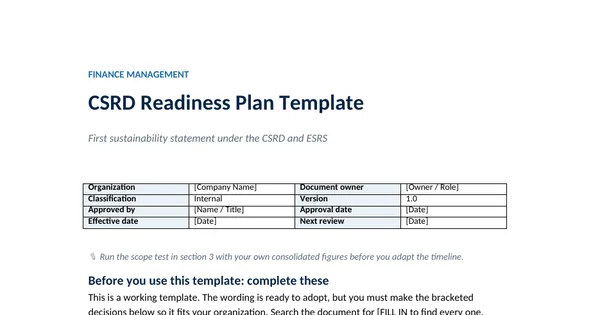
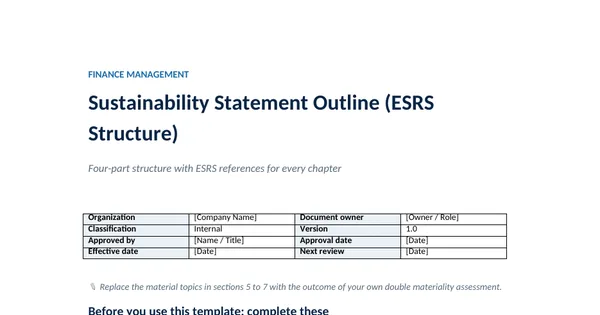
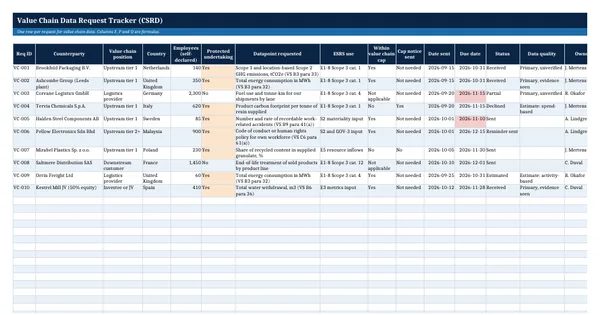
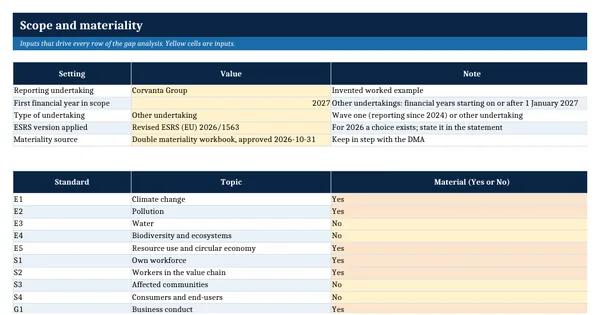
 Excel workbook preview
ESRS Disclosure Requirement Gap Analysis Template
3 free downloads per account. Just your email and a 6-digit code.
About this template
An ESRS gap analysis compares what the European Sustainability Reporting Standards require with what the company can already report. It is usually the first piece of work after the double materiality assessment, because it turns the list of material topics into a list of disclosure requirements, data owners and actions. Audit committees and assurance providers ask for it to see whether the first sustainability statement is achievable on time.
The register lists all 79 disclosure requirements of the revised ESRS adopted by the Commission on 3 July 2026 ((EU) 2026/1563, C(2026) 5010), which apply to financial years beginning on or after 1 January 2027, with the closest code from Delegated Regulation (EU) 2023/2772 for companies that still apply the 2023 set for 2026. ESRS 2 rows are always required, topical rows follow the materiality inputs, and phase-in options follow the revised ESRS 1 transitional provisions.
Who it is for
The controller or CSRD project lead who was asked by the audit committee where the company stands against each ESRS disclosure requirement before the first reporting year.
What is inside
- 79 disclosure requirements of the revised ESRS: ESRS 2 (15), E1 (11), E2 to E5 (19), S1 to S4 (28), G1 (6)
- Closest 2023 ESRS code for every requirement, marked indicative, for companies still on the 2023 set
- Scope and materiality sheet: material yes or no per topical standard drives every row
- Live status per row: required, phased in, not required, or assess materiality first
- Gap rating from data readiness (High, Medium, None) with colour coding
- Phase-ins sheet summarising revised ESRS 1 paragraphs 125 to 127 by type of undertaking
- Summary sheet per standard: required, phased in, gaps by rating, readiness percentage, overdue actions
- 14 worked rows for an invented manufacturer, 10 blank rows for entity-specific disclosures
How to use it
Fill in the Scope and materiality sheet from your double materiality assessment, then rate data readiness row by row.
Files
- XLSXesrs-disclosure-requirement-gap-analysis-template.xlsx27 KB
Opens in Microsoft Word or Excel, Google Docs or Sheets, and LibreOffice. Built on free, official texts that anyone can read: laws, regulations, standards and guidance published by public bodies. A template to adapt, not legal, tax or accounting advice.
Questions about this template
How many disclosure requirements are in the revised ESRS?
The revised set adopted on 3 July 2026 has 15 cross-cutting requirements in ESRS 2, including four general requirements for policies, actions, metrics and targets, and 64 topical requirements across E1 to E5, S1 to S4 and G1. Each requirement contains several datapoints, and the topical ones apply only to topics assessed as material.
Do I report every ESRS disclosure requirement?
No. ESRS 2 general disclosures apply to every reporting company. Topical requirements apply to topics and sub-topics linked to material impacts, risks or opportunities, and only the material information within them is reported. Some requirements can be phased in during the first years under the transitional provisions in ESRS 1.
Is there an official mapping between the 2023 ESRS codes and the revised codes?
At the time this template was written no official datapoint mapping had been published. The 2023 codes in this workbook are matched by subject and title and are marked as indicative. Check them against the official texts before relying on them in a filing or an assurance file.