
 Word document preview
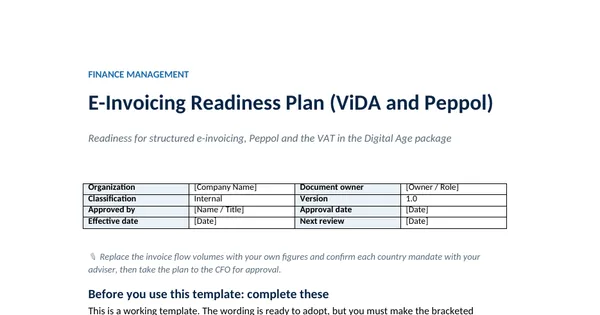
E-Invoicing Readiness Plan (ViDA and Peppol)
3 free downloads per account. Just your email and a 6-digit code.
About this template
An e-invoicing readiness plan sets out how a company will move from PDF and paper invoices to structured electronic invoices. Since 14 April 2025, Directive (EU) 2025/516 has let Member States require domestic e-invoicing without asking the EU for a derogation, and from 1 July 2030 structured e-invoicing and digital reporting become the default for intra-EU transactions. Belgium and Germany already have B2B timelines.
This plan maps the regulatory drivers, the current invoice flows and the target design on the European standard EN 16931 and Peppol BIS Billing 3.0. It contains a gap analysis rated by priority, a five-phase roadmap to 2030 with exit criteria, testing and archiving rules and a roles table. Facts come from the Commission's ViDA and eInvoicing pages, the Peppol BIS Billing 3.0 specification and Directive 2006/112/EC.
Who it is for
The finance systems lead or VAT manager asked by the CFO or the audit committee how the company will be ready for EU e-invoicing mandates and ViDA.
What is inside
- 9 body sections, from regulatory drivers to risks, plus purpose, scope and roles
- Regulatory drivers table with 7 rows: the VAT Directive, Directive 2014/55/EU, the ViDA dates and country mandates from the Commission's eInvoicing pages
- Current invoice flows table with 7 worked flows for an invented group
- Gap analysis table with 8 areas rated by priority
- Five-phase roadmap table with deliverables, owners and exit criteria
- Testing, archiving and control rules based on Articles 233 and 244 to 248 of Directive 2006/112/EC
- Roles table and a checklist with 6 decisions to make
How to use it
Replace the invoice flow volumes with your own figures and confirm each country mandate with your adviser, then take the plan to the CFO for approval.
Files
- DOCXe-invoicing-readiness-plan.docx42 KB
Opens in Microsoft Word or Excel, Google Docs or Sheets, and LibreOffice. Built on free, official texts that anyone can read: laws, regulations, standards and guidance published by public bodies. A template to adapt, not legal, tax or accounting advice.
Questions about this template
What does ViDA change for e-invoicing?
The Commission's ICT standardisation plan says Directive (EU) 2025/516 makes electronic invoicing the default for intra-Community transactions, with obligations from 1 July 2030, makes EN 16931 mandatory for intra-EU invoices and sets up digital reporting requirements. Member States may mandate domestic e-invoicing from April 2025 without prior derogation.
What is Peppol BIS Billing 3.0?
It is a Core Invoice Usage Specification of the European standard EN 16931 published by OpenPeppol. The specification says documents that comply with it also comply with the European standard. It covers invoices and credit notes in the UBL syntax and is sent over the Peppol network through service providers.
When does Germany require B2B e-invoices?
The Commission's eInvoicing in Germany page says companies must be able to receive EN-compliant e-invoices from 1 January 2025. Businesses with turnover above EUR 800 000 must stop issuing paper or unstructured electronic invoices from 1 January 2027, and all remaining businesses from 1 January 2028. Confirm the current position before planning.