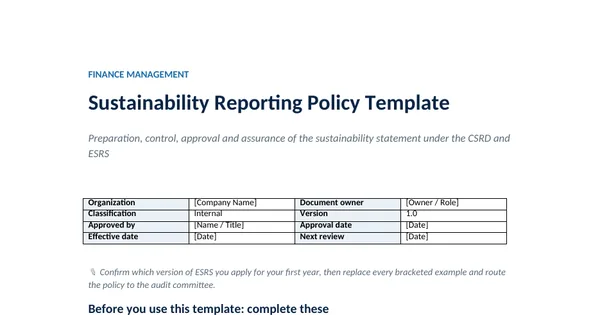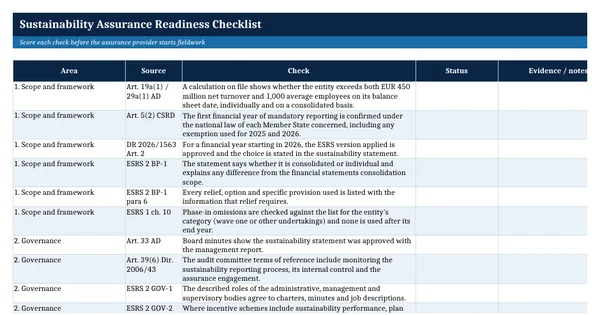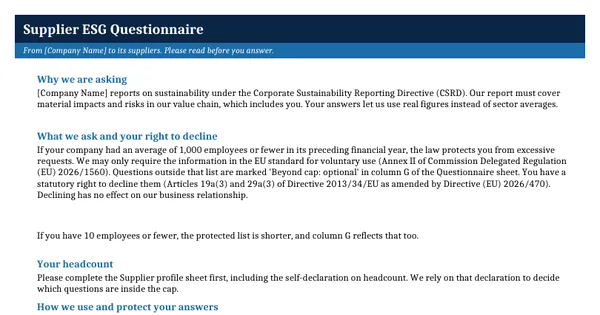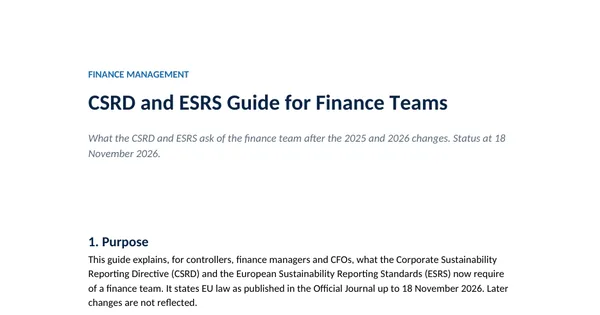

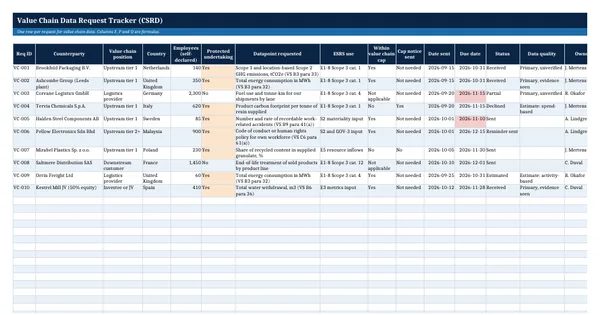
 Excel workbook preview
Value Chain Data Request Tracker (CSRD)
3 free downloads per account. Just your email and a 6-digit code.
About this template
Under the CSRD a reporting company has to cover material impacts, risks and opportunities in its upstream and downstream value chain, so it asks suppliers, customers, carriers and investees for data. Since Directive (EU) 2026/470 those requests have limits: a value chain partner with 1,000 employees or fewer may decline anything beyond the standard for voluntary use. This tracker is the log an assurance provider expects to see: who was asked for what, when, whether the cap was respected and what came back.
Each request is one row. The workbook works out whether the counterparty is a protected undertaking from its self-declared headcount, and flags any request that goes beyond the cap without the notice the Directive requires. Overdue replies and declined requests are flagged too, so the team knows where an estimate is needed. A reference sheet lists the 23 capped datapoints from Annex II of Delegated Regulation (EU) 2026/1560, and a summary sheet counts everything live.
Who it is for
The controller or sustainability lead who must show the assurance provider which value chain data was asked for, from whom, what came back and what was estimated.
What is inside
- Requests sheet with 17 columns, 10 worked rows and 20 blank formatted rows
- Protected undertaking flag computed from the self-declared employee count (1,000 or fewer)
- Flag formula that catches a request beyond the value chain cap with no notice sent, a declined request and an overdue reply
- Dropdowns for value chain position, cap status, notice, status and data quality
- Overdue due dates turn red and flags are coloured red, amber or green
- Cap reference sheet listing the 23 datapoints in Annex II of Delegated Regulation (EU) 2026/1560
- Summary sheet with live counts by status, value chain position and data quality, plus 4 control checks
- How to use sheet, frozen header, filter and landscape print fit
How to use it
Replace the 10 worked rows with your own open requests, starting with the suppliers behind your largest Scope 3 categories.
Files
- XLSXvalue-chain-data-request-tracker.xlsx17 KB
Opens in Microsoft Word or Excel, Google Docs or Sheets, and LibreOffice. Built on free, official texts that anyone can read: laws, regulations, standards and guidance published by public bodies. A template to adapt, not legal, tax or accounting advice.
Questions about this template
What is the CSRD value chain cap?
It is the upper limit of sustainability information a reporting company may require from value chain partners that had an average of 1,000 employees or fewer in the preceding financial year. The limit is the list of datapoints in Annex II of Delegated Regulation (EU) 2026/1560. The partner may decline anything beyond it and must be told which questions go beyond it.
Can we rely on a supplier's own statement of its headcount?
Yes. Directive (EU) 2026/470 lets a reporting company rely on a self-declaration from a value chain partner to decide whether it is protected, without verifying it. The exception is when the company knows, or can reasonably be expected to know, that the declaration is manifestly incorrect. The tracker records the declared headcount for that reason.
What if a supplier does not send the data?
The revised ESRS allow estimates, for example sector averages or spend-based data. For the first three years of reporting, a company that cannot get all value chain information explains the efforts made, the reasons and its plans to obtain it. The tracker counts declined and missing requests so that explanation is supported.