
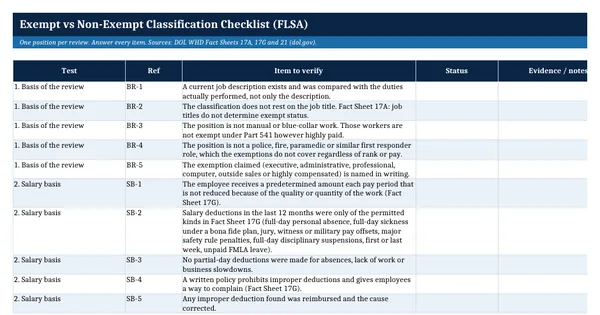
 Excel workbook preview
Exempt vs Non-Exempt Classification Checklist (FLSA)
3 free downloads per account. Just your email and a 6-digit code.
About this template
Classifying a position as exempt means it is not paid overtime, so a wrong classification builds up back pay for every overtime hour. Auditors and new finance leaders ask for evidence behind each exempt position. This checklist documents that evidence for one position at a time and records the result for every position in one place. It suits a first review of all salaried positions and the yearly re-review after that.
The tests come from DOL Fact Sheet 17A (salary level, salary basis and the executive, administrative, professional, computer, outside sales and highly compensated duties tests) and Fact Sheet 17G (permitted salary deductions). The Position review sheet applies the salary level of USD 684 a week and the highly compensated level of USD 107,432 a year by formula. Those levels sit in input cells, because a 2024 rule raising them was vacated and the level DOL enforces should be checked before use.
Who it is for
The HR or payroll lead asked by the CFO or an auditor to prove that every salaried exempt position really meets the FLSA tests.
What is inside
- Checklist sheet with 34 items in 10 groups: basis of review, salary basis, salary level and each duties test
- Status dropdown with colors and a coverage percentage, plus a Summary sheet per group
- Position review sheet with 11 worked positions and 20 blank rows
- Salary level, computer hourly and highly compensated tests calculated by formula
- Result per position: Exempt supported, Review, Not supported or Non-exempt, with counts
- Thresholds sheet with 6 inputs from DOL Fact Sheet 17A, marked verify before use
- Next review date set 12 months after each review and flagged red when overdue
- How to use sheet that notes the vacated 2024 salary rule
How to use it
Confirm the salary level DOL enforces today on the Thresholds sheet, then review each position on the checklist and enter the result on Position review.
Files
- XLSXexempt-vs-non-exempt-classification-checklist.xlsx20 KB
Opens in Microsoft Word or Excel, Google Docs or Sheets, and LibreOffice. Built on free, official texts that anyone can read: laws, regulations, standards and guidance published by public bodies. A template to adapt, not legal, tax or accounting advice.
Questions about this template
What makes an employee exempt from overtime?
Under DOL Fact Sheet 17A, an exempt employee generally must be paid on a salary basis, at no less than the salary level DOL enforces, and must perform the primary duties of one of the exemptions, such as executive, administrative, professional, computer or outside sales. Job titles do not decide exempt status. Blue-collar workers are not exempt however highly they are paid.
What is the current salary level for exempt employees?
DOL Fact Sheet 17A states USD 684 a week and USD 107,432 a year for highly compensated employees. A 2024 rule that would have raised these levels was vacated by a federal court in November 2024. Check the level DOL enforces on the day you review, and check state law, which can set a higher level.
Can you make deductions from an exempt employee's salary?
Only for the reasons DOL Fact Sheet 17G lists, such as full-day absences for personal reasons, full-day sickness under a bona fide plan, jury or witness fee offsets, major safety rule penalties, full-day disciplinary suspensions, the first or last week of work and unpaid FMLA leave. An actual practice of improper deductions can cost the exemption.