

 Word document preview
GHG Protocol carbon accounting
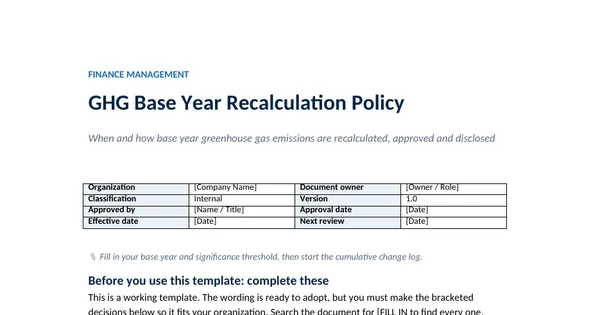
GHG Base Year Recalculation Policy
3 free downloads per account. Just your email and a 6-digit code.
About this template
A base year recalculation policy sets out when an organisation restates the emissions of its base year, the year its progress and targets are measured against. Without one, an acquisition or a better calculation method can make emissions appear to rise or fall when nothing real has changed. The GHG Protocol Corporate Standard requires companies to have such a policy and to disclose the significance threshold they use.
This policy follows chapter 5 of the GHG Protocol Corporate Standard. It covers the choice of a fixed base year, the changes that trigger recalculation, those that do not such as organic growth, a cumulative significance threshold, the method for acquisitions, divestments and method changes, and the approval and disclosure that follow, with worked tables. A roles table names who logs, tests and approves each change.
Who it is for
The controller preparing for an acquisition or a verifier review who was asked for the written rule on restating base year emissions.
What is inside
- Fixed base year section with a table of first-reported emissions by scope
- Triggers for recalculation: structural changes, method and factor changes, significant errors
- Five changes that do not trigger recalculation, including organic growth
- Cumulative significance threshold with a worked 4-change log
- Worked recalculation table from 4,792 to 5,059 t CO2e
- Approval, disclosure and records rules plus compliance, exceptions and review sections
- Roles table with 4 roles
How to use it
Fill in your base year and significance threshold, then start the cumulative change log.
Files
- DOCXghg-base-year-recalculation-policy.docx41 KB
Opens in Microsoft Word or Excel, Google Docs or Sheets, and LibreOffice. Built on free, official texts that anyone can read: laws, regulations, standards and guidance published by public bodies. A template to adapt, not legal, tax or accounting advice.
Questions about this template
When must base year emissions be recalculated?
Under the GHG Protocol Corporate Standard, when a structural change such as an acquisition or divestment, a change in calculation method or factor accuracy, or the discovery of significant errors has a significant effect on base year emissions. The effect can come from one change or from several smaller changes added together.
What significance threshold should we use?
The GHG Protocol leaves the threshold to the company and requires it to be disclosed. It mentions a program that used 10% of base year emissions, measured cumulatively. Many companies choose a lower figure such as 5%. Whatever you pick, apply it consistently to increases and decreases.
Does opening a new site trigger a base year recalculation?
No. Opening or closing sites the company owns or controls is organic growth or decline, a real change in emissions, so it stays in the trend. Acquiring a site that already existed in the base year is different: that is a structural change and counts toward the threshold.
More GHG Protocol carbon accounting templates
GHG Protocol carbon accounting
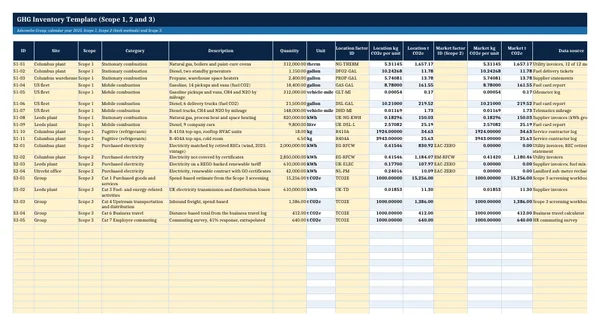
GHG Inventory Template (Scope 1, 2 and 3)
GHG Protocol carbon accounting
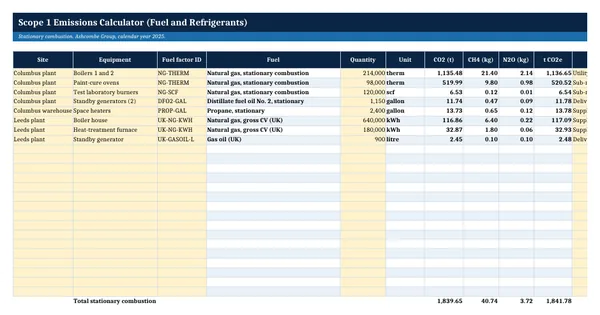
Scope 1 Emissions Calculator (Fuel and Refrigerants)
GHG Protocol carbon accounting
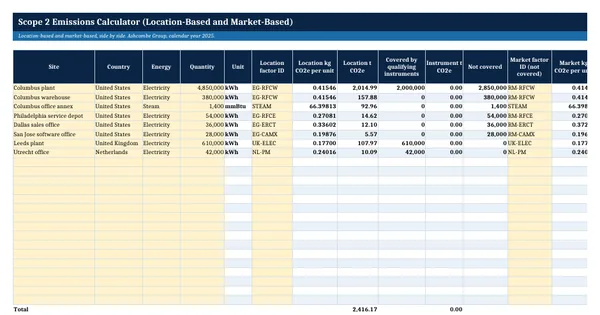
Scope 2 Emissions Calculator (Location-Based and Market-Based)
GHG Protocol carbon accounting