
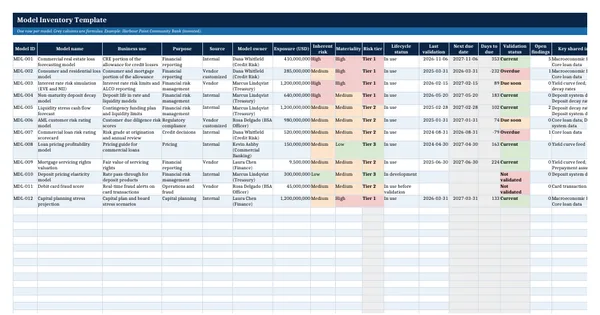
 Excel workbook preview
Model risk management (SR 26-2)
Model Inventory Template
3 free downloads per account. Just your email and a 6-digit code.
About this template
A model inventory is the list of every quantitative model a bank develops, uses or has retired, with enough information to understand each model's risk. Examiners, internal audit and the board risk committee ask for it first, because no other model risk activity can be planned without it. It is needed when a bank starts a model risk program, prepares for an examination, or finds that validation dates and owners live in scattered emails.
The workbook holds one row per model with owner, purpose, source, exposure, inherent risk and materiality. Formulas turn the two ratings into a risk tier, add the revalidation cycle for that tier and flag models that are overdue or were never validated. A second sheet totals models and exposure per shared data feed or assumption, which shows aggregate model risk. It follows the interagency Supervisory Guidance on Model Risk Management issued in April 2026 as SR 26-2.
Who it is for
The model risk manager or CRO of a community or regional bank who was asked by the examiner or the risk committee for a complete list of models and could not produce one.
What is inside
- Model Inventory sheet with 18 columns, 12 worked sample models and 20 blank formatted rows
- Risk tier calculated live from inherent risk and materiality ratings, colored Tier 1 to Tier 3
- Next validation date, days to due and a validation status (Current, Due soon, Overdue, Not validated, Retired) from formulas
- Dropdowns for purpose, source, ratings and lifecycle status, with freeze panes and filters
- Aggregate Risk sheet that counts models, Tier 1 models and exposure per shared data feed or assumption
- Summary sheet with counts, exposure and open findings by tier, validation status and purpose
- Settings sheet with rating points, tier cut-offs, revalidation cycles and the due-soon window as yellow input cells
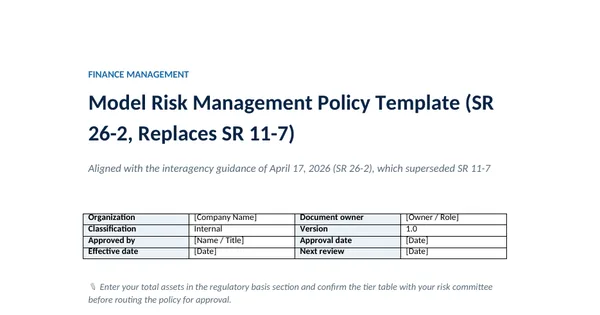
- Built on the April 2026 interagency model risk guidance (SR 26-2), which replaced SR 11-7
How to use it
Replace the 12 sample models with your own, then check the tier cut-offs and revalidation cycles on the Settings sheet.
Files
- XLSXmodel-inventory-template.xlsx19 KB
Opens in Microsoft Word or Excel, Google Docs or Sheets, and LibreOffice. Built on free, official texts that anyone can read: laws, regulations, standards and guidance published by public bodies. A template to adapt, not legal, tax or accounting advice.
Questions about this template
What should a model inventory include?
Enough to understand each model's risk and to manage models one by one and in aggregate. In practice that means an ID, name, owner, business use, purpose, source, exposure, risk ratings and tier, validation dates, open findings, limits on use and the data or assumptions the model shares with other models. This template has a column for each of these.
Is a spreadsheet a model?
Not always. The April 2026 interagency guidance excludes simple arithmetic calculations such as those found in spreadsheets, and deterministic rule-based processes with no statistical, economic or financial theory behind them. A spreadsheet that runs a regression or a loss forecast can still be a model. Record the decision either way.
Does SR 11-7 still apply to the model inventory?
No. On April 17, 2026 the Federal Reserve, OCC and FDIC issued revised guidance, SR 26-2, which supersedes SR 11-7. The new guidance still describes a comprehensive model inventory as common industry practice and is expected to be most relevant to banking organizations with over USD 30 billion in total assets.