
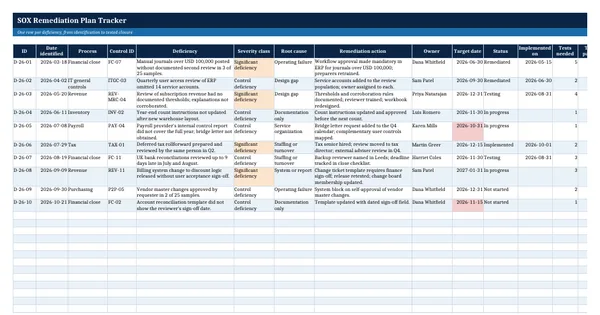
 Excel workbook preview
SOX Remediation Plan Tracker
3 free downloads per account. Just your email and a 6-digit code.
About this template
A remediation plan tracker records every internal control deficiency from the day it is found to the day the fix is tested and closed. Audit committees ask for it after year end testing, and auditors read it when they decide whether a deficiency still exists. It also feeds the quarterly certification, where the officers disclose significant deficiencies and material weaknesses to the auditors and the audit committee.
The register holds one row per deficiency with its severity class, root cause, action, owner and target date, and formulas that flag overdue items and show whether the fix has passed enough tests to close. The severity classes use the definitions in SEC Rule 12b-2. A guide sheet lists the indicators of a material weakness from the SEC's 2007 interpretive guidance, Release 33-8810.
Who it is for
The SOX lead or controller who must report remediation status to the audit committee after the auditor or internal testing found control deficiencies.
What is inside
- Register with 10 worked deficiencies and 20 blank formatted rows
- Dropdowns for severity class (3), root cause (6) and status (5)
- Live formulas for days to target, readiness to close and a Red, Amber or Green status
- Overdue target dates turn red and material weaknesses are highlighted
- Summary sheet: severity by status matrix, open and overdue counts
- Severity guide sheet with the SEC definitions and the indicators from Release 33-8810
- Freeze panes, filters, landscape print fit and a How to use sheet
How to use it
Replace the sample rows with your open deficiencies and set the number of passed test instances each fix needs before it can close.
Files
- XLSXsox-remediation-plan-tracker.xlsx15 KB
Opens in Microsoft Word or Excel, Google Docs or Sheets, and LibreOffice. Built on free, official texts that anyone can read: laws, regulations, standards and guidance published by public bodies. A template to adapt, not legal, tax or accounting advice.
Questions about this template
What is the difference between a significant deficiency and a material weakness?
Under SEC Rule 12b-2, a material weakness is a deficiency, or a combination of deficiencies, such that there is a reasonable possibility that a material misstatement will not be prevented or detected on a timely basis. A significant deficiency is less severe than that, yet important enough to merit attention by those responsible for oversight of financial reporting.
When is a deficiency remediated?
When the new or changed control has been in place long enough to operate several times and has been tested with a clean result. The number of instances depends on how often the control runs. The tracker holds that number per row and only shows a fix as ready to close when enough passed instances are recorded.
Must a remediated material weakness still be disclosed?
The SEC's 2007 guidance says that if all material weaknesses are remediated by year end, management may conclude internal control is effective, but should consider whether disclosure of the remediated weaknesses is appropriate or required under Items 307 or 308 of Regulation S-K.