

 Word document preview
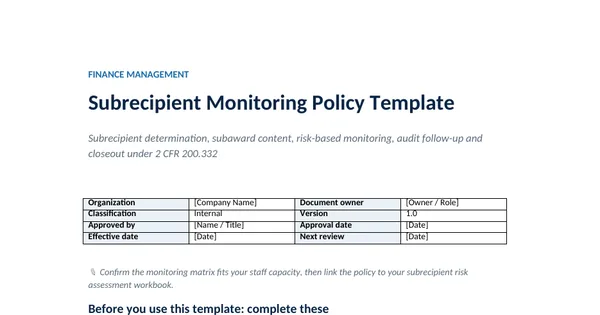
Subrecipient Monitoring Policy Template
3 free downloads per account. Just your email and a 6-digit code.
About this template
A subrecipient monitoring policy sets how a pass-through entity decides who is a subrecipient, writes subawards, evaluates risk and checks that partners spend Federal funds correctly. 2 CFR 200.332 puts these duties on every organization that passes Federal funds to another entity, and weak monitoring is one of the most frequent Single Audit findings for pass-through entities.
This policy follows 2 CFR 200.331, 200.332, 200.344 and 200.521 as published on eCFR. It covers the subrecipient or contractor determination, exclusion checks, risk evaluation, the content every subaward must contain, indirect cost rates, a monitoring matrix by risk level, invoice review with the prescribed subrecipient certification, audit follow-up, specific conditions and remedies, and closeout within 90 days.
Who it is for
The grants director of a nonprofit or local government that passes Federal funds to partners and was asked by its auditor for a written monitoring policy.
What is inside
- 16 numbered sections, including Roles, Compliance, Exceptions and Review
- Subrecipient or contractor table with the 5 characteristics of each from 200.331
- Worked risk table for 5 invented subrecipients with their specific conditions
- All subaward content required by 200.332(b), plus indirect cost rules for subrecipients
- Monitoring matrix with 7 activities across low, medium and high risk
- The subrecipient certification of 200.415(b), reproduced as prescribed text
- Audit follow-up with the six month management decision deadline of 200.521(d)
How to use it
Confirm the monitoring matrix fits your staff capacity, then link the policy to your subrecipient risk assessment workbook.
Files
- DOCXsubrecipient-monitoring-policy-template.docx42 KB
Opens in Microsoft Word or Excel, Google Docs or Sheets, and LibreOffice. Built on free, official texts that anyone can read: laws, regulations, standards and guidance published by public bodies. A template to adapt, not legal, tax or accounting advice.
Questions about this template
What is the difference between a subrecipient and a contractor?
Under 200.331 a subrecipient carries out part of a Federal program, for example by deciding who is eligible for assistance and following program rules, while a contractor provides goods or services it sells to many buyers in a competitive market. The substance of the relationship decides, not the name of the agreement, and the policy keeps the reasons on file.
Must a pass-through entity visit every subrecipient?
No. Section 200.332(f) lists site visits, training and agreed-upon procedures engagements as tools that may be useful depending on risk. Reviewing financial and performance reports, following up significant developments and resolving audit findings related to the subaward are required for every subrecipient under 200.332(e).
How fast must a management decision on a subrecipient audit finding be issued?
Section 200.521(d) requires the pass-through entity to issue its management decision within six months of the Federal Audit Clearinghouse accepting the audit report. The decision states whether the finding is sustained, the reasons, and the action expected from the subrecipient, as 200.521(a) describes.
More Uniform Guidance (2 CFR 200) templates
Uniform Guidance (2 CFR 200)
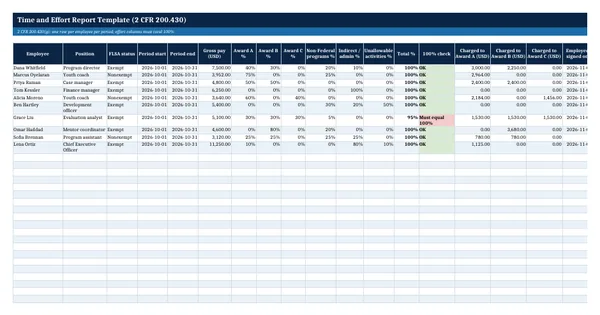
Time and Effort Report Template (2 CFR 200.430)
Uniform Guidance (2 CFR 200)
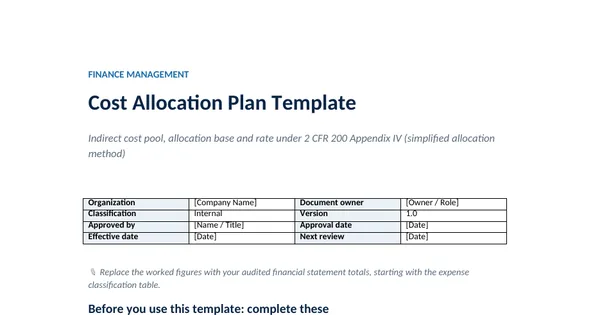
Cost Allocation Plan Template
Uniform Guidance (2 CFR 200)
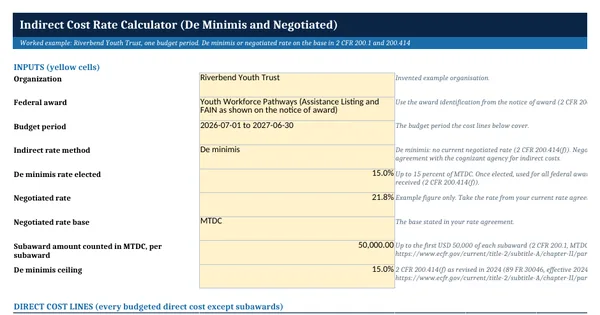
Indirect Cost Rate Calculator (De Minimis and Negotiated)
Uniform Guidance (2 CFR 200)