
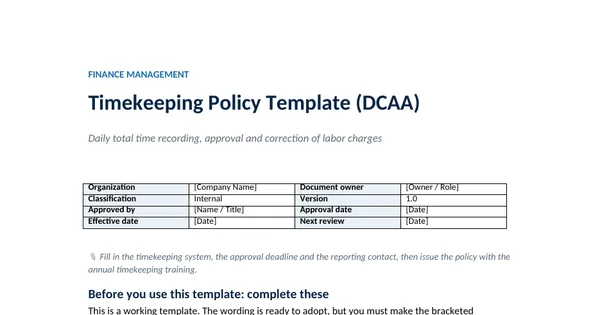
 Word document preview
Timekeeping Policy Template (DCAA)
3 free downloads per account. Just your email and a 6-digit code.
About this template
A timekeeping policy is one of the first documents a DCAA auditor or a prime contractor asks for when it reviews a small contractor's accounting system. It tells employees how to record time and tells the auditor how the company keeps labor charges accurate. Without one, a floor check or preaward survey has nothing to test the timesheets against, and labor, usually the largest cost on the contract, becomes hard to support.
This template is a complete policy for a contractor that records time in a timekeeping system or on paper. It covers daily total time recording, charge codes, leave and uncompensated overtime, certification and approval, corrections, segregation of duties, floor checks, training and mischarging. It rests on FAR part 31, the DFARS accounting system criteria and the DCAA Information for Contractors manual, all free official sources.
Who it is for
The controller or contracts manager at a government contractor who must hand DCAA or a prime a written timekeeping policy before an audit or preaward survey.
What is inside
- 10 body sections plus roles, compliance, exceptions and review sections
- Charge code table with 7 code types, example codes, use and approver
- Corrections table with 5 situations, who changes the entry, who approves and what record is kept
- Total time accounting and uncompensated overtime rules tied to FAR 52.237-10
- Segregation of duties, system access and record keeping controls
- Floor check, internal review and annual training section based on DCAA guidance
- Mischarging section citing FAR 31.205-15(b), the False Claims Act and FAR 52.203-13
- Roles table with 7 roles and an adoption checklist of 6 items
How to use it
Fill in the timekeeping system, the approval deadline and the reporting contact, then issue the policy with the annual timekeeping training.
Files
- DOCXtimekeeping-policy-template.docx41 KB
Opens in Microsoft Word or Excel, Google Docs or Sheets, and LibreOffice. Built on free, official texts that anyone can read: laws, regulations, standards and guidance published by public bodies. A template to adapt, not legal, tax or accounting advice.
Questions about this template
Is a written timekeeping policy required for government contracts?
The FAR does not name a timekeeping policy as such, but a contractor must keep records adequate to show that claimed costs were incurred and are allocable, and DoD contracts with the accounting system clause require a timekeeping system that identifies labor by cost objective. DCAA guidance expects written timekeeping instructions. In practice an auditor asks for the policy early in a review.
How often should employees record their time?
DCAA guidance expects time to be recorded daily. Recording a week of hours from memory at the end of the week is a common floor check finding because the hours and charge codes cannot be shown to match the work performed. This policy requires entry at the end of each working day, or as work moves between charge codes.
What is labor mischarging?
Mischarging is recording time to a charge code other than the one for the work actually performed, for example moving hours from an overrun contract to one with budget left. Costs that result from mischarging, including the cost of correcting it, are unallowable under FAR 31.205-15. It can also lead to liability under the False Claims Act.