 Word document preview
AML Policy Template (Anti-Money Laundering Program)
3 free downloads per account. Just your email and a 6-digit code.
About this template
An AML policy is the written anti-money laundering program a bank's board approves and examiners ask for first. It shows how the bank meets the Bank Secrecy Act program rule, who the BSA Officer is, and how customers, transactions and reports are handled. This template is written for a community bank that needs a current document, for example after an examination finding, a new BSA Officer, or a change in FinCEN rules such as the February 2026 relief on beneficial ownership at each new account.
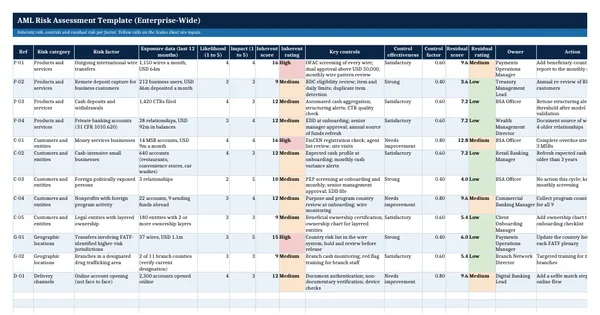
Its sections cover the legal basis, governance, risk assessment, customer identification and due diligence, sanctions screening, monitoring and suspicious activity reporting, currency reporting and records, training and independent testing. Every rule it states was checked against the eCFR text of 31 CFR Chapter X, the FDIC rules in 12 CFR Parts 326 and 353, the OFAC reporting rules in 31 CFR Part 501, FinCEN order FIN-2026-R001 and the FATF Recommendations. Bank-specific choices are marked for completion.
Who it is for
The BSA Officer or compliance head at a community bank whose examiner or new board asked for a current, board-approved AML/CFT program document.
What is inside
- 16 numbered sections, from purpose and scope to roles, compliance, exceptions and review
- Legal basis table mapping 13 requirements to 31 CFR sections and to the policy section that meets them
- SAR table with the 30 and 60 day filing rules, insider abuse, immediate notice and retention
- Records table with CTR, CIP, beneficial ownership and 314(b) retention rules
- Training and independent testing sections with the interval and provider marked for completion
- Covers the February 2026 FinCEN beneficial ownership relief (FIN-2026-R001)
- OFAC blocked and rejected reporting deadlines from 31 CFR 501.603 and 501.604
- Roles table for 4 roles and a 6 item adoption checklist
How to use it
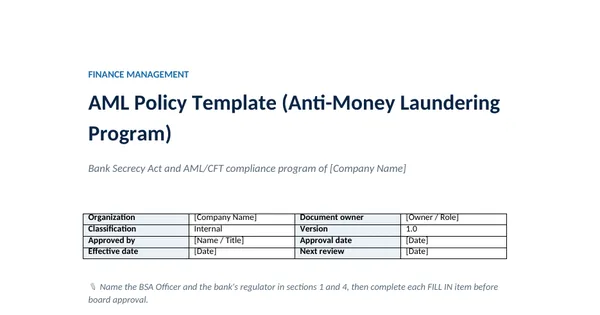
Name the BSA Officer and the bank's regulator in sections 1 and 4, then complete each FILL IN item before board approval.
Files
- DOCXaml-policy-template.docx41 KB
Opens in Microsoft Word or Excel, Google Docs or Sheets, and LibreOffice. Built on free, official texts that anyone can read: laws, regulations, standards and guidance published by public bodies. A template to adapt, not legal, tax or accounting advice.
Questions about this template
What must a bank AML program include?
Under 31 CFR 1020.210 a bank's program includes a system of internal controls, independent testing, a designated individual responsible for day-to-day compliance, training for appropriate personnel, and risk-based procedures for ongoing customer due diligence. It must also meet the correspondent and private banking rules in 31 CFR 1010.610 and 1010.620 and the program rule of the bank's federal regulator.
How fast must a bank file a SAR?
31 CFR 1020.320 requires a SAR no later than 30 calendar days after the bank first detects facts that may be a basis for filing. If no suspect is identified, filing may be delayed another 30 days to identify one, but never more than 60 days after initial detection. Violations that need immediate attention are also reported to law enforcement by telephone.
Does the board have to approve the AML policy?
Yes for most banks. For example, 12 CFR 326.8 requires an FDIC-supervised bank's compliance program to be written, approved by the board of directors and noted in the minutes, and 31 CFR 1020.210(b) requires board approval for banks without a federal functional regulator. Check the rule of your own regulator.