

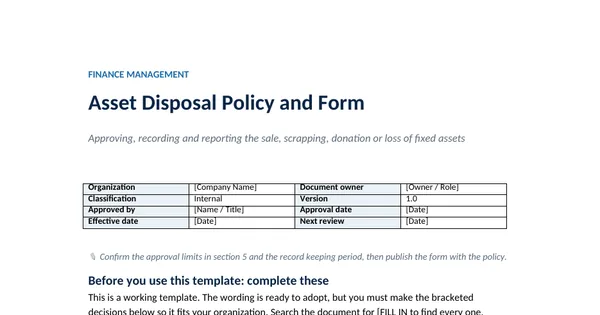
 Word document preview
Fixed assets and capital expenditure
Asset Disposal Policy and Form
3 free downloads per account. Just your email and a 6-digit code.
About this template
An asset disposal policy and form control how fixed assets leave the organization: sold, traded in, auctioned, donated, scrapped, lost or stolen. Without one, equipment walks out with no approval, data stays on old laptops, gains and losses are never booked, and the fixed asset register keeps assets that are long gone. Auditors test disposals for exactly these gaps, and so do buyers in due diligence.
This Word template combines a short policy with a five-part request form. It sets disposal methods, approval limits by net book value, data sanitization in line with NIST SP 800-88 Rev. 2, the accounting for a gain or loss with a worked example, and the US tax reporting of business property sales on IRS Form 4797. The form has a blank column and a worked example column side by side.
Who it is for
The controller who found assets sold, scrapped or given away without approval or a register update and was asked to put a disposal rule and form in place.
What is inside
- 13 numbered sections, from principles and methods to tax reporting, lost assets, roles and the request form
- Disposal methods table for 7 methods with when each is used and the extra control for each
- Approval limits table with 4 levels based on net book value or expected proceeds
- Worked gain on disposal calculation and the journal entry for an invented delivery van
- Data sanitization rule that refers to NIST SP 800-88 Rev. 2 and a certificate for every data-bearing device
- Asset disposal request form in 5 parts (request, finance, data and hazards, approval, completion) with a worked example column
- Roles table for 5 roles, a document control box and a pre-use checklist of 6 decisions
How to use it
Confirm the approval limits in section 5 and the record keeping period, then publish the form with the policy.
Files
- DOCXasset-disposal-policy-and-form.docx41 KB
Opens in Microsoft Word or Excel, Google Docs or Sheets, and LibreOffice. Based on general finance practice, not on one published standard. A template to adapt, not legal, tax or accounting advice.
Questions about this template
What should an asset disposal form include?
The asset number and description, location, reason for disposal, proposed method, estimated proceeds, the net book value at the disposal date and the expected gain or loss, whether the asset holds data or hazardous materials, the approvals required, and the completion details: actual date, actual proceeds, buyer or recycler, certificate numbers and the journal entry that removed the asset.
How do you calculate the gain or loss on disposal of an asset?
Take the net proceeds, meaning the sale price less the costs of selling, and subtract the net book value, meaning cost less accumulated depreciation up to the disposal date. A positive result is a gain, a negative result is a loss. The policy shows this for a van that cost 46,200 dollars, was fully depreciated to its 6,000 dollar salvage value and sold for 8,500 dollars.
Which IRS form reports the sale of business equipment?
IRS Form 4797, Sales of Business Property. The IRS says it is used to report the sale or exchange of property, involuntary conversions, the disposition of noncapital assets and the computation of recapture amounts under sections 179 and 280F(b)(2). The tax gain usually differs from the book gain because tax depreciation differs. Your tax preparer completes it.
More Fixed assets and capital expenditure templates
Fixed assets and capital expenditure
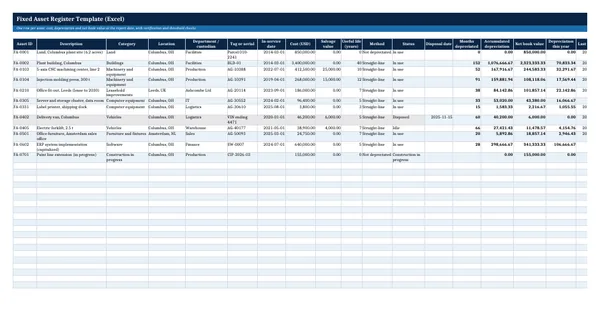
Fixed Asset Register Template (Excel)
Fixed assets and capital expenditure
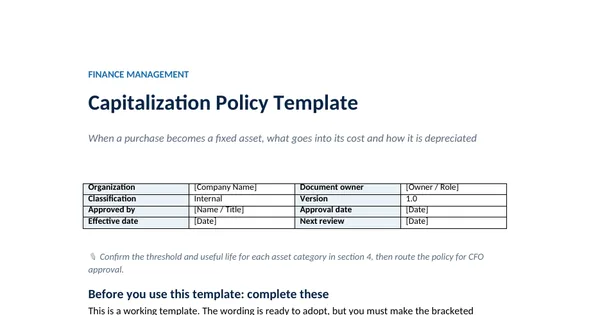
Capitalization Policy Template
Fixed assets and capital expenditure
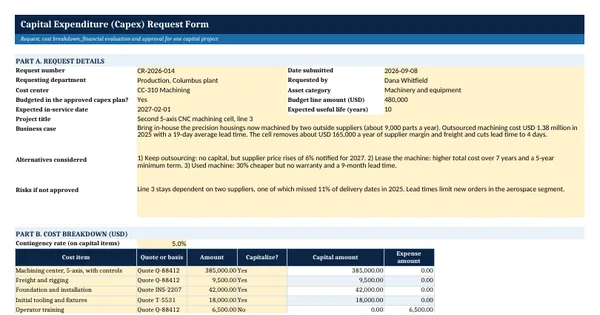
Capital Expenditure (Capex) Request Form
Fixed assets and capital expenditure