

 Word document preview
Fixed assets and capital expenditure
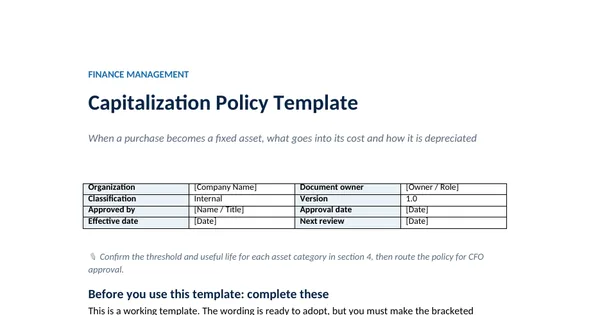
Capitalization Policy Template
3 free downloads per account. Just your email and a 6-digit code.
About this template
A capitalization policy is the written rule that decides when spending on equipment, buildings, vehicles or software is recorded as a fixed asset and depreciated, and when it is charged straight to expense. Auditors ask for it because the same purchase must be treated the same way every time. Lenders and the tax preparer rely on it too, because the US de minimis safe harbor for tax requires accounting procedures in writing at the start of the tax year.
This Word template is a complete policy for a mid-size group. It sets thresholds and useful lives by category, defines what goes into an asset's cost, separates repairs from improvements, covers internal-use software and construction in progress, and sets the depreciation convention. The tax section rests on 26 CFR 1.263(a)-1(f) and IRS Publication 946. A worked table shows eight purchase decisions and why each was made.
Who it is for
The controller asked by the auditor or the new CFO for the written rule that decides which purchases become fixed assets, with nothing on file but habit.
What is inside
- 16 numbered sections, including definitions, capitalization criteria, asset cost, repairs and improvements, software, construction in progress, depreciation and tax
- Threshold and useful life table for 9 asset categories
- Worked table of 8 real-world purchase decisions with the reason for each
- Repairs versus improvements test in plain words (betterment, restoration, adaptation), aligned with the US tangible property regulations
- Tax section on the de minimis safe harbor under 26 CFR 1.263(a)-1(f), with the per invoice limits and the annual election statement
- Roles table for 5 roles and standard compliance, exceptions and review sections
- Document control box and a pre-use checklist of 5 decisions to make
How to use it
Confirm the threshold and useful life for each asset category in section 4, then route the policy for CFO approval.
Files
- DOCXcapitalization-policy-template.docx41 KB
Opens in Microsoft Word or Excel, Google Docs or Sheets, and LibreOffice. Based on general finance practice, not on one published standard. A template to adapt, not legal, tax or accounting advice.
Questions about this template
What is a typical capitalization threshold?
There is no single required amount. Many US companies with audited financial statements use 5,000 dollars per item, which matches the de minimis safe harbor limit in 26 CFR 1.263(a)-1(f) for a taxpayer with an applicable financial statement. Without such a statement the IRS limit is 2,500 dollars per invoice or item under Notice 2015-82. Smaller firms often choose lower amounts for control reasons.
Do I need a written capitalization policy for the de minimis safe harbor?
A taxpayer with an applicable financial statement must have written accounting procedures at the beginning of the tax year that treat the qualifying amounts as an expense. A taxpayer without one needs accounting procedures in place at the start of the year. In both cases the election is made each year by a statement attached to the timely filed original return. Confirm the details with your tax adviser.
How do I tell a repair from an improvement?
A cost is an improvement when it betters the asset, restores it or adapts it to a new or different use. Betterment includes fixing a defect that existed when the asset was bought and adding capacity or productivity. Restoration includes replacing a major component. Recurring work that keeps the asset in its ordinarily efficient operating condition is a repair and is expensed.
More Fixed assets and capital expenditure templates
Fixed assets and capital expenditure
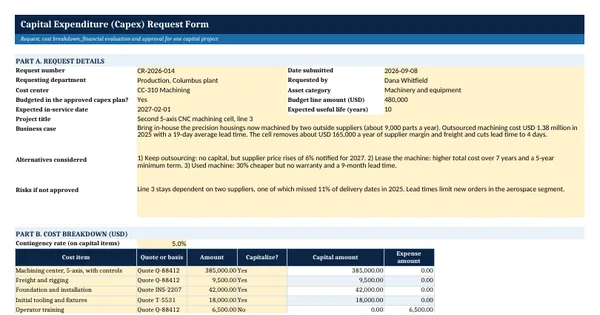
Capital Expenditure (Capex) Request Form
Fixed assets and capital expenditure
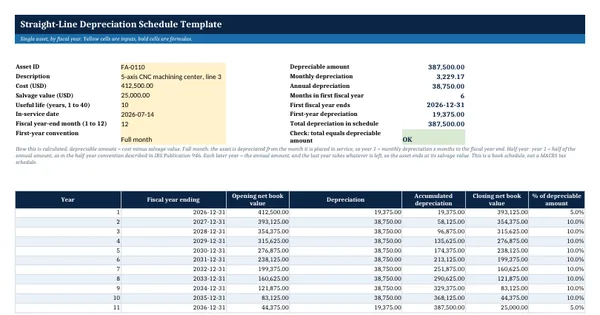
Straight-Line Depreciation Schedule Template
Fixed assets and capital expenditure
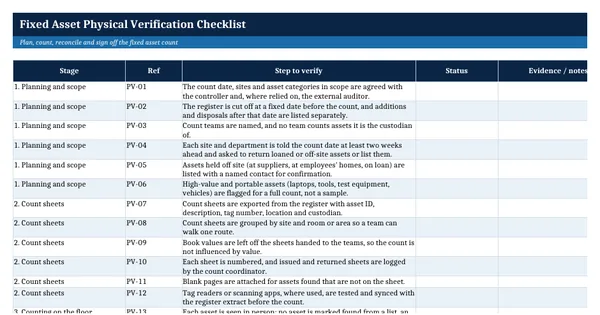
Fixed Asset Physical Verification Checklist
Fixed assets and capital expenditure